
 Worksheets
Trigonometry Final Exam Review 2022
Total questions: 77
Worksheet time: 19hrs 15mins

What is the period of the following function?
−32π
32π
2π
3

What is the b-value of the following function? y=acosb(x+c)+d
1
2
3
4

Match the following equations with the graph given.
y=−3sin(x)−4
y=3sin(x)−4
y=3cos(x)−4
y=−3cos(x)−4
The period of a sine or cosine graph can be found by the following formula:
2πb
b2π
2πb
π2b
What is the midline for the following equation:
y=2cos(31x+6π)+2
1/3
-2
+2
4
Write the equation for a sine function with an amplitude of 6, a period of π/4 and a downward vertical translation of 4.
y=6 sin (8x) - 4
y=6 sin 8(x-1) - 4
y=6 sin (π/4) + 4
y=6 sin (π/4 x) + 4
What is the radius of the unit circle?
1.5
2
1/2
1
The value of sinθ is positive in
the 1st and 2nd quadrants
the 1st and 3rd quadrants
the 1st and 4th quadrants
the 2nd and 3rd quadrants
What is the sin 45°?
1
√3/2
½
√2/2
If the tangent ratio of a right triangle is 1448 what is the cosine ratio?
5014
5048
4814
1450
The value of cos(-2400) is
0.5
-0.5
-0.866
-0.707
The terminal side of a 330° angle is in what Quadrant?
Quadrant I
Quadrant II
Quadrant III
Quadrant IV
Graph the angle in standard position. −220°


Write an equation or the graph.
y = 2sec(x)
y = 3sec(x)
y = 3sec(2x)
y = 3csc(x)
y = 3csc(2x)

What is the period of this function?
2π
π
2π
What trigonometric functions have vertical asymptotes? Select all that apply.
sine
cosine
tangent
secant
cosecant
Which of the following is an asymptote for secant?
x= π
x = 3π / 2
x = -2π
x = 0
If secθ>0 and sinθ<0 then θ must be in which quadrant?
I
II
III
IV
Simplify to a single term: sec(x)cos(x)
Simplify to a single term: tan2(x)−sec2(x)
cot2(x)
-1
sin2(x)
1
Simplify to a single term: sin2(x)sec2(x)−1
cos2(x)1
sec2(x)
csc2(x)
sin2(x)1
Factor and Simplify: tan2(x)−tan2(x)sin2(x)
cos2(x)
tan2(x)(1−sin2(x))
tan2(x)(sin2(x)−1)
sin2(x)
Factor and Simplify: tan4(x)+2tan2(x)+1
(tan(x)+1)2
sec(x)
(tan2(x)+1)2
sec2(x)
Factor and Simplify: sin4(x)−cos4(x)
sin2(x)+cos2(x)
1
sin2(x)−cos2(x)
-1
Simplify: 1+cos(x)1+1−cos(x)1
2sec2(x)
2sin2(x)
2cos2(x)
2csc2(x)
Simplify: 1+sin(x)cos(x)+cos(x)1+sin(x)
2cos(x)
2sec(x)
2sin(x)
2csc(x)
sin2(x)+cos2(x)
1
1+2sin(x)cos(x)
sin2(x)+2sin(x)cos(x)+cos2(x)
tan−13−sec−1(−2)=
π
−3π
3π
32π
sin−1[cos(sin−1(23))]=
6π
3π
4π
2π
Inverse function of Sine of an angle ?
Cosine
Cosecant
Secant
Cotangent
tan−13−sec−1(−2)=
π
−3π
3π
32π

A
B
C
D
Solve for 0≤x≤2π
2cos2x + cosx = 0
π/2, 3π/2
0, π,2π
2π/3, 4π/3
π/3, 5π/3
Solve for 0≤x≤2π
4cos2x - 2 = 0
π/3, 5π/3
π/4, 7π/4
3π/4, 5π/4
π/6, 11π/6
Solve for 0≤x≤2π
2sin2x - 5sinx + 2 = 0
π/6, 5π/6
7π/6, 11π/6
π/3, 2π/3
4π/3, 5π/3
Which of the following is NOT
a solution to
tan θ = 0 ?
θ = 0
θ = π /2
θ = π
θ = 2π
cos x + 1 = 0
Solve for x: 5cosx+2=3cosx
π
43π
DNE
34π
Select all possible answers to the equation 4sin2u+8=11
3π
2π
6π
32π
34π

Why doesn't 2cosx − 3 = 0 have solutions?
cosx is never bigger than one
cosx is never equal to a fraction
Actually, this equation does have a solution, x = π
This equation will have a solution tomorrow.
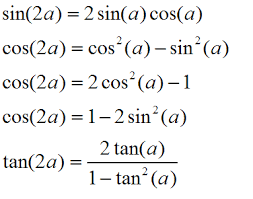
cos θ = 4/5 and 270° < θ < 360°
Find sin 2θ
sin θ = −3/5 and 3π/2 < θ < 2π Find tan θ/2
cos θ = 4/5 and 270° < θ < 360°
Find sin 2θ
sin (2θ)
1. sin θ= 3/5 , 0<θ<π/2
Use Sum or Difference Identities to find the exact value of each expression.
cos(75°)
1/4


sin2θ + cos2θ = 1

tan2x + 1 = secx
If sinθ=54 , find cscθ .
59
45
51
41
Simplify (sec2x)(1 - sin2x)
-cos(x)
1
-1
-sin(x)
Use Sum or Difference Identities to find the exact value of each expression.
cos(75°)
1/4
√6/4 - √2 / 4
√6 + √2 / 4
-√6/4 - √2 / 4
Expand cos (5π+6π)
cos5πcos6π−sin5πsin6π
cos5πcos6π+sin5πsin6π
cos 112π
cos5πsin6π−cos5πsin6π
cos75ocos15o−sin75o sin15o is equivalent to
sin 90o
sin 60o
cos 90o
cos 60o
1−tan45otan30otan45o+tan30o is equivalent to
tan75o
tan 15o
cos30osin45o
tan90o

Simplify the following expression.



