wayground logo

Free Printable Worksheets

Font size

S
M
L
XL
Worksheets

Genetics Quiz

Total questions: 49

Worksheet time: 42mins

Name
Class
Date
1.
Which of the following cell types is formed by meiosis?
a)
muscle cells
b)
skin cells
c)

gametes

d)
blood cells
2.
What is a phenotype?
a)
The expression of a trait; what you see.
b)
refers to the genetic makeup of an individual
c)
An organism that has the same genes for a trait (ex. TT or tt)
d)
the passing of traits from parent to offspring
3.
An organism's appearance is known as its
a)
heredity
b)
phenotype
c)
genotype
d)
pedigree
4.
What does heterozygous mean?
a)
An organism that has the same genes for a trait (TT or tt)
b)
An organism that has different genes for a trait (Tt)
c)
When neither gene is fully dominant; offspring is a mixture of both
d)
the different forms of a trait (hair color--> brown, blonde, red
5.
A heterozygous yellow pea plant's genotype would be:
a)
YY
b)
yy
c)
Yy
d)
Yg
6.
A corn plant heterozygous for tall sprouts mates with a corn plant with short sprouts. If tall sprouts are dominant, how many different phenotypes are possible in the offspring?
a)
1
b)
2
c)
3
d)
4
7.
If T=Tall & t=short, what is the genotypic ratio?
a)
1:3
b)
3:1
c)
1:2:1
d)
2:2
8.
If a heterozygous tall pea plant is crossed with a short pea plant, what are the possible genotypes of the future offspring?
a)
100% Tt
b)
50% Tt, 50% tt
c)
75%Tt, 25%tt
d)
25%TT, 50%Tt, 25%tt
9.

A gene is

a)

a section of DNA

b)

a chemical found in the nucleus of cells

c)

contains instructions for building a protein

d)

all of the above

10.

During meiosis, one parent cell gives rise to how many daughter cells?

a)

1

b)

2

c)

3

d)

4

11.

Human gametes contain how many chromosomes?

a)

46

b)

23

c)

12

d)

28

12.

When you cross two parents, each parent is responsible for passing _______ of their two alleles for each individual trait.

a)

1

b)

2

c)

3

d)

4

13.

Grey (G) fur is dominant to brown (g) fur in mice. What would be the genotype of a mouse that is homozygous dominant?

a)

GG

b)

Gg

c)

gg

d)

GGG

14.

Who was Gregor Mendel?

a)

Father of genetics

b)

Father of cells

c)

Coined the term heredity

d)

No one

15.

True or False: You can be blood type AB because A and B are co-dominant

a)

true

b)

false

16.
B=brown eyes
b= blue eyes
What is true about two brothers that have brown eyes?
One has genotype BB the other Bb.
a)
they have same phenotype and genotype
b)
they have different genotypes and phenotypes
c)
they have same phenotype but different genotypes
d)
they have same genotype but different phenotypes
17.
W=white hair
w= non-white hair
If you cross a horse with WW and a horse with ww what fraction of the offspring would be expected to have white hair?
a)
none
b)
3/4
c)
1/2
d)
all
18.
Which of the characteristics is a lion least likely to pass on to its offspring?
a)
fur color
b)
length of tail
c)
scars on leg
d)
body size
19.
What characteristic would a child not inherit from parents?
a)
freckles
b)
eye color
c)
hair style
d)
dimples
20.
What law states that in Tt the person will only show the dominant allele
a)
law of segregation
b)
law of independent assortment
c)
law of dominance
d)
law of punnett squares
21.
the passing of genetic traits from parent to offspring.
a)
heredity
b)
trait
c)
gene
d)
allele
22.
having two of the same genes for the trait (sometimes called purebred).
a)
homozygous
b)
hetrozygous
c)
protein
d)
chromosome
23.
An allele whose trait only shows up when no dominant allele is present.
a)
hidden allele
b)
dominant allele
c)
recessive allele
d)
present allele
24.
T - tall and t = short
In the punnett square below, what belongs in the missing square
a)
tt
b)
Tt
c)
Bb
d)
TT
25.
Any change or mistake in DNA replication can cause a ________  
a)
cancer cell 
b)
virus
c)
disease
d)
mutation
26.
In humans, what would the blood type of a child be if she inherited type A from Dad and type B from Mom?
a)
O
b)
A
c)
B
d)
AB
27.

A chart that displays family relationships indicating traits or disorders

a)

Punnett square

b)

Pedigree

c)

Karyotype chart

28.

In a pedigree chart, men are represented by

a)

Circles

b)

Diamonds

c)

Squares

29.

In a pedigree chart, women are represented by

a)

Circles

b)

Diamonds

c)

Squares

30.
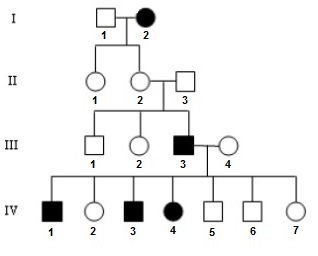
How many males are shown in this pedigree?
a)
8
b)
5
c)
2
d)
16
31.
Each one of the boxes on the Punnett Square represents what probability of an offsprings' genotype?
a)
25%
b)
1%
c)
10%
d)
0%
32.
How many generations are shown in this pedigree?
a)
1
b)
2
c)
3
d)
4
33.
Is this trait (the shaded individuals) dominant or recessive?
a)
dominant
b)
recessive
34.
This pedigree represents the inheritance of hemophilia in this family. How many of the females have the hemophilia trait?
a)
8
b)
5
c)
2
d)
3
35.
What proportion of the offspring in Figure 11-4 would be expected to have white, smooth hair?
a)
9/16
b)
3/16
c)
4/16
d)
1/16
36.

A mother is type AB blood and a father is type AB blood. What are the possible blood types the child could receive? Select all that apply.

a)

A

b)

B

c)

AB

d)

O

37.

A child's blood is type AB. One parent's blood is type B. What are the possible blood types the other parent could have? Select all that apply.

a)

A

b)

B

c)

AB

d)

O

38.

What protein is found in red blood cells that binds to and transports oxygen?

a)

peptidoglycan

b)

iron

c)

hemoglobin

d)

plasma

39.

These are found in blood and help fight infections...

a)

white blood cells

b)

platelets

c)

plasma

d)

red blood cells

40.

These are found in blood and help the blood to clot...

a)

white blood cells

b)

platelets

c)

plasma

d)

red blood cells

41.

Red blood cells will do this if they encounter the wrong antibodies...

a)

swell

b)

agglutinate

c)

dehydrate

d)

no reaction will occur

42.

Someone with Type A blood also has...

a)

Type A antibodies

b)

Type B antibodies

c)

both Type A & B antibodies

d)

neither Type A nor B antibodies

43.

Someone with both Type A & B antibodies is which blood type?

a)

A

b)

B

c)

AB

d)

O

44.

Someone with Type A blood has...

a)

A antigens

b)

A antibodies

c)

B antigens

d)

A & B antigens

45.

Proteins produced by the immune system that destroy foreign substances...

a)

antigens

b)

agglutinates

c)

platelets

d)

antibodies

46.

This determines whether a person's blood type is positive or negative...

a)

Rh factor

b)

platelets

c)

D antibodies

d)

plasma

47.

Which blood type is known as the universal donor? (can be used by all)

a)

AB +

b)

AB -

c)

O+

d)

O-

48.

Which blood type is known as the universal recipient? (can receive all types)

a)

AB+

b)

AB-

c)

O+

d)

O-

49.

Someone with Type AB blood has...

a)

Both A & B antibodies

b)

No antibodies

c)

only A antigens

d)

only B antigens