wayground logo

Free Printable Worksheets

Font size

S
M
L
XL
Worksheets

Evolution

Total questions: 19

Worksheet time: 23mins

Name
Class
Date
1.
Change over time...
a)
Evolution
b)
Nucleotide 
2.
Charles Darwin came up with this theory 
a)
Natural Selection
b)
Mutation
3.
To adjust to a changing environment
a)
Mutation
b)
Adapt
4.
Darwin wrote that organisms with traits that are best suited to the environment will ________________
a)
increase in number
b)
become extinct
5.
Another word for adapt is ____________.
a)
change
b)
create
6.
Which of the following is NOT an example of natural selection? 
a)
People selectively breeding hamsters.
b)
Insect populations developing resistance to certain pesticides.
c)
Bacteria becoming resistant to antibiotics.
d)
Male birds of certain species developing colorful feathers to attract female mates.
7.
Which term refers to the process by which individuals that are better suited to the environment survive and reproduce therefore passing down their genes to their offspring? 
a)
Evolution 
b)
Variation 
c)
Adaptation
d)
Natural Selection 
8.
Which species’ DNA is most similar to the DNA of the toothed whale? 
a)
Hippopotamus 
b)
Baleen Whale
c)
Grazing Mammals
d)
Camels
9.
The environment around Manchester, England, changed during the Industrial Revolution.  How did this change affect peppered moths living in the area?
a)
Natural selection favored moths with dark wings because predators could not see them on the soot-colored trees.
b)
Natural selection favored moths with white wings that were easy for predators to see.
c)
Natural selection favored moths with white wings because predators could not see them on the soot-colored trees.
d)
Natural selection caused moths with white wings to become extinct.
10.
When an organism completely dies out, it is called.....
a)
Adaption
b)
Extinction
c)
Fossilization
d)
Mutation
11.
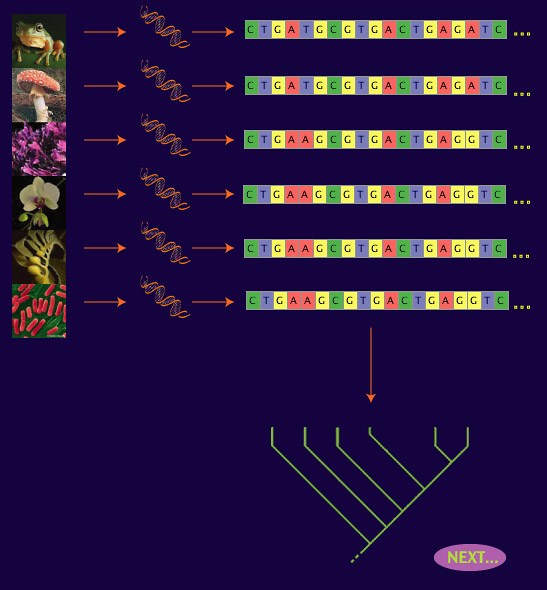
Two organisms that are closely related would have
a)
very similar DNA sequence
b)
exactly the same DNA sequences
c)
no proteins in common
d)
completely different DNA sequence
12.

Who was the Scientist most famous for his study of natural selection and evolution?

a)

Theodor Schwann

b)

Robert Hooke

c)

Charles Darwin

d)

Rudolf Virchow

13.

What is the process in which populations CHANGE gradually over time?

a)

evolution

b)

species

c)

variation

d)

competition

14.

How do we measure the age of a fossil in years?

a)

variation

b)

absolute dating

c)

selection

d)

mutation

15.

What do you call similar structures that related species have inherited from a common ancestor?

a)

Natural Selection

b)

Analogous Structure

c)

Vestigial Structure

d)

Homologous Structure

16.

What do we call structures that no longer perform their original function?

a)

Natural Selection

b)

Analogous Structure

c)

Vestigial Structure

d)

Homologous Structure

17.

What do you call a characteristic that allows an organism to survive in an environment?

a)

variation

b)

adaptation

c)

selection

d)

overproduction

18.

Select ALL the parts of Natural Selection.

a)

overproduction

b)

evolution

c)

variation

d)

selection

e)

competition

19.

Select ALL that show evidence of evolution.

a)

DNA

b)

mutations

c)

fossils

d)

skeletal structures