
 Worksheets
World History Final - Part I -2023
Total questions: 90
Worksheet time: 6hrs 26mins

Siberian concentration camp (labor camp) used during Stalin's Great Terror (Purge).
Gulag
Totalitarianism
Communism
Fascism

Hatred and mistreatment of the Jewish people.
Police Terror
Antisemitism
Propaganda
Censorship
Indoctrination

Who took over Russia after the death of Vladimir Lenin?
Solzhenitsyn
Tojo
Stalin
Trotsky

What is No Man's Land?
Land between the opposing trenches
Land used for battlefields
Land used for the bathroom
Land behind the trenches
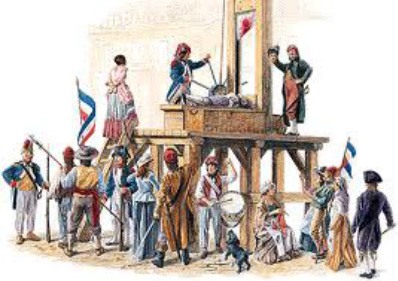
T/F: Only members of the clergy & nobility were killed during the Reign of Terror.
TRUE
FALSE


The Bastile was
A fortified fort in Paris for the kids to play in
A prison that also held weapons and gun powder
A new place for Marie and Louis to go to have dinner
Where King Louis XVI and Marie Antoinette lived

According to John Locke, governments rule with the "consent of the governed." In other words...
Governments can only rule over a people, so long as they agree.
Governments rule with God's blessings.
A king is always right.

Which of the following was an underlying, or deep-rooted, cause of the French Revolution?
unequal tax burdens
equal land ownership
a law granting peasants more freedom
a growing French empire

Hitler believed which race was the "master race?"
Aryan
Slav
Caucasian
Jewish

Which country dropped out of WWI due to their country's Bolshevik (Communist) revolution?
Germany
France
Russia
Great Britain


The idea that reason should guide society rather than tradition helped cause the revolution and came from
the Declaration of Independence
the Scientific Revolution
the Enlightenment
all of the above

The Reign of Terror was a time when
Marie Antoinette was executed
The Committee of Public Safety used terror to keep the Republic safe
Thousands of French people were sent to the guillotine
all of these

All of the following countries were members of the Axis Powers EXCEPT...
Germany
Italy
Japan
United States

The mass extermination of Jews by Nazi Germany prior to and during World War II was known as The
Great Purge
Reaping
Holocaust
Jewish Genocide

Which event brought the United States into World War II?
Dropping the atomic bomb
The attack on Pearl Harbor
The Zimmerman Telegram
The Holocaust

Warfare using fast-moving planes and tanks followed by mass infantry to overwhelm an enemy is called ____________ or "lightening war."
the final solution
mass effect
blitzkrieg
lebensraum

The British victory in the Battle of Britain caused Hitler to stop the planned invasion of the British Isles.
True
False

Who was the leader of the U.S.S.R?
Adolf Hitler
Josef Stalin
Hideki Tojo
Benito Mussolini

Japanese surprise attack on December 7, 1941: "...a day that will live in infamy."
Midway Island
Wake Island
Iwo Jima
Pearl Harbor

What is significant about D-Day?
It was the Allied invasion of France, the largest land-sea-air operation in army history, and the turning point of the war.
Thousands of Nazi soldiers froze or starved to death after they were trapped by the Soviets.
The Allies discovered concentration camps where Jews and others had been murdered.
The British stopped the German advance and were able to gain control of the Suez Canal.

What caused the U.S. and German relations to deteriorate in 1915?
German invasion of Belgium
German blockade
Sinking of the Lusitania
German embargo on U.S. goods

Russian Leader before Bolshevik Revolution
Tsar Nicholas II
Kaiser Wilhelm II
King George V
Vittorio Orlando

What is nationalism?
the doctrine (belief) that your national culture and interests are superior to any other
Creating partnerships
Seizure of country from stronger country
Building an army
Which country dropped out of WWI due to their country's revolution?
Germany
France
Russia
Great Britain

This forced Germany to accept full blame for WWI.
Fourteen Points
Treaty of Versailles
Armistice
Red Scare

How did women show strength and independence during World War I?
Some, like the 'Women's Battalion of Death' fought.
Some died as ambulance drivers on the front lines.
Many kept the engines of war running with factory and farm production.
All of the above.

What is the immediate cause of WWI?
Assassination of Franz Ferdinand.
Assassination of Jean Jaurès.
Assassination of Alexander II.
Assassination of William McKinley

What two things were the British trenches?
Wet
Smelly
Dry
Clean

Direct Democracy is...
Citizens vote for representatives
There is a King who decides on all laws
Citizens vote on every law proposed.
Is in use in the United States today.

How were decisions made in an Athenian Assembly?
Discussion
Fighting
citizens votes
and by lot
Competitions

Mark all the people that were not allowed to vote in Athenian Democracy.
Men
Women
Slaves
Foreigners (Metics)

Many office holders in Athens were chosen by lot. This means leaders were selected by...
lottery
vote.
violence.
poll

True or False: The principles of Greek democracy influence the structure and function of modern democratic governments like the US.
True
False

A government where the power belongs to the people and every citizen can participate in making decisions regarding their government.
Monarchy
Oligarchy
Democracy
Theocracy

True or False: Only citizen men could vote in Athens.
True
False

government where the power is held by one person who is chosen by a supreme power. (divine rule)
monarchy
oligarchy
democracy
theocracy

government in which ruling power is in the hands of a person who seized control from a democratic government.
oligarchy
tyranny
democracy

What makes a direct democracy impossible for most countries today?
Too many people & too little time
Too few laws, too much time

Oligarchy is...
Rule by a small group of people
Rule by the many
Dictatorship
Tyranny of one leader

"If a man is able to serve the state, he is not stopped by the obscurity of his condition."
What is a synonym for 'obscurity?'
anonymity
familiarity
popularity
wealth

"The franchise is open to all men who are of citizen birth by both parents."
'franchise' in the historical sense means...
free haircuts
slavery
The right to vote.
a store chain

Pericles was all of the following EXCEPT...
General during the Peloponnesian War
a Metic
Leader of Athens
Source on Democracy in Thuycidides' History

Why do we source a document?
a) Helps a reader identify a bias by knowing the author
b)You can learn the date of its origin
c)Helps a reader evaluate the reliability
All of the above: a,b, & c

Historians disagree over whether Athens was a democracy or not.
True
False

What is an ostracon?
a vessel for holding oil
a cask of wine
a broken piece of pottery used as a writing surface.
a bone used for divination (fortune telling)

When we watch current events like the protests in Iran or the attack on the US capitol building, we see that democracy...
Is always expanding or contracting (shrinking)
Exists everywhere
Once established, never fades away
is a promise of peace and stability

What was Aristotle's job?
a)Expert and consultant on writing constitutions
b)Philosopher
c) General during the Peloponnesian War
both a & b

Our government reflects Athenian values in naming our bicameral Congress the House of Representatives and the...
Executive
Supreme Court
Court of Appeals
Senate

To say an election, like the kind used to ostracize those considered a threat to democracy, was rigged...is to say it was...
fraud
perfect
fraudulent
democratic

To ostracize someone from Athenian society for 10 years is to...
promote them
reward them
elect them
shun them

What conclusion can we draw from our study of Athenian Democracy?
Democracy is often imperfect and can always be improved
What is 'democratic' is in the 'eye of the beholder'
(depends on the person)
The questions we ask can be more important than the answers
All of the above

Over the years the franchise has expanded. What is 'franchise?'
The right to drive
The right to vote
country borders
human rights

Pericles is remembered for...
a) giving a speech on democracy at a funeral for soldiers
b) being a leader of Athens
c) writing the Athenian constitution
d) a & b

Thucydides' account of Pericles' speech may be unreliable because...
No one knows when it was recorded
It was a secondary source
He was a biased supporter of Pericles
All of the above
There is no corroborating account to confirm his account

In a just democracy, magistrates would be selected based on their merit.
What do magistrates & merit mean?
officials...talent/ ability
judges...allegiances
police...family relationships
philosophers... insight

Leader of Hawaii when the American businesses overthrew the government, surrounding the palace at gunpoint.
Sanford Dole
Queen Liliuokalani
Queen Kalakaua
Jose Marti

Countries want to use imperialism to gain colonies for all of the following reasons except
gain new resources
show their power
learn about other cultures
spreading their greatness

How did the U.S. benefit from winning the Spanish American War?
The US adopted Spanish as a second language
The US won colonies: Puerto Rico, Guam, and the Philippines
The US gained control of the Panama Canal
The US added new states from Asia

After the Spanish American war, what area did the U.S. keep as a territory to have a Pacific Port, causing a three year war?
Japan
Philippines
Panama
China

What did the U.S. create to expand their power around the world?
A large and advanced army
Newspapers that said good things about the U.S.
Amendments to the Constitution
A large navy and refueling ports across the Pacific Ocean

Why did many industrialized or advanced countries need to takeover less advanced countries?
For better climate and cleaner environment
To create a democratic government
To teach the local population about recycling
To claim or takeover natural resources located in those countries

Why did nations want to be imperialistic?
They wanted prestige among other nations
They needed more natural resources
They needed more markets to sell industrial goods
All of the Above

Which of the following is NOT one of the reasons/ideas behind imperialism?
Military Needs
To isolate your country from the rest of the world.
White Supremacy
Nationalist Pride


The 1823 Monroe Doctrine blocked European interests and asserted the United State's right to _______.
build the Panama Canal
annex Hawaii
attack the Spanish
interfere in South American politics

What was the name of the war where Britain sent their navy to force China to allow Britain to sell addictive substances to China?
Opium War
War of 1812
War of the Worlds
English war

US entered war, gaining control of Puerto Rico, Guam, Cuba, the Mariana Islands, and the Philippines in this war...
Rico War
Spanish American War
War on terrorism
Island war


The poem, The White Man's Burden, by Rudyard Kipling, represents the belief that European culture was _______.
superior to other cultures
misunderstood by Americans
the oldest culture in the world
a replica of Ancient Greek culture

New Imperialism was focused mainly in
North and South America
Africa and Asia
Antarctica and Australia
Europe

What was the result that the Boxer Rebellion, the Sepoy Rebellion, and Zulu War had in common
Europeans emerged victorious thanks to superior technology
Indigenous people defeated Europeans
Europeans were defeated thanks to inferior technology
Imperialism was limited due to these actions

This country in Asia was known as Britain's "crown jewel".
Canada
India
Argentina
Korea

The Monroe Doctrine prevented Europe from taking over countries in __________________
Africa
Australia
Asia
Central and South America


Hitler not only ordered 6 million Jews killed, but also the _________________, elderly, homosexuals and gypsies.
Armenians
handicapped
Nihilists
Dutch

Blond
English

A scarlet letter 'A'


By the end of the Holocaust, over __________ Jews had been killed.

The Nuremberg Laws
separated Jews from German society
said Jews couldn't marry non-Jews
said Jews couldn't own businesses
all of the above

1914
1776
1939
1861

All is true about the lives of Jews in Extermination Camps except

1989
1939
1918

Organized massacre of a particular ethnic group, in particular that of Jews in Russia or eastern Europe (predates the Holocaust).
Pogrom
Blitzkrieg
Kristallnacht
Lebenstraum

In 1933 which of the following countries had the highest population of Jews?
Germany
France
Italy
Poland

