Wayground logo

Free Printable Worksheets

Font size

S
M
L
XL
Worksheets

Plate Tectonics and Earthquakes Review

Total questions: 60

Worksheet time: 1hrs 2mins

Name
Class
Date
1.
Who is the person credited with developing the theory of continental drift?
a)
Harry Hess
b)
Galileo
c)
Alfred Wegener
d)
Newton
2.
What two specific continents fit together most noticeably?
a)
Africa and North America
b)
South America and Europe
c)
South America and Africa
d)
 Antartica and Africa
3.
Which type of information was NOT collected by Wegener to support his continental drift hypothesis?
a)
glacial deposits
b)
 fossils
c)
seafloor magnetic data
d)
rocks
4.
The theory of continental drift named a key part of this idea Pangaea. What is Pangaea?
a)
One of the ancient animals that helped Wegener prove that fossils from different continents originally came from the same location
b)
 supercontinent that existed in Earth's distant past
c)
The underwater ocean range in the middle of the ocean
d)
The hot spot which gave rise to the Hawaiian Islands, among others
5.
Why was Wegener's theory not accepted?
a)
He had no proof of how they were moving
b)
He had no evidence
c)
He was married
d)
He was not a Scientist
6.
Pangaea was a giant landmass that existed 2 million years ago
a)
True
b)
False
7.
What is the force that moves the continents? 
a)
Conduction 
b)
Convection 
c)
Radiation 
d)
Conveyor belts 
8.
The continents move very slowly, only a few __________per year.
a)
meters
b)
kilometers
c)
centimeters
d)
miles
9.
India, Australia, South America, and Africa all have deep grooves or scratches in rocks which is climate evidence of ....
a)
erosion
b)
dinosaurs
c)
glaciers
d)
aliens
10.
Glossopteris grew in warm, swampy areas proving Antarctica used to have a ________________climate.
a)
warm and wet
b)
hot and dry
c)
cold and icy
d)
temperate
11.
A plate boundary where two plates move away from each other is called
a)
Divergent Boundary
b)
Convergent Boundary
c)
Transform Boundary
d)
Subduction
12.
Convergent Plate Movement can create
a)
Rifts
b)
Mountains
c)
Ocean Ridges
d)
Radiation
13.
When pressure builds between two tectonic plates, it can suddenly release causing a (an) ______________________
a)
Earthquake
b)
Volcano
c)
Convection Current
d)
Gravitational Pull
14.
Which of the following is where one plate slides under another plate?
a)
submarine zone
b)
divergence zone
c)
subduction zone
d)
lower zone
15.
During sea floor spreading, molten material rises up from the mantle...
a)
along the continents
b)
at the mid ocean ridges
c)
deep ocean trenches
d)
at north and south poles
16.
Associated with transform boundaries.
a)
Volcanoes
b)
mountains
c)
trenches
d)
earthquakes
17.
Name the boundary
a)
convergent boundary
b)
divergent boundary
c)
transform boundary
d)
sergent boundary
18.
Name the boundary
a)
convergent boundary
b)
divergent boundary
c)
transform boundary
d)
sergent boundary
19.
Name the boundary
a)
convergent boundary
b)
divergent boundary
c)
transform boundary
d)
sergent boundary
20.
Which answer below correctly describes the formation of a volcanic island arc?
a)
Islands are created along the mid ocean ridge as new oceanic crust is formed.
b)
Islands are created one at a time as the plate moves across a hot spot in the mantle.
c)
Islands are created along a subduction zone as oceanic crust is forced back down in to the mantle.
d)
Islands are created as pressure is released when two tectonic plates are pulled apart.
21.

The movement of the tectonic plates is caused by

a)

the rotation of the Earth.

b)

convection currents in the Asthenosphere

c)

the gravity of the iron-nickel core.

d)

the Moho discontinuity.

22.

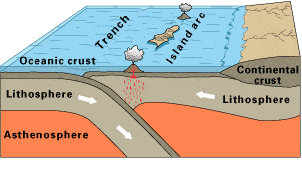
Observe this diagram of a plate boundary. One statement BEST describes what is happening. It is that

a)

the oceanic crust is melting.

b)

the denser ceanic crust is subducting under the less dense oceanic crust

c)

volcanic islands are forming.

d)

the tectonic plates are moving away from each other.
23.
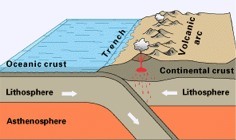
Observe the plate boundary shown here. What type of plate boundary is this? Many geologic events occur at these boundaries. Some are shown, but one is missing. What geologic event would you predict would occur at this plate boundary?
a)
convergent oceanic-oceanic plate boundary; volcano
b)
divergent oceanic-oceanic plate boundary; sea floor spreading
c)
convergent oceanic-continental plate boundary; earthquake
d)
convergent continental-continental plate boundary; mountain building
24.
The image illustrates what type of boundary?
a)
Divergent
b)
Convergent
c)
Transform
d)
Emergent
25.
Volcanoes found away from plate boundaries, such as Hawaii, are known as 
a)
hot spots
b)
calderas
c)
trenches
d)
mid-ocean ridges
26.
What takes place because of sea-floor spreading?
a)
Crust is recycled.
b)
Crust is created.
c)
The ocean is evaporated.
d)
The sea floor remains unchanged.
27.
The focus of an earthquake is 
a)
above the epicenter
b)
the epicenter
c)
below the epicenter
d)
next to the epicenter
28.
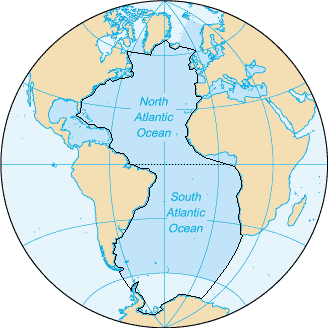
In the Atlantic ocean, where is the youngest seafloor located?
a)
Towards the edges, near the eastern and western continents
b)
Towards the middle of the ocean
c)
Towards the north and south poles
d)
Young seafloor is located randomly throughout the ocean
29.

Paleomagnetism was used to confirm sea floor spreading because it showed

a)

Patterns or polar reversals in the seafloor that was identical on either side of the mid ocean ridge

b)

The magnetic north pole was at one time in the Atlantic Ocean

c)

Cosmic radiation being deflected by the Earth’s magnetic field lead to fracturing the continents

d)

The oldest rock on the ocean floor is closest to the mid ocean ridge

30.

Which of the following statements is correct:

a)

Oldest sea floor rock is found near the mid ocean ridge and youngest is found further away

b)

Paleomagnetism is used to determine the age of rock and sediments

c)

The Earth’s magnetic field is constant and steady and never fluctuates or moves Crust is

d)

Crust is destroyed at the subduction zones, and created at the mid ocean ridge

31.

the study of the alignment of magnetic minerals in rock

a)

magnetology

b)

paleotology

c)

paleomagnetism

d)

continental drift

32.
The snapping back of deformed rock to its previous shape.
a)
elastic rebound
b)
plastic rebound
c)
rebound motion
d)
divergent boundary
33.
What action should you take if you are indoors when an earthquakes strikes?
a)
Lie under a table or desk
b)
Watch the weather
c)
Call a friend
d)
Act as though nothing is happening
34.

Which feature is created by all 3 types of plate boundaries.

a)

Earthquakes

b)

Mountains

c)

Subduction Zones

d)

Volcanoes

35.

What type of fault is the San Andreas in California?

a)

Convergent

b)

Transform

c)

Optimus Prime

d)

Divergent

36.

What is a warning before a tsunami hits?

a)

The television news will make a prediction about a week ahead based upon the weather in the area.

b)

The water will move away from the shore unusually fast and strong into the ocean.

c)

The fish in the ocean will start jumping out of the water.

d)

There will be lots are rain and wind about 2 hours before one hits.

37.

What does the word tsunami mean in Japanese?

a)

Harbor Wave

b)

Big Storm

c)

Time to run

d)

Underwater earthquake.

38.
The Richter scale measures:
a)
the amount of radon gas released
b)
the movement of plates
c)
the strength of an earthquake
d)
the weight of tectonic plates
39.

Most earthquakes happen along _________________.

a)

the coast

b)

faults

c)

the desert

d)

mountain ranges

40.
Earthquakes under the water can cause _________________________________.
a)
tornadoes
b)
tsunamis
c)
lightening
d)
hailstorms
41.

Many earthquakes happen along the borders of...

a)

Countries

b)

Tectonic Plates

c)

Climate Zones

d)

None of the above.

42.

The place where an earthquake originates inside the Earth's surface is called...

a)

Epicenter

b)

Focus

c)

Underground

d)

Crust

43.

The place on the Earth's surface, above the origin of the earthquake.

a)

Epicenter

b)

Focus

c)

Surface

d)

Crust

44.

The Earth's crust is made up of tectonic plates. These move due to:

a)

tsunamis pushing the plates around

b)

pressure caused by heated magma rising from the core

c)

the inner core pushing the plates around

d)

people jumping too heavily

45.

The largest recorded earthquake happened in 1960 and measured 9.5 magnitude. Which country was it in:

a)

China

b)

Japan

c)

USA

d)

Chile

46.

What would you do if you were in an earthquake;

a)

Scream and run about

b)

Call Grandma in England

c)

Drop, Cover and Hold

d)

Jump in the cracks in the floor

47.

How much bigger is a magnitude 8 earthquake compared to magnitude 6 quake on the Richter Scale?

a)

2 times bigger

b)

20 times bigger

c)

48 times bigger

d)

100 times bigger

48.
What is a smaller earthquake that follows a larger earthquake?
a)
Aftershock
b)
Liquefaction
c)
Seismic Gap
d)
Tsunami
49.

What is the scale used to measure the strengths of earthquakes?

a)

Fujita scale

b)

Richter scale

c)

Damage scale

d)

NASA scale

50.

Are plates always moving?

a)
b)
51.

What geologic feature will occur at a hot spot ?

a)

volcano

b)

folded mountain

c)

deep sea trench

d)

crevasse

52.

A prime example of an area over a hot spot is :

a)

Japan

b)

the Andes Mountains

c)

the East African Rift

d)

the Hawaiian Islands

53.

What area of the continental United States is over a hot spot ?

a)

the Florida Everglades

b)

the Grand Canyon

c)

Yellowstone National Park

d)

New York City

54.

The number of tectonic plates that cover our planet is closest to :

a)

3

b)

20

c)

100

d)

4400

55.

In rare instances tsunamis can be caused by

a)

giant meteors

b)

wind

c)

gravitational pull of the moon

d)

Junaid blowing air at the ocean

56.

Tsunamis can be

a)

as high as 100 feet.

b)

as high as 2 feet.

c)

as high as 1,000 feet.

d)

as high as 10,000 feet.

57.

Tsunamis can move at

a)

over 500 miles per hour

b)

over 1,000 miles per hour

c)

over 5,000 miles per hour

d)

under 5 miles per hour

58.

Which areas are most susceptible to a tsunami?

a)

low lying areas

b)

high areas

c)

middle areas

59.

What kind of damage can tsunamis cause?

a)

They can destroy road, bridges, and buildings.

b)

They can cause tornadoes.

c)

They can make people sad.

d)

They can cause a drought.

60.

If a tsunami is head to your area which of the following should you do?

a)

Climb a tall tree

b)

Go underground to a basement

c)

Go to higher ground like a hill or mountain

d)

Just stay and don't move from your area