wayground logo

Free Printable Worksheets

Font size

S
M
L
XL
Worksheets

Category 3 Review Biology STAAR

Total questions: 31

Worksheet time: 1hrs 2mins

Name
Class
Date
1.

Which of the following is the collection of life's remains found in sedimentary rock?

a)

natural selection

b)

homologous structures

c)

Charles Darwin

d)

the fossil record

2.

Similarities in bone arrangements, like those in the picture, support the hypothesis that...

a)

these organisms are not well adapted

b)

these organisms share a common ancestor

c)

these organisms all share the same DNA sequences

d)

these organisms are members of the same species
3.
Which of the following is an example of a vestigial structure?
a)
the wings of a red-tailed hawk
b)
the hind limbs of a house cat
c)
the fins of sharks
d)
the tailbone of a human
4.

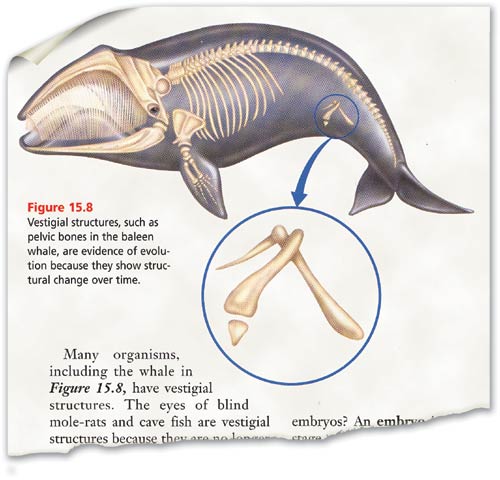
The picture shows a/an ___________

a)

homologous structure

b)

vestigial structure

5.
Structures are similar in appearance but not in structure
a)
Vestigial 
b)
Homologous 
c)
Analogous Structures 
d)
Embryonic 
6.

A change in a DNA sequence that affects genetic information

a)

mutation

b)

fitness

c)

transformation

7.

An inherited characteristic that increases an organism's chance of survival

a)

adaptation

b)

evolution

c)

fitness

8.

By looking at the genes of some animals we can determine which living species are most closely related to each other. This also reveals which species most recently diverged from their common ancestor.

Based on the partial gene segments shown, which pair of animals are genetically most closely related and therefore most recently diverged from their common ancestor?

a)

Chimpanzee and Mouse

b)

Rat and Mouse

c)

Rat and Chimpanzee

9.

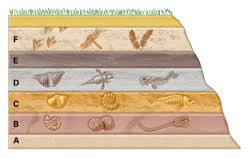
Which rock layer contains the newest fossils?

a)
F
b)
E
c)
B
d)
C
10.
Charles Darwin’s observation that finches of different species on the Galápagos Islands have many similar physical characteristics supports the hypothesis that these finches 
 
a)
have the ability to interbreed.
b)
acquired traits through use and disuse.
c)
all eat the same type of food.
d)
descended from a common ancestor.
11.

Images of the embryo and adult stages of three different organisms are shown.


Which of the following is the best conclusion that can be drawn from this evidence?

a)

Having similar embryos indicates that these organisms eat the same types of food.

b)

Having similar embryos indicates that these organisms live in a similar environment.

c)

Having similar embryos indicates that these organisms share a recent common ancestor.

d)

Having similar embryos indicates that a certain protein controls how many legs the adult organisms will have.

12.

If a new trait DOES help an organism survive, what may happen to it?

a)

It dies and its DNA is not passed on

b)

It survives and its DNA is passed on

c)

It changes its traits to adapt and survive

13.

What happens to new traits that HELP organisms survive over time?

a)

They become MORE COMMON

b)

They become LESS COMMON

c)

They are EQUALLY COMMON

14.

An organism identified with binomial nomenclature includes which two taxa?

a)

class and order

b)

family and genus

c)

genus and species

d)

kingdom and phylum

15.

What is the order of the taxonomic levels from least specific to most specific?

a)

Kingdom, Family, Species, Order, Class, Phylum, Genus

b)

Kingdom, Phylum, Class, Order, Family, Genus, Species

c)

Species, Order, Kingdom, Family, Genus, Phylum, Class

d)

Species, Genus, Family, Order, Class, Phylum, Kingdom

16.
A student discovers an arachnid with a segmented abdomen, long legs, and a tail with no stinger. The student uses the dichotomous key below to identify it. Which arachnid has the student found?
a)
Whip Scorpion
b)
Wind Scorpion
c)
Daddy long legs
d)
Scorpion
17.

What is the genus name here:

Canis lupus

a)

Canis

b)

lupus

18.
Organisms in this smallest taxonomic group share many characteristics.
a)
domain
b)
kingdom
c)
species
d)
class
19.
Which organisms are most closely related?
a)
Equus caballas (Horse) & Equus burchellii (Zebra)
b)
Cyanea artica (Jellyfish) &
Ctenodiscus crispatus (Mud Starfish)
c)
Naja naja (cobra) & Glycine max (soya bean)
d)
Ophiocomina nigra (black brittle star) & Brassica nigra (black mustard)
20.
The scientific name for an organism is made from the:
a)
class and family name
b)
genus and species name
c)
domain and kingdom name
d)
kingdom and phylum name
21.
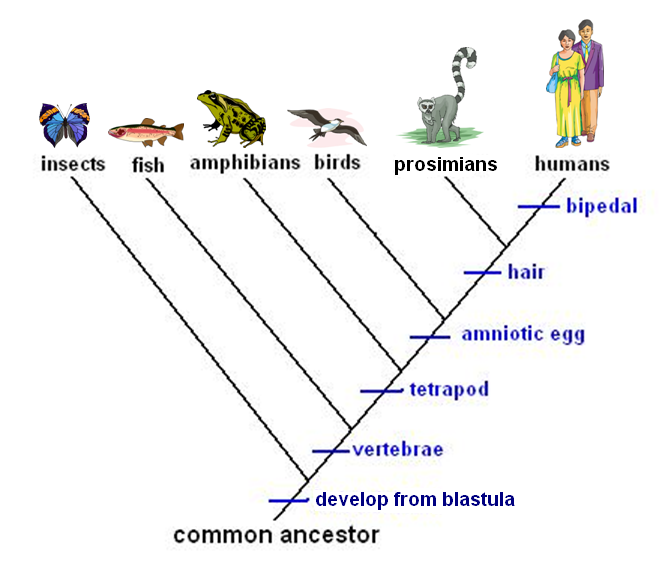
Which organisms pictured on the cladogram have hair?
a)
prosimians only
b)
prosimians and humans
c)
humans only
d)
prosimians and birds
22.
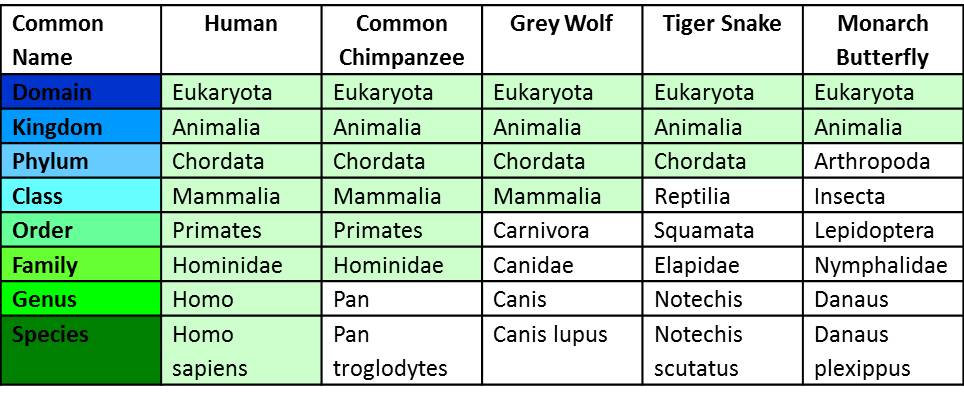
Which organism in the table is least closely related to the chimpanzee?
a)
human
b)
grey wolf
c)
tiger snake
d)
monarch butterfly
23.
Which of the following organisms are LEAST closely related?
a)
organisms that share a domain
b)
organisms that share a family 
c)
organisms that share a genus 
d)
organisms that share a species 
24.
Term given to describe the 2 name naming system is:
a)
dichotmous key
b)
binomial nomenclature
c)
2 scientific names
d)
binomial key
25.
Cells that do not have a true nucleus are called....
a)
eukaryote
b)
prokaryote
c)
unicellular
d)
multicellular
26.
Cells that have a true nucleus are called....
a)
eukaryotes
b)
prokaryotes
c)
unicellular
d)
multicellular
27.
Based on their scientific names, a scientist would know that the organisms Entamoeba histolytica and Entamoeba dispar do not belong to the same --
a)
class
b)
family
c)
genus
d)
species
28.

If two organisms belong to the same order, then they must also belong to the same...

a)

Species

b)

Class

c)

Family

d)

Genus

29.
Which scientific name is written correctly?
a)
Okapia Johnstoni
b)
Carcharodon carcharias
c)
balaenoptera Musculus
d)
panthera leo
30.
"Lion" is an example of what?
a)
Scientific name
b)
Common name
c)
Adaptations
d)
Food
31.
"Pinus taeda" is an example of what?
a)
Adaptations
b)
Common name
c)
Scientific name
d)
Food