
Font size
 Worksheets
Science Interim 4
Total questions: 37
Worksheet time: 42mins

according to the picture if we are in December, in 6 months which month would it be?
September
June
March
December

according to the picture if we are in June and the Earth goes around the sun for 12 months (1 year) which month would it be?
December
September
June
March
Earth is tilted 23.5 degrees. What happens every year because of this?
We have New Year's Day on January 1st.
We have spring, summer, autumn and winter.
We have 12 months each year.
We have Aurora Borealis.
If the Northern Hemisphere is farthest from the sun which season is it?
summer
fall
winter
spring
If Antarctica is at its closest point to the sun which season is it?
summer
fall
winter
spring
Select all that apply that are in our solar system
Planets
Comets
Black Holes
Asteroids

The Law of Universal Gravitation is the motion of planets within the solar system
True
False
Oceans and Seas are major distributors of the sun's rays and energy
True
False
What 3 things did Wegener study to support his ideas? Mark all THREE.
matching fossils
matching land features
matching forces
climate change
What was the name of the supercontinent?
Panorama
Pangea
Panamerican
Wegener
Scientists think that the continents once formed a giant landmass that broke apart, and then slowly drifted apart. What is the name given to this hypothesis?
sea-floor Spreading
plate tectonics
continental drift
Pangaea
what is a major ridge under water?
underatlantic ridge
overatlantic ridge
midatlantic ridge
mountain
Name all the continents near the Mid Atlantic Ridge
North America
South America
Europe
Africa
A way of telling the age of a once living thing is by____________ which is measuring the amount of C14 of it.
Cotton Dating
Carton Dating
Corbin
Carbon Dating
The time taken for something to halve it quantity is
Half-Time
Half-Pint
Half-Century
Half-Life
Can you find diamonds everywhere on Earth?
Yes
No
Most diamonds are found on the edge of continents
True
False
Name the steps in the water cycle
Evaporation
Condensation
Transpiration
Runoff
Transportation
The core's energy does what?
Heats the rising groundwater
Cools the sinking groundwater
keeps the water the same
water doesn't exist
The movement of water over land and taking particles with it is called
Deposition
Runoff
Erosion
Weathering
The term that geologists use for underground water
Underground water
Ground water
Permeable water
Water soil

Look at this picture. How does rainwater cause weathering and erosion?
Rain can't cause erosion.
The water breaks down soil and carries it down the river.
The water eats the soil.
The water does not carry soil.
Would a stream of water dig into a hill over time?
Yes
No
Water is a what type of resource?
renewable resource
non-renewable resource
continuous resource
a city right behind a mountain will not have good vegetation because
they have the perfect amount of water
they deal with the rain shadow
they have the perfect situation
none of these
When someone gives a forecast what are they doing?
giving definite information
giving perfect information
giving their best guess
not doing anything
uneven water temperatures is the biggest reason for oceans to have
currents
evaporation
land
dinner
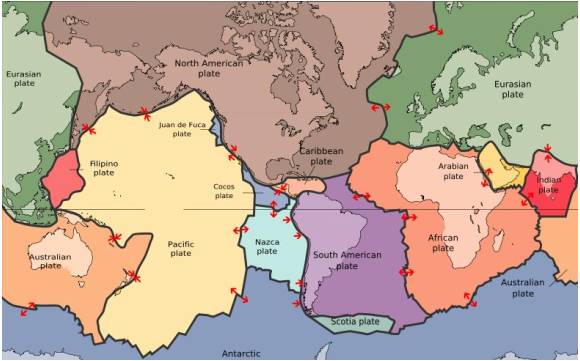
The map in the picture shows tectonic plate boundaries. This map would be useful in predicting the location of future
droughts
hurricanes
earthquakes
tornadoes
Where is an area on earth that could absorb the most of the sun's rays tp heat up the water
North Pole
South Pole
Arctic circle
Equator
If the biosphere gets the most effect from pollution what could happen to animals
Increase animal population
decrease endangered species
increase endangered species
do nothing
The more humans use fossil fuels what happens to the earth's temperature
goes up
goes down
stays steady
they don't even work together what so ever

