
 Worksheets
U. S. History II Final Exam
Total questions: 40
Worksheet time: 40mins
During the early 1900s, the term "muckrakers" was used to describe-
pacifists who demonstrated against war
Politicians who criticized Progressive Era presidents
Writers who exposed the evil in American society
Newspaper columnists who reported in celebrities
After the Spanish American War, the U.S. Directly controlled all of the following territories EXCEPT
The Philippines
Guam
Puerto Rico
Cuba

Why did Theodore Roosevelt help support a revolt against Columbia?
Columbia refused to comply with trade agreements
He wanted to establish a naval base in Columbia
He wanted to establish a colony in Columbia
He wanted to build the Panama Canal
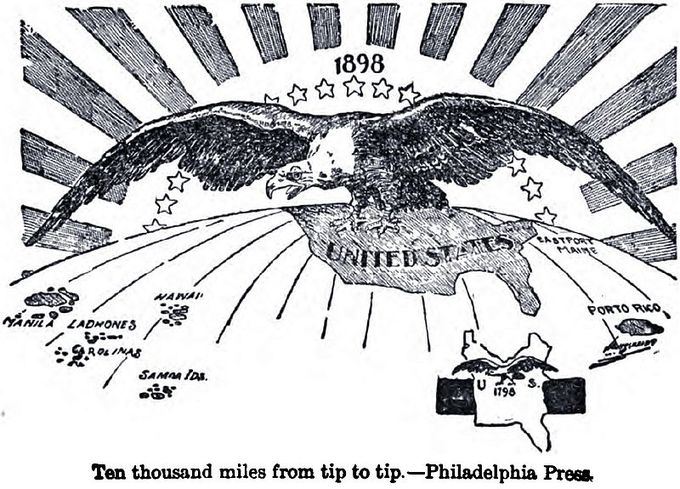
This image is a representation of...
US Exploration
US Diplomacy
US War Relations
US Imperialism
Which of the following was NOT one of the MAIN underlying causes of World War I?
Militarism
Alliances
Industrialization
Nationalism
Where did the soldiers of the Western Front in WWI live, fight, and die?
Trenches
Bunkers
No Man's Land
Ships

Which countries made up the Central Powers in WWI?
Germany, Austria-Hungary, Bulgaria, Ottoman Empire
Germany, Austria-Hungary, Italy, France
Russia, France, Great Britain, United States, Italy
Germany, Serbia, Austria-Hungary, Belgium

Which country dropped out of WWI due to their country's revolution?
Germany
France
Russia
Great Britain

_____________________________ was a mass movement of African-Americans from the rural South to Northern cities from 1910-1930.
The New Deal
Following World War I, the U.S. foreign policy of the 1920's became
A nickname given to the 1920's because of the decade’s prosperity, technological advances, and cultural boom.
Roaring Twenties
Harlem Renaissance
Jazz Age
Great Decade

This Langston Hughes poem illustrates a major theme of the Harlem Renaissance by
supporting the creation of colleges operated by African Americans
stressing the need for economic reform
expressing the pride and hope of many African Americans
detailing mistreatment of African Americans by the music industry
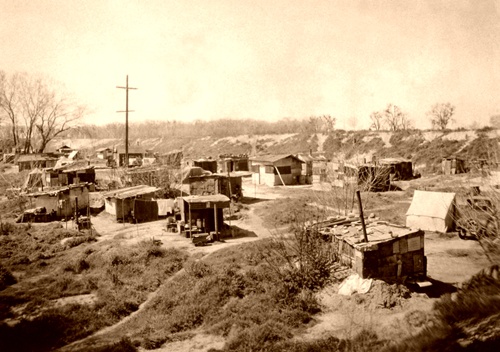
The End of World War I
The three Allied Powers that were most instrumental in defeating the Axis powers in WWII were
Soviet Union and Germany and Italy
United States and Great Britain and France
United States and Great Britain and Soviet Union
United States and Germany and Japan

What event ended the use of Appeasement and started World War II in 1939?
Assassination of Austria's Archduke Franz Ferdinand
Japan's attack on Pearl Harbor
Which country signed a nonaggression pact with Germany that led to the invasion and division of Poland?
United States
Austria
Great Britain
U.S.S.R

Term which refers to the military, political, and ideological barrier established between the Soviet bloc and Western Europe form 1945-1990.
Berlin Wall
Great Wall of China
During the Cold War, what policy did the U.S. follow to stop the spread of communism?
Open Door Policy
Big Stick Policy
Containment Policy
Dollar Diplomacy
A western military alliance formed in 1949 to defend against possible Soviet aggression in Europe that is still active and growing today
Warsaw Pact
The Allies
North Atlantic Treaty Organization
United Nations

During the Cuban Missile Crisis, what did President J.F. Kennedy do when he heard that the Soviet Union was constructing nuclear missile sites in Cuba.
He initiated a trade embargo and economic sanctions against the Soviet Union and Cuba.
He gave into all of the demands of the Soviet & Cuban governments.
He ordered a naval blockade around Cuba to prevent Soviet ships from bringing the necessary materials.
He declared war on the Soviet Union & Cuba.

After WW2, the Domino Theory mainly threatened American Containment Policy in which part of the world?
South America
Africa
East & Southeast Asia
Australia

1968, massive attack by the Viet Cong on major cities in South Vietnam; caused American public support of war to plummet
Operation Rolling Thunder
Gulf of Tonkin Resolution
Tet Offensive
Kent State University

What was the outcome of this headline?
students retaliated by storming the capitol building
growing support against American involvement in war in Vietnam
the war in Vietnam ended
troops were sent to all college campuses
After the Vietnam War
South Vietnam stayed independent but communist.
both countries were reunited.
the Americans had to pay for most of the damage.
all of the above.
What organization, started by W.E.B. Du Bois, chose to fight civil rights abuses using the court system?
Yellow Journalism
ACLU
NAACP
American Labor Party

What movement during the 1920s helped inspire the Civil Rights Movement in the 1950s and 1960s?
Great Migration
Prohibition
NAACP
Harlem Renaissance

What court case made segregation of schools illegal in the 1950s?
Guzman V. School
Brown V. Board of Education
Miranda V. Arizona
Plessy V. Ferguson

Why were federal troops sent to Little Rock, Arkansas in 1957?
to stop race riots
to enforce voting laws to allow African Americans to vote
to protect African American students who were attending an all-white high school
to arrest black students who were sitting at a whites-only lunch counter

What group during the Civil Rights Movement allowed members to use all necessary means to defend and provide for their community?
Black Tigers
NAACP
SNCC
Black Panthers

