Wayground logo

Free Printable Worksheets

Font size

S
M
L
XL
Worksheets

Algebra 1 Review

Total questions: 102

Worksheet time: 6hrs 58mins

Name
Class
Date
1.
Which set of values is a function?
a)
(9,5) (10,5) (9,-5) (10,-5)
b)
(3,4) (4,-3) (7,4) (3, 8)
c)
(6,-5) (7, -3) (8, -1) (9, 1)
d)
(2, -2) (5, 9) (5, -7) (1, 4)
2.
a)
Function
b)
Not a Function
3.
g(x) = 11 - x
Find g(x) = -7 
a)
4
b)
17
c)
18
d)
-77
4.
f(x)=x2-5x
f(4)=
a)
-4
b)
126
c)
24
d)
84
5.
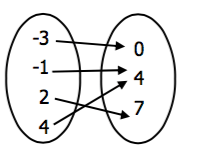
Is this mapping a function or not a function? 
a)
Function
b)
Not a Function 
6.
Find the slope of the line.
a)
-2
b)
2
c)
-1
d)
1
7.
Find the slope of the line that passes through the points (2, 4) and (6, 12)
a)
1/2
b)
-1/2
c)
2
d)
-2
8.

Which equation matches the graph?

a)

y = 2x

b)

y = 1/4 x + 2

c)

y = 1x + 4

d)

y = 2x - 3

9.

What is the y-intercept.

a)

y-intercept is -3

b)

y-intercept -2

c)

y-intercept is 3

d)

y-intercept is -1

10.
What is the slope?
a)
-1/3
b)
-3
c)
-4
d)
5
11.
What is the domain of the graph?
a)
-3 ≤ x ≤ 3
b)
3 ≤ x ≤ -3
c)
-2 ≤ x ≤ 10
d)
-3 ≤ x ≤ 10
12.
What is the range of the graph?
a)
-2 < y < 10
b)
-3 < x < 3
c)
-2 ≤ y ≤ 10
d)
-3≤ x ≤ 3
13.

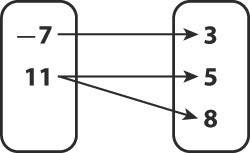
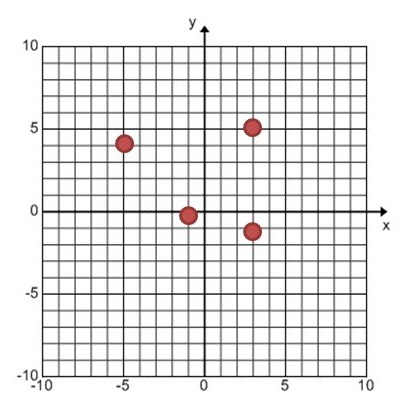
Is the relation shown a function?

a)

No, because the x-value 11 is paired with 5 and 8.

b)

Yes, because each x-value has only one y-value paired with it.
14.

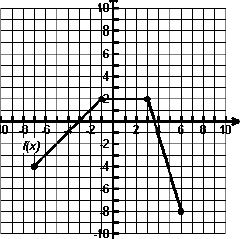
Does the graph represent a function?

a)

Yes

b)

No

15.

What is the range of the function?

a)

-7≤x≤6

b)

-7<x<6

c)

-8<y<2

d)

-8≤y≤2

16.
For the function {(0,1), (1,-3), (2,-4), (-4,1)}, write the domain and range.
a)
D: {1, -3, -4,}
R: {0, 1, 2, -4}
b)
D:{0, 1, 2, -4}
R:{1, -3, -4}
c)
D:{0, 1, 2, 3, 4}
R:{1, -3, -4}
17.
Identify the range of the following function when given the domain { 2, 3, 10}:
y = 4x - 12
a)
4, 12, 20
b)
-20, 0, 28
c)
-4, 0, 28
d)
8, 12, 40
18.

Find the function's x- and y-intercepts.

a)

x-int (0,-3) and (0,1)

y-int (-4,0)

b)

x-int (-3,0) and (1,0)

y-int (0,-4)

c)

x-int (-4, 1)

y-int (-4, ∞)

d)

x-int (-3,0) and (1,0)

y-int (0,-3)

19.

Find the function's maximum and minimum points

a)

no maximum

minimum (-4,-1)

b)

no minimum

maximum (-3, 1)

c)

no maximum

minimum (-1,-4)

d)

maximum (-3,1)

minimum (0,-3)

20.

Identify where the function is increasing and where it is decreasing.

a)

increasing x > -1 and decreasing x<-1

b)

increasing x < -1 and decreasing x > -1

c)

increasing ꓣ and decreasing nowhere

d)

increasing -1 < x < 4 and decreasing -3 < x < 1

21.

Identify the intervals where the function is positive and where it is negative.

a)

positive x > -1 and negative x < -1

b)

positive nowhere and negative -4 < x < -1

c)

positive x < -3 and x > 1 and negative -3 < x < 1

d)

positive R and negative x < -4

22.
Which ordered pair could represent a  
y-intercept on a graph?
a)
(6, 0)
b)
(0, 4)
c)
(-1, 3)
d)
(2, 0)
23.

What is the DOMAIN?

a)

x≥0x\ge0

b)

x<0x<0

c)

All Real Numbers

d)

{0, 1, 2, 3, 4,...}

24.

Which function has an axis of symmetry of x = 0?

a)
b)
c)
d)

None of the above

25.

Which function has a maximum at (2, 0)?

a)
b)
c)
d)
26.

What is the equation of the axis of symmetry?

a)

y = 0

b)

x = 0

c)

x = 3

d)

x = -3

27.

What are the zeros?

a)

0 and 2

b)

-4 and 0

c)

2 and 3

d)

0 and 4

28.
Does the quadratic have a max/min vertex, and does the parabola open up/down?
a)
max/ opens down
b)
min/ opens up
c)
max/ opens up
d)
min/ opens down
29.
What is the y-intercept of the function?
a)
2
b)
3
c)
1
d)
-2
30.
What is the range of this graph?
a)
y = 6
b)
(0, -4)
c)
y > -6
d)
y < -6
31.
Given y=3x determine the y-intercept 
a)
(0,1)
b)
(0,3)
32.
Given the function, f(x) = 6.5(0.85)x, identify the growth/decay rate.
a)
6.5
b)
0.85
c)
x
d)
f(x)
33.

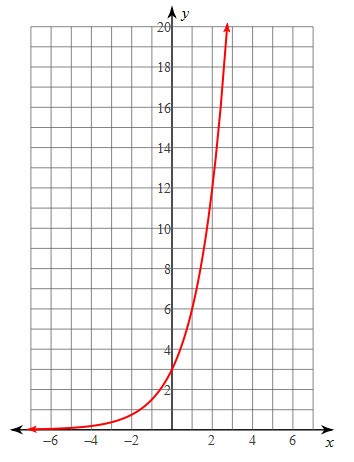
Which equation best represents the graph above?

a)

f(x)=5(.5)x

b)

f(x)=10(.25)x

c)

f(x)=10(5)x

d)

f(x)=10(.75)x

34.

Which dashed line is an asymptote for the graph above?

a)

Line a

b)

Line b

c)

Line c

d)

Line d

35.
Solve:
7x - 3x - 8 = 24
a)
8
b)
-8
c)
3.2
d)
4
36.
Solve:
3(x - 2) = 18
a)
6.7
b)
4
c)
8
d)
-4
37.
Solve:
7x + 19 = -2x + 55
a)
4
b)
14.8
c)
8.2
d)
-4
38.
Solve:
2(2x + 3) = -6(x + 9)
a)
1.2
b)
6
c)
-6
d)
7.5
39.
Solve for x: 
4x + 1 = 7x - 5
a)
-1
b)
2
c)
6/11
d)
8
40.
Solve for x:
6(2x + 1) = 18
a)
3
b)
17/12
c)
1
d)
2
41.
Solve for x:
10 = 3x -12
a)
22/3
b)
2/3
c)
10/9
d)
8
42.
Solve for x:
8x + 2 + 3x + 5 = x + 12
a)
-1/2
b)
2
c)
-2
d)
1/2
43.
Solve for x:
5 + 3x = 8x - 15
a)
10
b)
4
c)
2
d)
20/11
44.
Solve and graph the inequality.
77 ≤ 5 + 8n
a)
A
b)
B
c)
C
d)
D
45.
-2(x+2) < 14
a)
x < - 5
b)
x > -5
c)
x < -9
d)
x > -9
46.

Solve:

5(v + 3) - 10v > -10

a)

v < 5

b)

v > 5

c)

v > -5

d)

v < -5

47.

Write the equation in Standard FORM that has the same y-intercept as

y=4x+3y=4x+3  and goes through (3, 7)

a)

−9=4x−3y-9=4x-3y  

b)

12=4x+y12=4x+y  

c)

−1=3x−4y-1=3x-4y  

d)

17=4x−y17=4x-y  

48.
Are these two lines parallel, perpendicular or neither?
y = -1/3x - 5
y = 1/3x + 2
a)
Parallel
b)
Perpendicular
c)
Neither
49.

Which of the following lines is PERPENDICULAR to the graph of y = -6x + 3 ?

a)

y=16x+2y=\frac{1}{6}x+2

b)

y=x+4y=x+4

c)

y=−16y=-\frac{1}{6}

d)

y=6x−32y=6x-32

50.

Write the equation of the line that is parallel to the line y=3x+7 and passes through the point (-4, -14).

a)

y = -3x +10

b)

y = -3x - 4

c)

y = 3x - 14

d)

y = 3x - 2

51.
Given f(x) = (x-3)2 + 5.  What transformations took place from the original function f(x)?
a)
Left 3 and up 5
b)
Right 3 and down 5
c)
Left 3 and down 5
d)
Right 3 and up 5
52.
Name the parent function.
a)
linear
b)
quadratic
c)
cubic
d)
logarithmic
53.
Match the equation to its description.
a)
Right 2 and up 2
b)
Left 2 and up 2
c)
Right 2 and down 2
d)
Left 2 and down 2
54.
Which equation describes the transformation of shifting f(x)=x2 two units right?
a)
x2 + 2
b)
x2 - 2
c)
(x + 2)2
d)
(x - 2)2
55.

Given f(x) = (x+2)2 - 5. What transformations took place from the original function f(x)?

a)

Left 2 and up 5

b)

Right 2 and down 5

c)

Left 2 and down 5

d)

Right 2 and up 5

56.
Lee charges $3 for a basket and $2.50 for each pound of fruit picked at the orchard. Write an equation in y = mx + b form for the total cost of x pounds of fruit from the orchard.
a)
y = 3x + 2.5
b)
y = 2.50x + 3
c)
y = 2.50x 
d)
y = 3x + 2.50
57.
Which of the following situations could be descried by the equation y= -25x + 120
a)
There are 120 people in the football stadium, and 25 more are entering each hour.
b)
A plumber charges $25 for a house call and $120 per hour.
c)
A teacher has 120 students. Her third period has 25 students
d)
There are 120 gallons of water in a tank. It releases water at a rate of 25 gallons per minute
58.

A bus company took a tour bus on the ferry when there were 30 people aboard. The ferry charged the bus company $180.

The following week, the bus had 50 people on board and the ferry charged them $220.

What is the rate of change (m) in this situation?

(a)  

59.

During the summer, Briana runs an ice cream shop. Her biggest seller is waffle ice cream cones. She charges $1.85 for a waffle cone, and $0.60 for each scoop of ice cream.

a)

Y= 1.85X + 60

b)

y=60X + 1.85

c)

y=.60X + 1.85

d)

y= 1.85X -60

60.

Write the function rule to represent the table.

a)

y = 7x + 3

b)

y = 3(7)x

c)

y = 7(3) x

d)

y = 3x + 7

61.
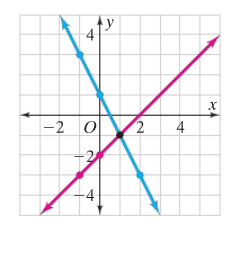
What is the solution?
a)
(1, -1)
b)
(-1, 1)
c)
(0, -2)
d)
(0, 1)
62.
Solve for x and y
3x + 2y = 16
7x + y = 19
a)
(-2,5)
b)
(-2,-5)
c)
(2,-5)
d)
(2,5)
63.

This system has _____ solutions

a)

no

b)

one

c)

two

d)

Infinitely many

64.
Solve the system by elimination. 
−4x − 4y = 0
4x + 4y = 0 
a)
(−6, −4) 
b)
Infinite number of solutions  
c)
(−6, 10) 
d)
(6, 4) 
65.
What is the solution to the system?
8x + 4y = 12
y = -2x + 3
a)
(0,3)
b)
(3,0)
c)
No solution(parallel lines)
d)
Infinitely many solutions
66.
Find the solution to the system of equations:
3x + 2y = 16
y = -7x + 19
a)
(-2,5)
b)
(-2,-5)
c)
(2,-5)
d)
(2,5)
67.

Solve the following system of equations using the elimination method.

a)

infinite solutions

b)

(0, -2)

c)

no solutions

d)

(0, 2)

68.
Add the following polynomials: 
(6x + 4x4 - 3x2) + (7x4 + 5x2 + 8x)
a)
11x4  + 2x2 + 14x
b)
16x4  + x2 + 14x
c)
11x4  + x2 + 14x
d)
11x4  + 2x2 + 10x
69.
Subtract the following polynomials:
(3x²-3x+2) - (x²-2x+1)
a)
2x²+x+1
b)
2x²-5x+3
c)
2x²-x+1
d)
4x²-5x+3
70.

(x + 5)(x + 4)

a)

x2 + x + 20

b)

x2 + 20x + 9

c)

x2 + 9x + 20

d)

x2 - 9x + 54

71.

Find the product:

(5s+2)2\left(5s+2\right)^2  

a)

25s2+425s^2+4  

b)

25s2+10s+425s^2+10s+4

c)

25s2+20s+425s^2+20s+4  

d)

5s2+20s+45s^2+20s+4  

72.

Multiply and Simplify.

(4x+1)(4x−1)\left(4x+1\right)\left(4x-1\right)  

a)

16x2−116x^2-1  

b)

8x2−18x^2-1  

c)

16x2+116x^2+1  

d)

8x2+18x^2+1  

73.
Multiply  7x2y3 (2x4y5+6xy3)
a)
14x8y15+42x2y9
b)
9x6y8+13x3y6
c)
14x6y8+42x3y6
d)
14x6y8+42x2y6
74.
(5c-2)(3c2-5c+4)
a)
15c3-31c4+30c2-8
b)
15c3-19c2+10c-8
c)
15c3-31c2+30c-8
d)
15c3-31c2+30c+8
75.

Factor:
18x4−12x218x^4-12x^2  

a)

6x2(3x2−2)6x^2\left(3x^2-2\right)  

b)

x2(18x2−12)x^2\left(18x^2-12\right)  

c)

6(3x2−2x2)6\left(3x^2-2x^2\right)  

d)

6x(2x3−2x)6x\left(2x^3-2x\right)  

76.

Factor:

12ab3+20b12ab^3+20b  

a)

4ab(3b+5)4ab\left(3b+5\right)  

b)

b(12ab2+20)b\left(12ab^2+20\right)  

c)

4b(3ab2+5)4b\left(3ab^2+5\right)  

d)

12b(ab2+2)12b\left(ab^2+2\right)  

77.

Factor:
15xy+30x2y215xy+30x^2y^2  

a)

xy(15+30xy)xy\left(15+30xy\right)  

b)

15(xy+2x2y2)15\left(xy+2x^2y^2\right)  

c)

15xy(1+2xy)15xy\left(1+2xy\right)  

d)

5xy(3+6xy)5xy\left(3+6xy\right)  

78.
Factor
x2 + 9x - 36
a)
(x + 12)(x - 3)
b)
(x + 9)(x - 4)
c)
(x - 12)(x + 3)
d)
(x - 9)(x - 4)
79.
Factor
n2 + 16n + 63
a)
(n-7)(n+4)
b)
(n+7)(n-9)
c)
(n-3)(n-10)
d)
(n+7)(n+9)
80.
Factor
x2 - 5x - 36
a)
(x - 4)(x + 9)
b)
(x - 6)(x + 6)
c)
(x + 4)(x - 9)
d)
(x -12)(x + 3)
81.
Factor
3v2 - 4v - 7
a)
(3v-7)(v+1)
b)
3(v-7)(v-1)
c)
(3v+1)(v-9)
d)
(3v+1)(v-10)
82.
Factor:
 4h² - 17h + 4
a)
(2h - 2)²
b)
4(h + 4)(h + 1)
c)
(2h - 2)(2h + 2)
d)
(h - 4)(4h - 1)
83.
factor:x2 - 25
a)
( x + 5 ) ( x - 5 ) 
b)
( x - 5 ) ( x - 5 ) 
c)
( x + 5 ) ( x + 5 ) 
d)
Prime
84.

Solve for the values of x:

(2x - 1)(x + 4) = 0

a)

x=1/2, x= -4

b)

x=1/2, x= 4

c)

x= 1, x=-4

d)

x=-2.5, x=4

85.
solve:  
4x2+16x+15=0
a)
-5/2,-3/2
b)
(2x+5)(2x+3)
c)
-10,-6
d)
5/2, 3/2
86.
Solve      3x2 - 192 = 0
a)
-32 or 32
b)
No Solution
c)
-8 or 8
d)
-64 or 64
87.
Solve:
X2 - 3 =6X + 10
a)
X = 7, -1
b)
X = -7, 1
c)
X = -7, -1
d)
No Solution
88.
a)
b)
c)
d)
89.
a)
b)
c)
d)
90.
a)

a-3

b)

a3

c)

3a

d)

1/a-3

91.
a)
b)
c)

2x4y4

d)

2

92.
a)
A
b)
B
c)
C
d)
D
93.
a)
A
b)
B
c)
C
d)
D
94.
Simplify the expression:
a)
8√6
b)
6√6
c)
8√5
d)
64√6
95.
Simplify the expression:
a)
25x2y3
b)
-5xy2 ∛5x
c)
5ixy2 ∛5x
d)
-125x3y6 ∛5x
96.
Simplify the expression:
a)
3y4∜5x3y3
b)
9xy∜5xy3
c)
121.5x.75y1.75
d)
3y∜5x3y3
97.
Simplify the expression:
a)
6x2y2 ∛3
b)
6xy2 ∛6x2
c)
∛1296x5y6
d)
cannot combine; unlike radicand
98.
Which of the following represents direct variation?
a)
y = kx
b)
y = k/x
c)
y = x/k
d)
y = mx + b
99.
Write an equation for this relationship.
a)
y=4x
b)
y=1/8x
c)
y=1/4x
d)
y=8x
100.
Is the given table a direct variation? If so, what is the constant?
a)
Yes; 1/4
b)
Yes; 4
c)
Yes; 2
d)
No
101.
Is this proportional?
a)
yes
b)
no
102.
Which of the given graphs is a direct variation?
a)
A
b)
B
c)
C
d)
D