
 Worksheets
Cell theory and Oragnelles
Total questions: 24
Worksheet time: 27mins
Mitochondria

Who came up with the name "cells" while looking at a slice of cork under a microscope?
Matthias Schleiden
Anton van Leeuwenhoek
Robert Hooke
Rudolf Virchow

What is NOT a part of cell theory:
all cells come from existing cells
all cells have a nucleus
all living things are made of cells
cells are basic unit of structure and function in living things

Prokaryotes are
bacteria
fungi
plants
animals

Prokaryotic cells do NOT have membrane bound organelles or ______________________________.
cytoplasm
a nucleus
ribosomes
DNA

Eukaryotes include fungi, plants, animals, and....
bacteria
protists
archaebacteria
eubacteria

All cells have a cell membrane, cytoplasm, DNA, and...
cell wall
nucleus
ribosomes
chloroplast

The interior contents of the cell (except for the nucleus):
nucleolus
cytoplasm
cell wall
cell membrane

Structures that have different jobs within the cell:
antibodies
lipids
organelles
blood cells

Structure in the cell made of protein and RNA, used for protein synthesis...(found in all cells)
nucleus
cell membrane
cytoplasm
ribosomes

What kind of microscope (seen here) is common in classrooms, uses light to shine through a sample, with a maximum magnification of about 1000 to 1500x?
Dissecting microscope
Compound light microscope
Scanning Electron Microscope (SEM)
Transmission Electron Microscope (TEM)
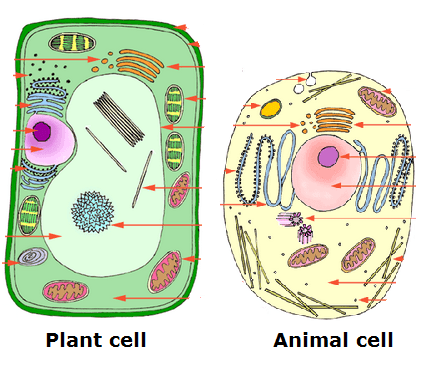
What distinguishes a plant cell from an animal cell? (How do you tell them apart) Hint: There's 3 ways (Check all 3)
Central Vacuole
Mitochondria
Cell Wall
Ribosomes
Chloroplasts
What are all the functions of the nucleus?
Store DNA
Control center of the cell
Makes ATP
Help the cell produce food
What is the function of the vacuole?
To produce energy for the cell
To store water and other nutrients
To store genetic material (DNA)
To give the cell shape and support
Select the 3 parts of Cell Theory.
Cells are the basic unit of life
All living things come from cells
All cells came from pre-existing cells
Cells only divide by meiosis
Which organelle receives proteins and materials from the endoplasmic reticulum, packages them, and distributes them?
lysosomes
golgi apparatus
ribosomes
endoplasmic reticulum
What 4 parts do both Prokaryotic and Eukaryotic cells have?
cytoplasm, DNA, ribosomes, nucleus
cytoplasm, DNA, ribosomes, mitochondria
cytoplasm, DNA, ribosomes, cell/plasma membrane
cytoplasm, DNA, ribosomes, ER

