wayground logo

Free Printable Worksheets

Font size

S
M
L
XL
Worksheets

N3.2 Absorption

Total questions: 20

Worksheet time: 15mins

Name
Class
Date
1.

What system is described by the following words?


Transport, Nutrients, Oxygen, Heart, Blood

a)

Circulatory System

b)

Digestive System

c)

Muscular System

d)

Endocrine System

2.

What system is described by the following words?


Break down, Enzymes, Stomach, Intestines

a)

Circulatory System

b)

Digestive System

c)

Muscular System

d)

Endocrine System

3.

In the alimentary canal, most water is absorbed in the

a)

oesophagus

b)

stomach

c)

small intestine

d)

colon

4.

Numerous fingerlike projections in the folds of the wall of the ileum is classified as

a)

Bolus

b)

Chyme

c)

Bile

d)

Villi

5.

What is the purpose of the villi? (select all that apply)

a)

increase the surface area

b)

chemically break down food

c)

absorb nutrients into the bloodstream

d)

mechanically break down food

6.

Which structure contains microvili?

a)

A

b)

B

c)

C

d)

D

7.

Which structure(s) carry/carries blood to/away the villi?

a)

A

b)

B

c)

C

d)

D

8.

How many villi are shown in the diagram? (input number only)

(a)  

9.

The fat-soluble / lipid-solution nutrients will be absorbed into

a)

structure W

b)

structure Y

c)

structure Z

10.

The water solution nutrients will be absorbed into

a)

structure W

b)

structure Y

c)

structure Z

11.

How many layer(s) of cell is/are there in structure Z?

a)

1

b)

2

c)

3

d)

4

12.

All nutrients are absorbed in the same locations along the small intestine

a)

true

b)

false

13.

Which of the following result in increased surface area on the intestinal wall? (Check all that apply.)

a)

circular folds

b)

villi

c)

microvilli

d)

lymphatic capillaries

e)

spinchters

14.
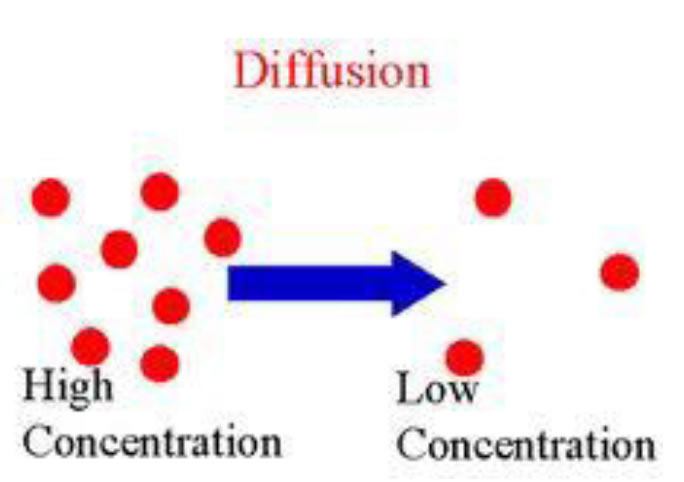
Movement of particles from high to low concentration. 
a)
Passive Transport
b)
Active Transport
15.
What is it called when molecules move across the cell membrane from an area of high concentration to an area of low concentration through a carrier protein?
a)
Diffusion
b)
Osmosis
c)
Active Transport
d)
Facilitated Diffusion
16.
This picture represents what type of cell transport?
a)
endocytosis
b)
exocytosis
c)
osmosis
d)
passive transport
17.
Which is true about active transport?
a)
It requires energy
b)
it does not require energy
c)
It moves substances down the concentration gradient
d)
it moves material from high to low concentration
18.
This cell organelle helps organisms maintain homeostasis by controlling what substances may enter or leave cells.
a)
vacuole
b)
nucleus
c)
cell membrane
d)
cell wall
19.
Cells use energy to move materials across a membrane (low to high concentration).
a)
Active transport
b)
Passive transport
c)
Diffusion
d)
Osmosis
20.
Cell membrane surrounds a particle and encloses it (for large particles)
a)
Endocytosis
b)
Exocytosis
c)
Permeable
d)
In high concentration