wayground logo

Free Printable Worksheets

Font size

S
M
L
XL
Worksheets

GEOGRAPHY TRIAL 1

Total questions: 84

Worksheet time: 14mins

Name
Class
Date
1.

Tourism is

a)

more likely to suffer external shocks

b)

less likely to suffer external shocks.

2.

When times are hard tourism suffers because:

a)

People become scared of terrorist attacks.

b)

Holidays are a high cost purchase.

c)

People would rather not have a 'staycation'

3.

International tourism has been affected negatively by:

a)

Coronavirus

b)

Coronavirus

c)

Coronavirus

d)

Covid-19

4.

What does this image show affecting tourism negatively?

a)

Too much sun

b)

Palm trees are growing too slowly.

c)

Rising sea levels

d)

Swash.

5.

What factor am I describing here that affects tourism over time and space?

a)

Hollywoodisation?

b)

Political uncertainties?

c)

Dark tourism?

d)

International image?

6.

What am I describing here?

a)

Exchange rate fluctuations?

b)

Shopoholicitis?

c)

The lure of Florida?

d)

The 1980s toursit trap?

7.

This picture shows what?

a)

A stratovolcano?

b)

Natural disasters

c)

Natural processes

d)

Natural colours.

8.

Playa del Ingles in Gran Canaria may see tourist numbers decrease due to:

a)

Tenerife being better?

b)

More exciting locations being offered such as Antarctica.

c)

It is difficult to get to.

d)

The weather is not very good.

9.

You may be advised not to travel to the Ukraine because:

a)

There are too many bears.

b)

The food is not very good.

c)

It is too cold.

d)

The political situation is 'tense'

10.

Why is Spain such a popular destination for international tourists?

a)

It has great food

b)

It is close to many rich countries

c)

The climate is very agreeable for tourism

d)

The country offers beaches, mountains, sports, culture and wrinkly potatoes

11.
Which of the following is NOT an element of culture?
a)
Protection & Security
b)
Health & Wellness
c)
Religion
d)
Language
12.
How do you calculate the Rate of Natural Increase for a population?
a)
Birth Rate - Mortality Rate = Overall Growth Rate
b)
Infant Mortality Rate - Birth Rate = Rate of Natural Increase
c)
Birth Rate ÷ 1,000 people per square mile = Population Density
d)
Urban Population - Rural Population = Rate of Natural Increase
13.
Which of the following are possible ways that diffusion can occur?
a)
Migration
b)
Trade Routes
c)
Blending
d)
All of these answers
14.
Which civilization acted as a cultural hearth?
a)
Australia
b)
Spanish
c)
Mesopotamia
d)
Klingon
15.
Why is having an infrastructure necessary for economic success?
a)
It is a tax collected to help educate a country's citizens
b)
Nations need buildings, roads, and services for the economy to run
c)
It helps parliaments decide how to pass laws that rule the economy
d)
Businesses depend on it because it helps determine currency values
16.
Which push or pull factor affects population size?
a)
Better access to cheeses
b)
Luxury cars to purchase
c)
Drought
d)
More cinemas and theaters
17.
Communist governments often turn into this type of government after power struggles occur
a)
Democracy
b)
Monarchy
c)
Oligarchy
d)
Dictatorship
18.
This religion also has an ethnic group attached to it independent of its belief system
a)
Christianity
b)
Judaism
c)
Islam
d)
Hinduism
19.
Which statistic is the best way to determine how healthy a population is?
a)
Death Rate
b)
Population Density
c)
Infant Mortality Rate
d)
Senior Rate
20.
What is the final step that must happen for cultural change to occur?
a)
Diffusion
b)
Innovation
c)
Acculturation
d)
Conversion
21.
Hinduism is which type of religion?
a)
Monotheistic
b)
Polytheistic
c)
Animistic 
d)
Reijistic
22.
What is the fertility rate needed to keep the population stable?
a)
0
b)
1
c)
2
d)
3
23.
A population pyramid shows:
a)
Population distribution for age and sex of an area
b)
Population distribution for land area
c)
Population distribution per capita level
d)
Population distribution for age of population
24.
What is the most heavily populated region on the planet?
a)
Southern Latin America
b)
Western Europe
c)
South Asia
d)
Sub-Saharan Africa
25.
Would a traditional economic system work well in a large area like Chicago?
a)
Yes
b)
No
26.
In a command economy, which group controls the means of production?
a)
Businesses
b)
Citizens
c)
Governments
d)
Arbiters 
27.
What factors control economic success in a market economy
a)
Government regulations
b)
Banking and loans
c)
Demands of consumers
d)
Taxation
28.
The most developed countries in the world have reached this level of economic activity:
a)
Primary
b)
Secondary 
c)
Tertiary
d)
Quaternary
29.
From an economic standpoint, what is the criteria for a material to be considered a natural resource?
a)
It must be inexhaustable
b)
It must be fireproof
c)
It must be used to create value
d)
It must be destructible
30.
Which of the following are characteristics of economically developing nations?
a)
Low GDP
b)
Limited economic activity
c)
Residents struggle to provide basic needs
d)
All of these answers
31.
If the American company of Nike manufactures shoes in another country, the manufacturing company counts that as part of their...
a)
GNP
b)
GDP
c)
PPP
d)
AVP
32.
The number of live births per total population, often expressed per thousand population
a)
death rate
b)
birthrate
c)
mortality rate
d)
population increase rate
33.
The average number of children a woman of childbearing years would have in her lifetime, if she had children at the current rate for her country
a)
birthrate
b)
infant birth rate
c)
rate of natural increase
d)
fertility rate
34.
The number of deaths among infants under age one as measured per thousand live births
a)
infant mortality rate
b)
death rate
c)
rate of natural decrease
d)
carrying capacity
35.
The number of deaths per thousand
a)
rate of natural decrease
b)
carrying capacity
c)
mortality rate
d)
population density
36.
The rate at which population is growing, found by subtracting the mortality rate from the birthrate. (Also called population growth rate.)
a)
population density
b)
rate of natural increase
c)
pull rate
d)
push rate
37.
A graphic device that shows gender and age distribution of a population
a)
population pyramid
b)
carrying capacity
c)
population density
d)
population map
38.
A factor that causes people to leave their homelands and migrate to another region
a)
push factor
b)
pull factor
39.
A factor that draws or attracts people to another location
a)
push factor
b)
pull factor
40.
The average number of people who live in a measurable area, reached by dividing the number of inhabitants in an area by the amount of land they occupy
a)
carrying capacity
b)
GDP
c)
population density
d)
GNP
41.
The number of organisms a piece of land can support without negative effects
a)
population threshold
b)
habitable land
c)
uninhabitable land
d)
carrying capacity
42.
The UN is an example of what?
a)
Alliance
b)
Multinational state
c)
Confederation
d)
Supranational organization
43.
A state with only one nation within its borders
a)
Stateless-Nation
b)
Nation-State
c)
Ethnocentric Nation
d)
Statehood
44.
a state that contains more than one ethnicity.
a)
United States
b)
Multi-Cultural State
c)
Multi-Ethnic State
d)
Nation-State
45.
a sovereign state that comprises a town and the surrounding countryside.
a)
Nation-State
b)
City-State
c)
Stateless Nation
d)
National State
46.
A region where boundaries are very thinly or weakly developed, zones where territoriality is unclear and not well established.
a)
Frontier
b)
Shatterbelt
c)
Buffer State
d)
Satellite State
47.
Extreme patriotism or love for one's country.
a)
Pride
b)
Nationalism
c)
Patriotism
d)
Power
48.
NAFTA is way of avoiding conflict in North America by eliminating _________ & _________. 
a)
tariffs, dictators
b)
tariffs, quotas
c)
quotas, sales tax
d)
quotas, income tax
49.
Boundaries established by rivers, oceans, deserts, mountains, etc. 
a)
Political boundaries
b)
Physical boundaries
c)
Cultural boundaries
d)
Geographic boundaries
50.
The Sahara desert and Himalayan mountains are examples of which type of boundary?
a)
Physical
b)
Cultural
c)
Boundaries
51.
A state that encompasses a very small land area
a)
Island state
b)
Megastate
c)
Ministate
d)
Microstate
52.
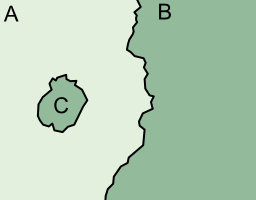
In this image if C belongs to B it is considered a ___________ of country B and a _______ of country A
a)
core, periphery
b)
enclave, exclave
c)
exclave, enclave
d)
heartland, periphery
53.
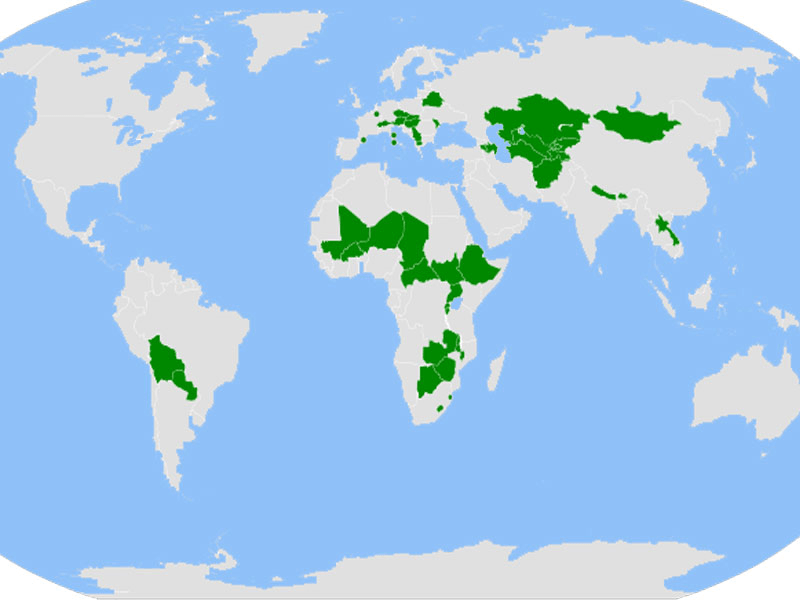
Which characteristic do all the nations seen here share?
a)
All are compact
b)
All are landlocked
c)
All are federal states
d)
All are members of OPEC
54.
Which type of boundary would use lines of latitude and longitude?
a)
Antecedent
b)
Subsequent
c)
Geometric
d)
Relic
55.
A nationality is
a)
a group of people tied to a place through legal status and tradition.
b)
a country.
c)
any cohesive group of people.
d)
a group with shared religion, language, and origin of birth.
56.
Denmark is a good example of a nation-state because
a)
nearly all Danes speak Danish and live in Denmark.
b)
Danish and German nationalities intermingle in Schleswig-Holstein.
c)
the people living on the Faeroe islands, which are controlled by Denmark, speak Faeroese.
d)
Denmark consolidated its boundaries by giving Greenland to Norway.
57.
Which of the following is not a strong centripetal force in the United States?
a)
network television
b)
the flag
c)
the many ethnic groups living in the United States
d)
"The Star Spangled Banner"
58.
What is the military alliance set up by West Europe and the US to align against communism?
a)
NATO
b)
UNHCR
c)
Warsaw Pact
d)
NAFTA
59.
How many states must be involved to make an organization Supranational?
a)
1
b)
2
c)
3
d)
0
60.
Citizens in a totalitarian government would experience -
a)
  multiple political parties
b)
censorship, religious laws, and repression
c)
  a written constitution
d)
  direct elections for every governmental decision
61.
A theocratic government is often characterized by—
a)
the existence of multiple political parties
b)
censorship, religious laws, and repression
c)
a written constitution
d)
direct elections for governmental decisions
62.
Which of the following is NOT a factor that determines the political power of a country?
a)
the strength of the economy
b)
the size of its army
c)
the stability of the government
d)
the official language of the country
63.
This person is in charge of what type of government?
a)
Democracy
b)
Theocracy
c)
Dictatorship
d)
Oligarchy
64.
The study of human political organization of the Earth
a)
Cultural Geography
b)
Ethnography
c)
Deography
d)
Political Geography
65.
Coal, oil, and natural gas are all examples of  
a)
A.  alternative energy sources. 
b)
 B.  capital resources.
c)
C.  fossil fuels. 
d)
 D.  renewable resources.
66.
Hydroelectric power is generated by: 
a)
 coal power plants
b)
nuclear reactors
c)
rivers and waterfalls
d)
windmills.
67.
Sally’s ability to operate a beauty salon successfully is an example of a ___ resource.  
a)
capital 
b)
natural 
c)
human 
d)
renewable
68.
Which of the following is an example of unskilled labor?
a)
building inspector
b)
computer technician
c)
dishwasher
d)
plumber
69.
A ___ engages in tertiary economic activity.  
a)
carpenter 
b)
lumberjack 
c)
orange grower 
d)
police officer  
70.
 How are natural resources distributed throughout the world?    
a)
 Natural resources are spread out unevenly around the earth.
b)
Most natural resources lie beneath the ocean floor.
c)
Most natural resources are found in developed nations. 
d)
 Natural resources are distributed evenly among all nations. 
71.
A country with a mostly rural population engaged in mainly primary economic activities is probably a  
a)
developing nation. 
b)
 developed nation.
c)
industrialized nation. 
d)
primary nation.
72.
 Which of the following is NOT an indicator of a nation’s economic development?  
a)
labor force characteristics
b)
major religions 
c)
 urban/rural ratio  
d)
educational achievement 
73.
The Organization of Petroleum Exporting Countries (OPEC) was created to    
a)
 control the supply and price of oil
b)
improve transportation in developing nations
c)
 promote the production of high-quality fossil fuels.
d)
limit the access of nations to solar power
74.
The ___ level of economic activity is represented in this photograph. 
a)
Tertiary
b)
Primary
c)
Quaternary
d)
Secondary
75.
Which of the following is NOT primarily an economic union?   
a)
Organization of Petroleum Exporting Countries (OPEC) 
b)
 North American Free Trade Agreement (NAFTA) 
c)
United Nations (UN)
d)
European Union (EU)
76.
·  Access to larger markets
· More efficient industries
·Greater influence on world market
 

The items listed above are some 

a)
effects of unequal distribution of resources.
b)
advantages of economic unions.
c)
 advantages of local spatial divisions. 
d)
 indicators of the quality of life in rural areas.
77.
 Which of the following is NOT a disadvantage of economic unions? 
a)
less restricted access to natural, human, and capital resources. 
b)
concentration of some industries in certain countries
c)
closing of some industries
d)
agribusiness replacing family farms
78.
 Which region of the world produces the greatest amount of petroleum?  
a)
 Asia and Oceania
b)
Southwest Asia
c)
United States and Canada
d)
Europe
79.
How long a person is expected to live is called what....
a)
labor
b)
high GDP
c)
life expectancy
d)
low GDP
80.
What is the word for the number of people who can read and write in a country
a)
income
b)
literacy rate
c)
life expectancy
d)
free enterprise
81.
What is the total value of goods and services produced by a country
a)
Gross Product Domestic
b)
Domestic Gross Product
c)
Product Gross Domestic
d)
Gross Domestic Product
82.
Jaylynn has opened a restaurant serving strawberry desserts. Tien and Marcela are security guards at the restaurant. What business sector are they all apart of?
a)
Tertiary
b)
Primary
c)
Quartinary
d)
Secondary
83.
Blake and Herman have opened a very successful furniture making factory. They are apart of which business sector?
a)
Secondary
b)
Tertiary
c)
Primary
d)
Quartinary
84.
Which of the following factors influence productivity. economic growth, and the future standard of living for a nation? 
a)
Investment in factories
b)
 Health, education and training of people
c)
Machinery and new Technology
d)
All of the above