
 Worksheets
Year 7 Big Fat Quiz of the Year
Total questions: 82
Worksheet time: 50mins

The scientists who study celestial objects are known as...
Astrologers
Astronomers
Astroturf
Celestial Scientists

The last four planets in our solar system are known as...
Gas Giants
Gas Guzzlers
Planetoidal Monoliths
Mega-Planets

This picture shows...
Impact craters on the Sun
Impact craters on the Moon
Impact craters on the Earth
Abstract art

They orbit around the sun and don't give off their own light. What are they?
Moons
Fruits
Blinging rings
Planets

Choose the right name of the magnet below.
Cylinder magnet
Bar magnet
Horseshoe magnet
Ring magnet

Based on this picture,tick two things use magnets.
door
door holder
board game ( chess )
table
Choose the object that can be attracted to magnets.
nail
book
rubber
matchstick
compass
magnetic field

Student 1: Cell 1 is a plant cell because it has a cell wall
Student 2: Cell 2 is an animal cell because it has a nucleus
Student 3: Cell 1 is a plant cell because it has chloroplasts
Student 4: Cell 2 is an animal cell because it has a cell membrane
Who is correct?
The student conducted an experiment with circuits. Why was the bulb bright when he closed the switch?
The switch produced an electric current
Closing the switch broke the circuit
Closing the switch completed the circuit
The switch did not make a difference
______________ are characteristics that distinguishes one organism from another organism.
Traits
Genes
Descriptions
Chromosomes
Inside of the nucleus there are threadlike structures that contain genetic information from both parent cells that control the organisms traits. Those threadlike structures are called ______________.
Memory Log
Gene
Chromosome
Nucleic Acid
What is a set of an organisms observable traits that CAN change during the organism's lifetime due to age and environmental change?
Phenotype
Genotype
Traits
DNA
The Zygote is........
the process of the egg cell and sperm cell joining together.
the female sex cell that is formed in the ovary.
the male sex cell that is formed in the testis.
the new cell that is formed due to fertilization.
How many chromosome pairs do you have?
11.5
21
23
46
Which of the following is a gene?
a change in DNA
a segment in DNA
a complete set of traits
something we can see
If a tree falls in a forest and no one is there to hear it, does it make a sound?
No, because the molecules vibrating will not reach our ears.
Yes, because sound is caused by vibrations. A tree falling would make a BIG vibration and cause sound waves to travel through the forest.
A change in the DNA code of a gene is classified as a _____________________.
Environmental Influece
Chromosomal Change
Natural Alteration
Mutation
Which form of energy travels faster than anything in the universe?
electrical energy
sound energy
heat energy
light energy
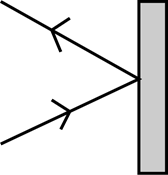
In the illustration, the light ray striking the object is-
When sound bounces of a hard surface and is heard again, it is called ... ?
Annoying
An echo
A rebound
A reflection
We can use echolocation and measuring the time taken for an echo to return to find the ... ?
Distance from a surface/object.
Find my friend Mr. Bat.
Biggest shoal of fish.
How deep the ocean is.
Genes contain genetic
Cells
Traits
Traitors
Cytoplasm
Why is a slinky useful when modelling sound waves?
It shows the particles moving to and fro, but returning back to their original location.
It is fun.
It shows vibrations of particles with each loop.
It shows air moving forwards from the source of the sound.

What does this symbol represent?
A variable resistor
A Voltmeter
A Motor
A Light dependent resistor

What is wrong with this circuit diagram?
There is only one cell
The lamp won't light
The cell is the wrong way around
The ammeter should be connected in series
How many planets do we have in our solar system?
9
8
7
6


The ______ is the center of our solar system.
Sky
Earth
Sun
Moon
compass
magnetic field
Choose all of the examples of a non-contact force:
Elija todos los ejemplos de una fuerza sin contacto:
Gravity
Tennis
Magnetism
Fluid Friction

If the North Pole of a permanent magnet is placed next to a compass as seen in the picture, which direction will the needle move?
Si el Polo Norte de un imán permanente se coloca junto a una brújula como se ve en la imagen, ¿en qué dirección se moverá la aguja?
To the right (away from the magnet)
A la derecha (lejos del imán)
To the left (towards the magnet)
A la izquierda (hacia el imán)
It will not move
No se moverá
Need more information
Necesitas más información
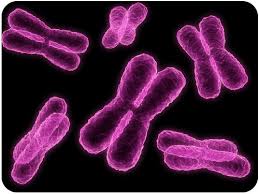
A normal human cell contains how many chromosomes?
16
26
46
14

What happens when two north poles of a magnet are placed together?
¿Qué sucede cuando dos polos norte de un imán se colocan juntos?
they repel (push away)
se repelen (se alejan)
they attract (pull together)
se atraen
they cancel each other out
se cancelan mutuamente
the strength of the magnet is doubled
la fuerza del imán se duplica
Magnets have a north and a south ___________
Los imanes tienen un norte y un sur ___________
shape
color
pole
region
Definition of a solid:
definite shape and definite volume
indefinite shape and definite volume
indefinite shape and indefinite volume
definite shape and indefinite volume
What happens as liquid iron cools?
The atoms slow down and move further apart
The atoms speed up and move further apart
The atoms slow down and move closer together
The atoms speed up and move closer together
Which of the following is true as you go from a solid to a gas?
The atoms decrease in speed
The atoms move closer together
The atoms increase in speed
The atoms do not change
What happens to dew as it evaporates in the sun?
It loses heat and becomes a gas
It gains heat and becomes a gas
It loses heat and becomes a liquid
It gains heat and becomes a liquid
Which of the following takes the shape of its container? Mark all that apply.
solid
liquid
gas
Solid to gas:
deposition
sublimation
condensation
evaporation

What is the reading on voltmeter V1 if the reading on V2 = 9Vand V3 = 3V?
27V
3V
9V
12V

The ratings for four typical domestic appliance fuses are 3A, 5A, 8A and 13A. Which fuse wires will melt if a current of 9A is passed through them?
3A, 5A, 8A and 13A
3A, 5A and 8A only
3A only
3A and 5A only
What is resistance?
An increase in voltage
Opposition to current
Energy from battery
An increase in current
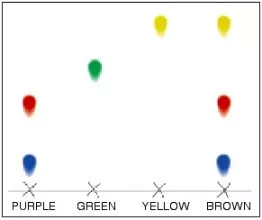
which of the following materials are best used as insulators?
Wood
Rubber
Metal
Plastic

Ink can be separated by a method of -----------------------------------------------
distillation
filtration
chromatography
sedimentation

PH scale
pH ruler
pH scale
pH statistical tables
If air gets warmer the particles spread out more. This means sound travels more slowly through it.
True.
False.
Not enough information.
Sound is ... ?
Particles bumping into each other
Waves of energy travelling from one place to another
The vibration of particles
All the above.
What colour does litmus paper turn when added to an alkali?
Blue
Red
Green
Colourless

