
 Worksheets
Yr 7 Classification Wk2 Review
Total questions: 20
Worksheet time: 19mins
Name
Class
Date
1.

You would find mushrooms in which kingdom?
a)
Plantae
b)
Protists
c)
Fungi
d)
Animalia
2.
The scientific name for an organism is made from the:
a)
class and family name
b)
genus and species name
c)
domain and kingdom name
d)
kingdom and phylum name
3.

The 8 levels of classification, most broad to most specific.
a)
Domain, Genus, Family, Order, Class, Phylum, Kingdom, Species
b)
Domain, Species, Kingdom, Genus, Phylum, Family, Class, Order
c)
Domain, Kingdom, Phylum, Class, Order, Family, Genus, Species
d)
Order, Kingdom, Species, Domain, Phylum, Family, Class, Genus
4.
What are the three domains?
a)
Archaea, Bacteria, and Eubacteria
b)
Archaea, Protists, and Eubacteria
c)
Archaea, Bacteria, and Eukarya
d)
Archaea, Fungi, Animalia
5.
Which of the following organisms are MOST closely related?
a)
organisms that share a domain
b)
organisms that share a family
c)
organisms that share a genus
d)
organisms that share an order
6.
What is the most specific level of classification?
a)
Family
b)
Domain
c)
Species
d)
Carolus Linnaeus
7.
Why do scientists group organisms using the Linnean system (genus and species) rather than by their common names?
a)
Latin words are easier to read
b)
The common name can change depending on the region (example: mountain lion, cougar, and puma are the same species)
c)
The scientific name sounds more official
8.
Taxonomy is the study of plants
a)
True
b)
False
9.
The modern Biological classification system is based on the pioneering work of:
a)
Carl Linnaeus
b)
Isaac Newton
c)
Charles Darwin
d)
John Meritus
10.
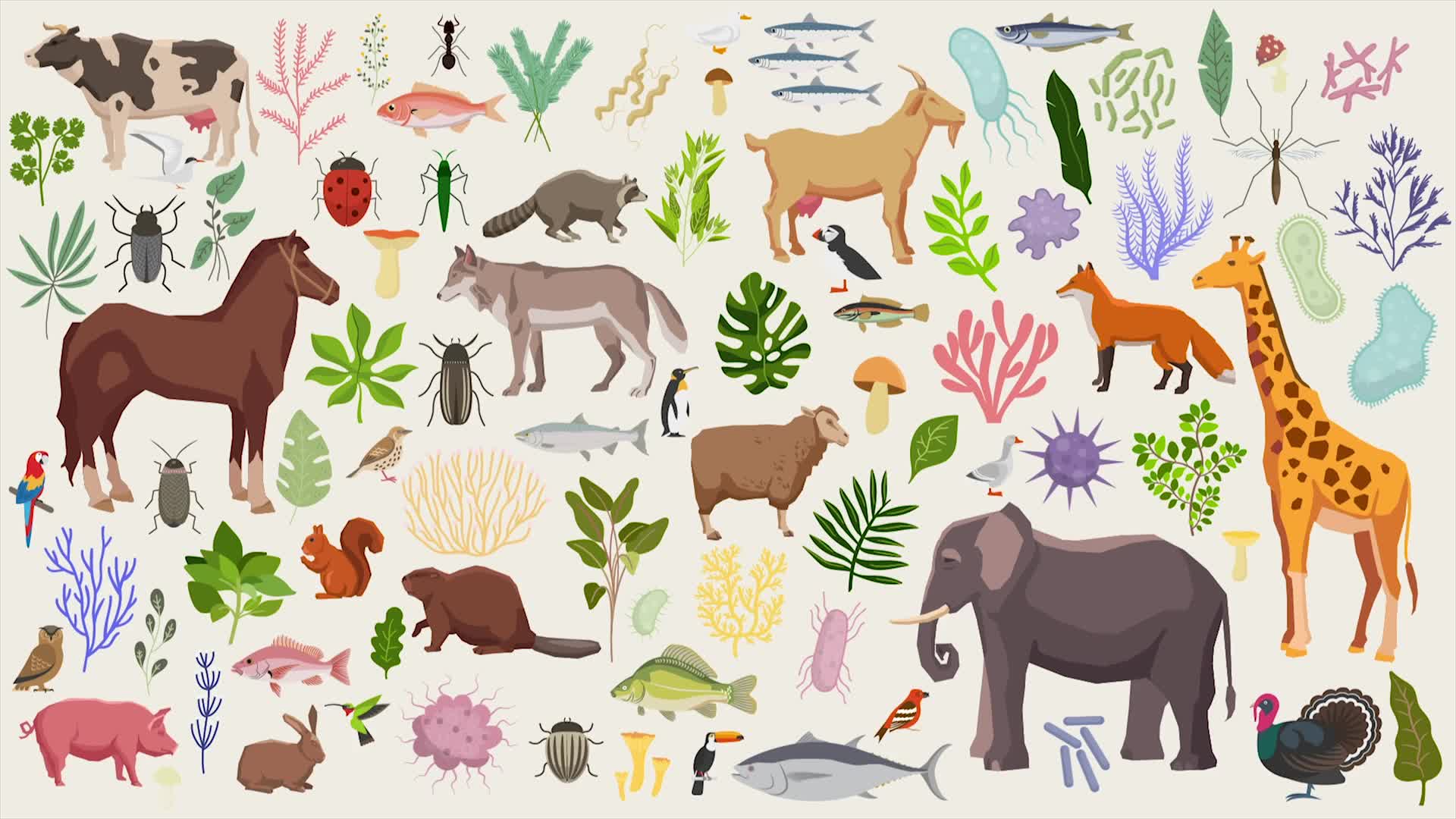
To sort an organism into a group based on shared traits is called __________.
a)
Domains
b)
Taxonomy
c)
Genetics
d)
Classification
11.

Organisms in the same phylum are more alike than organisms in the same class.
a)
TRUE
b)
FALSE
12.

A scientific name consists of a ___________.
a)
domain and kingdom
b)
phylum and class
c)
family and order
d)
genus and species
13.

An organism in the United States has the same scientific name as it does in China.
a)
TRUE
b)
FALSE
14.
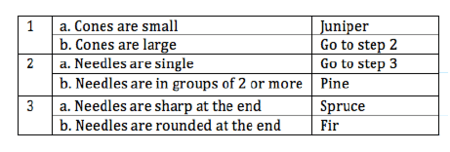
A dichotomous key for trees is provided. Hikers found a tree that has large brown cones and single sharp needles. What species of tree have the hikers found?
a)
Juniper
b)
Pine
c)
Spruce
d)
Fir
15.

A dichotomous key for insects is given. To what order does an insect with two pairs of scaly wings belong?
a)
Coleoptera
b)
Heteroptera
c)
Diptera
d)
Lepidoptera
16.
What step do we always start with when using dichotomous keys?
a)
1
b)
2
c)
3
d)
4
17.
When using a dichotomous key to identify organisms, what do we look at?
a)
physical features
b)
weather patterns
c)
environment
d)
diet
18.
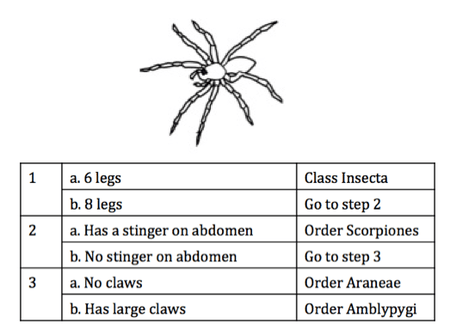
An illustration and a dichotomous key are given. What is the correct classification for this organism?
a)
Class Insecta
b)
Order Amblygygi
c)
Order Araneae
d)
Order Scorpiones
19.
A botanist discovers a new plant in the jungle. Which of the
following observations of the plant’s characteristics would be useful in determining its identity with a dichotomous key?
following observations of the plant’s characteristics would be useful in determining its identity with a dichotomous key?
a)
It was discovered in the summertime
b)
It is wet from a recent rain storm.
c)
Its leaves curl up on the edges.
d)
It is eaten by native jungle ants.
20.
Which of the following characteristics will most likely be helpful in identifying a butterfly using a dichotomous key?
a)
It migrates north in the summer
b)
It has long tail
c)
It likes only certain plants
d)
Its wings beat very fast in hot weather
100 %

