wayground logo

Free Printable Worksheets

NEW

Font size

S
M
L
XL
Worksheets

Materials and Change

Total questions: 20

Worksheet time: 11mins
Name
Class
Date
1.
What is a solvent
a)
the liquid in which a solute is dissolved to form a solution.
b)
Another word for solution
c)
A thing that make drinks turn colors
d)
Its a metal molecole
2.
Solution where more solute can still be dissolved at the given temperature. 
a)
Saturated
b)
Unsaturated
c)
Mixture
d)
Homogeneous solution
3.
If I dissolve carbon dioxide in water, what is my solvent?
a)
Carbon Dioxide
b)
There is no solvent
c)
Oxygen
d)
Water
4.

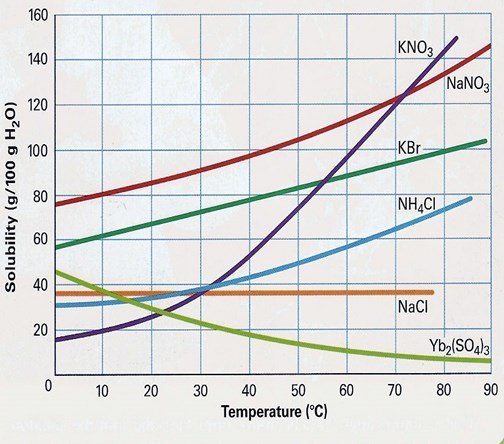
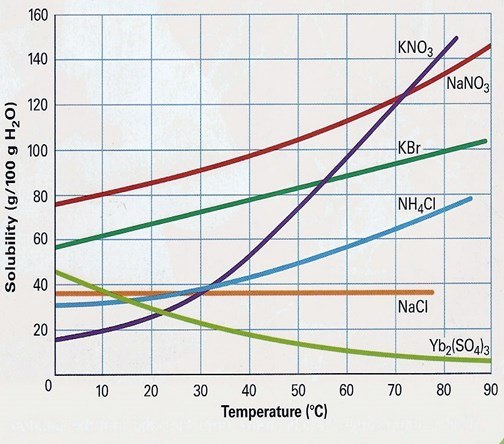
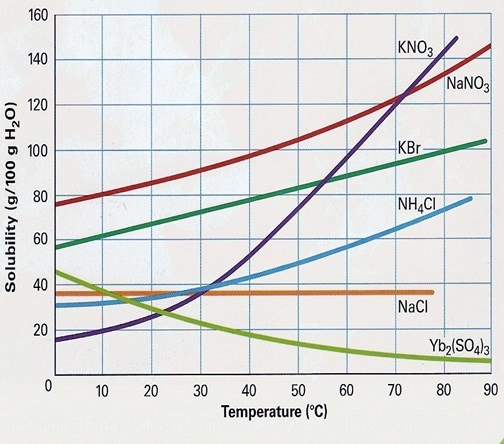
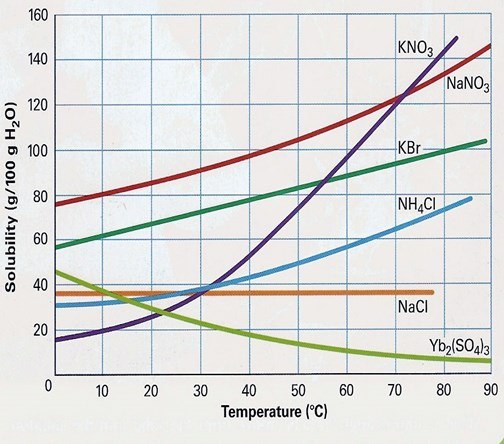
At 30'C, which substance has the lowest solubility?

a)

KNO3

b)

KBr

c)

NaCl

d)

Yb2(SO4)3

5.

At which temperature do KBr and KNO3 have the same solubility?

a)

60

b)

55

c)

50

d)

Never

6.

At 10'C, NaNO3's solubility is 80 g/100 g of H2O. Based on this information, what would the solubility be in 50 g of H2O.

a)

40

b)

80

c)

160

d)

16

7.

Identify how many grams of KNO3 is required to make a saturated solution at 40'C.

a)

50 g

b)

45 g

c)

60 g

d)

33 g

8.

Identify a method to decrease the dissolving rate of a solution:

a)

decrease the temperature

b)

add KE

c)

stir the solution

d)

increase the temperature

9.

Two substances combine into 1 substance.

a)

Synthesis

b)

Decomposition

c)

Single Replacement

d)

Double Replacement

10.

One substance breaks down into two or more substances.

a)

Synthesis

b)

Decomposition

c)

Single Replacement

d)

Double Replacement

11.
the starting materials in a chemical reaction
a)
Products
b)
Reactants
c)
Starters
d)
Enders
12.
a substance that is formed as the result of a chemical reaction
a)
Product 
b)
Reactant
c)
Starters
d)
Enders
13.
a substance formed when two or more elements are chemically bonded together
a)
Element Soup
b)
Pure Element
c)
Ion
d)
Compound
14.
tells us the number of atoms of each element in a compound
a)
Coeffecient
b)
Exponent
c)
Chemical Formula
d)
Calculator
15.
the symbolic representation of a chemical reaction
a)
Long Hand
b)
Short Hand
c)
Electron Configuration
d)
Chemical Equation
16.
a process or reaction in which the system absorbs energy from its surroundings; usually, but not always, in the form of heat
a)
Endothermic Reaction
b)
Exothermic Reaction
c)
Diffusion
d)
Fission
17.
a chemical reaction that releases energy by light or heat
a)
Endothermic Reaction
b)
Exothermic Reaction
c)
Diffusion
d)
Fission
18.
Provides evidence that a chemical reaction has occurred. 
a)
dissolving 
b)
melting
c)
formation of a gas
d)
bending
19.
A metal is reacted with an acid to produce a salt and a hydrogen gas. What type of reaction has occurred? 
a)
neutralization 
b)
double replacement 
c)
single replacement 
d)
synthesis 
20.

Fill in the blank. (Copper has a charge of 2+)

Cu+ AgNO3 → Ag + _____

a)

Cu(NO3)2

b)

CuNO3

c)

CuAg

d)

Cu