
 Worksheets
Reflection, Refraction, Diffraction, Resonance
Total questions: 25
Worksheet time: 21mins
change in speed of a wave
change in amplitude of a wave
change in frequency of a wave


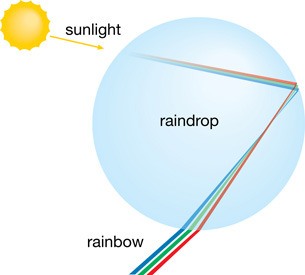
Why does white light from the sun form a colorful rainbow when it passes through water droplets in the atmosphere?
The droplets of water in the air have different densities
Different-sized water droplets refract white light at different angles
The colors that make up white light refract at different angles
White light diffracts when it encounters water

What is the main difference between refraction and diffraction?
Refraction is a phenomenon that affects light; diffraction is a phenomenon that affects sound.
Refraction involves the bending of light; diffraction involves the bending and spreading of light, usually around an obstacle.
Refraction usually happens in the atmosphere; diffraction usually happens closer to the earth's surface.
Refraction involves changes to the density of light; diffraction involves changes to the speed of light.

When light hits an area and bounces back it is called:
echo
refraction
reflection
absorbing

Refraction is when light__________.
Is bounced by an object or material.
Changes speed as it travels in different materials which causes bending.
When light speeds up to over 300,000 km/s
The substance that a wave is passing through
medium
frequency
wavelength
gravy

Sonar and echolocation use ----- to detect objects under water.
Refraction
Reflection

What type of interference is being shown in the picture?
Constructive
Destructive

What type of interference is occurring in the picture?
Constructive
Destructive
When 2 waves meet and create a bigger wave
Constructive Interference
Destructive Interference
When two waves meet and create a smaller wave
Constructive
Destructive


Standing waves are created by
Two identical waves reflecting off each other
Two identical waves being diffracted together
Two identical waves move through each other in opposite directions
Two identical waves are diffracted from two identical sources
In the diagram which letters represent the nodes
A B C
A C E
B D
B D E
A C D


Natural frequency is best described as
the frequency at which an object naturally vibrates at when it is disturbed
a vibration that can be heard in the wild
the radio frequency that astronauts naturally use when travelling into space
the material used to make a swing
How can resonance break an object?
forcing an object to vibrate at its natural frequency for a short time
forcing an object to vibrate at different frequencies for a short time
forcing an object to vibrate at different frequencies for a longtime
forcing an object to vibrate at its natural frequency for a long time

If you are a supervillain, which of the following statements is true?
We want bridges to resonate at their natural frequency to collapse.
We do not want bridges to resonate at their natural frequency to remain functional.

