wayground logo

Free Printable Worksheets

NEW

Font size

S
M
L
XL
Worksheets

Dichotomous Keys

Total questions: 20

Worksheet time: 25mins
Name
Class
Date
1.
What is the purpose of a dichotomous key?
a)
to find a common ancestor
b)
to show the evolution of organisms
c)
to show relationships between organisms
d)
to identify organisms
2.
What step do we always start with when using dichotomous keys?
a)
1
b)
2
c)
3
d)
4
3.
When using a dichotomous key to identify organisms, what do we look at?
a)
physical features
b)
weather patterns
c)
environment
d)
diet
4.
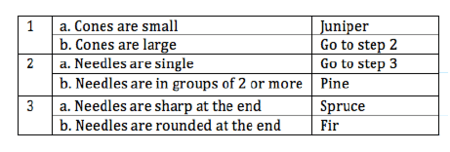
A dichotomous key for trees is provided. Hikers found a tree that has large brown cones and single sharp needles. What species of tree have the hikers found?
a)
Juniper
b)
Pine
c)
Spruce
d)
Fir
5.
A dichotomous key for insects is given. To what order does an insect with two pairs of scaly wings belong?
a)
Coleoptera
b)
Heteroptera
c)
Diptera
d)
Lepidoptera
6.

How many options should every branch in a dichotomous key have?

a)

1

b)

2

c)

3

d)

4

7.
Term given to describe the 2 name naming system is:
a)
dichotmous key
b)
binomial nomenclature
c)
2 scientific names
d)
binomial key
8.
The first part of a scientific name is an organism's _______________ and the second part is its ________________.
a)
species, genus
b)
phylum, order
c)
class, spices
d)
genus, species
9.
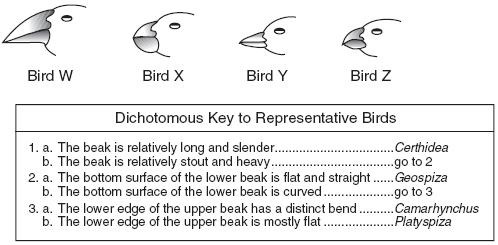
What is the name of bird Z?
a)
Certhidea
b)
Geospiza
c)
Camarhynchus
d)
Platyspiza
10.
A student discovers an arachnid with a segmented abdomen, long legs, and a tail with no stinger. The student uses the dichotomous key below to identify it. Which arachnid has the student found?
a)
Whip Scorpion
b)
Wind Scorpion
c)
Daddy long legs
d)
Scorpion
11.
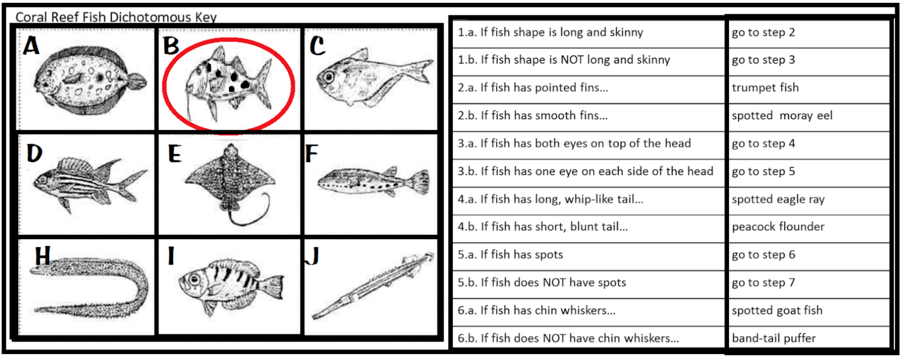
Using this dichotomous key, identity the name of the circled fish.
a)
band-tail puffer
b)
spotted goat fish
c)
peacock flounder
d)
trumpet fish
12.

Leaf S (3RD LEAF)

a)

Eastern white pine

b)

balsam poplar

c)

sweet gum

d)

ginko

13.
Who is considered to be the father of traditional classification?
a)
Gregor Mendel
b)
Robert Hooke
c)
Francis Crick
d)
Carolus Linnaeus
14.

The largest grouping of organisms is ____________________ and the smallest is _________________________________.

a)

Domain, species

b)

Domain, kingdom

c)

Species, domain

d)

Kingdom, species

15.

What is a dichotomous key?

a)

A tool for classifying organisms based on their physical traits

b)

A map for finding animal habitats

c)

A key that opens a scientist's laboratory

16.
What should you do when typing a scientific name?
a)
Capitalize the first word
b)
Capitalize the first word and underline the whole thing
c)
Capitalize the first word and italicize the whole thing
d)
Nothing
17.

Identify leaf F

a)

Cydonia

b)

Magnolia

c)

Aesculus

d)

Fraxinus

e)

Ilex

18.

A student discovers an arachnid with a segmented abdomen, long legs, and a tail with no stinger.

The student uses the dichotomous key below to identify it.

1. a) Abdomen segmented.............go to 2

b) Abdomen not segmented ......go to 4

2. a) Abdomen with tail....................go to 3

b) Abdomen without tail...............go to 5

3. a) Tail with stinger..........................Scorpion

b) Tail without stinger.....................Whip scorpion

4. a) Legs longer than body.............Daddy Long Legs

b) Legs not longer than body……….Wind scorpion

5. a) Covered with spines .......................Mite

b) Few spines.....................................Tick

a)

Whip Scorpion

b)

Daddy Long Legs

c)

Mite

d)

Tick

19.

Which leaf is shown in the drawing?

a)

Magnolia

b)

Redbud

c)

Sweetgum

d)

None of the above

20.

According to key above, which animal has wings covered by an exoskeleton and a round body?

a)

Ladybug

b)

Grasshopper

c)

Dragonfly

d)

Housefly