Wayground logo

Free Printable Worksheets

Font size

S
M
L
XL
Worksheets

Relative Dating

Total questions: 23

Worksheet time: 30mins
Name
Class
Date
1.
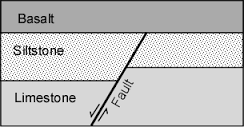
What are the relative ages of the features in order from oldest to youngest?
a)
Limestone, Basalt, Fault, Siltstone
b)
Siltstone, Fault, Basalt, Limestone
c)
Limestone, Fault, Basalt, Siltstone
d)
Limestone, Siltstone, Fault, Basalt
2.
Which of the following is the oldest?
a)
Layer L
b)
Intrusion D
c)
Intrusion H
d)
Layer E
3.
Which of the following correctly lists the layers in order from oldest to youngest?
a)
A, B, C, D, E
b)
E, B, C, D, A
c)
E, D, C, B, A
d)
C, B, A, D, E
4.

Which layer is OLDER? Fault E or Intrusion D?

a)

Fault E

b)

Intrusion D

5.
Used to determine whether an object is older or younger than other objects
a)
Superposition
b)
Relative Dating
c)
Fossil
d)
Unconformity
6.

Which layer is OLDER? Intrusion M or Layer D?

a)

Intrusion M

b)

Layer D

7.
The best index fossils have which two traits?
a)
widespread geographically, long lifespan
b)
widespread geographically, short lifespan
c)
specific place, long lifespan
d)
specific place, short lifespan
8.
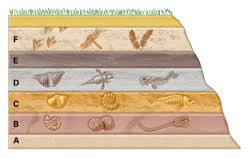
Which rock layer contains the newest fossils?
a)
F
b)
E
c)
B
d)
C
9.
Which fossil makes the best index fossil?
a)
Fossil 1
b)
Fossil 2
c)
Fossil 3
d)
None follow all of the rules
10.

What is the best reason that fossil #4 is NOT a good index fossil?

a)

It is not widespread

b)

it is not short-lived (in numerous layers)

c)

It is in half of the outcrops

11.

Which fossil makes the best index fossil?

a)

ammonite

b)

brachiopod

c)

trilobite

d)

shark

e)

all four are good index fossils

12.
Analyze the seashell found in the white layer.  Which statement is true of the rock layer that contains this fossil?
a)
It could also contain a fossil from the bottom layer.
b)
It is older than the layers below it.
c)
It is younger than the layers above it.
d)
It is older than the layers above it.
13.
The Law of Superposition helps scientists to determine what?
a)
The absolute age of rock layers
b)
The age of fossils
c)
The relative age of rock layers
d)
the super powers of rocks
14.

Which of the following can be learned by using the fossil record?

a)

When organisms changed or evolved

b)

when organisms appeared on Earth

c)

when organisms became extinct

d)

All the above

15.

What part of an organism is most likely to become a fossil?

a)

heart

b)

bones

c)

skin

16.
States that younger rocks lie above older rocks if the layers have not been disturbed
a)
Law of crosscutting
b)
Law of superposition
c)
Relative Dating
d)
Unconformity
17.
How does the law of crosscutting explain the age of a fault?
a)
The fault is younger than the rocks above it.
b)
The fault is younger than the rocks it cuts through.
c)
The fault is older than the rocks above it.
d)
The fault is older than the rocks it cuts through.
18.
Used to determine whether an object is older or younger than other objects
a)
Superposition
b)
Relative Dating
c)
Fossil
d)
Unconformity
19.
Traces or remains of organisms that lived long ago
a)
Fossil
b)
Unconformity
c)
Superposition
d)
Column
20.
How have the rocks been disturbed?
a)
tilting
b)
folding
c)
faulting
d)
igneous intrusion
21.

Layer B on side #1 (left) is a match to which layer on side #2 (right)?

a)

z

b)

y

c)

w

d)

there is no match

22.

The diagram below represents a stack of rock layers. These layers have not changed position since they formed. If the age of layer 4 is 400 million years and the age of layer 1 is 500 million years, then the age of Layer 2 is

a)

younger than 400 million years.

b)

400 million years.

c)

older than 500 million years.

d)

between 400 million and 500 million years.

23.

What do you call a crack in the Earth's surface where Earthquake is generated?

a)

CRUST

b)

TYPHOON

c)

FAULT

d)

EPICENTER