
NEW
Font size
 Worksheets
F4 PHY CHAPTER 4 HEAT
Total questions: 15
Worksheet time: 22mins

Which material heats up quickest?
Aluminium
Concrete
Diamond
Glass
Water

Which material heats up slowest?
Aluminium
Concrete
Diamond
Glass
Water
Which of the following best explains why the sand at the beach is hotter than the water?
Sand has a higher specific heat than water.
Sand has a lower specific heat than water.
There is more water than sand at the beach.
There is more sand than water at the beach.
The SI units J kg-1°C-1 measures
Specific heat capacity
Heat capacity
temperature
heat energy
_______________ states that the amount of heat energy is required to raise 1 kg of object's temperature of 1°C.
Conduction
Convection
Specific heat capacity
Heat capacity
There are four main processes in changing of phase, and they are
Melting
Boiling
Condensation
All the above
Latent heat is
the heat absorbed or released at a boiling process during a change of phase
the heat absorbed or released at a constant temperature during a change of phase
the heat absorbed or released at a constant temperature during a change of phase of 1 kg object
the heat absorbed or released by an object to increase or decrease its temperature by 1 degree Celcius
The heat absorbed by melting a solid is known as
latent heat of fusion
latent heat of solid
latent heat of liquid
latent heat of vaporisation
specific latent heat of vaporisation is
the amount of heat required to change 1 kg of the substance from the solid to liquid phase without change in temperature
the amount of heat required to change 1 kg of the substance from the liquid to gaseous phase without change in temperature
the amount of heat required to change the temperature 1 kg of the substance by 1 degree Celcius
What is the formula to calculate specific latent heat of vaporisation?
L = Q/m
c = Q/(mΔƟ)
Q = mcΔƟ
Q = mL
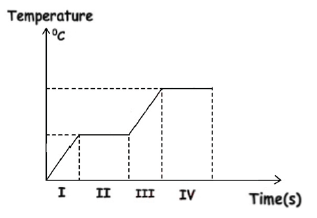
Consider the following temperature-time graph when a solid is heated. which part of the graph involves latent heat of vaporization?
Part I
Part II
Part III
Part IV
The heat absorbed by melting a solid is known as
latent heat of fusion
latent heat of solid
latent heat of liquid
latent heat of vaporisation

