wayground logo

Free Printable Worksheets

Font size

S
M
L
XL
Worksheets

Evolution Recap 10D

Total questions: 21

Worksheet time: 19mins

Name
Class
Date
1.

The word “antibiotic” means

a)

"against growth"

b)

"against disease"

c)

"against all odds"

d)

“against life”

2.

Antibiotics are chemical substances that kill bacterial cells by interrupting a key cellular function

a)

True

b)

False

c)

Maybe

3.

Broad spectrum antibiotics are bad because:

a)

They kill many different pathogenic bacteria

b)

They are really cheap to buy

c)

They can increase the rate of development of antibiotic resistance

d)

All of the above

4.

Broad spectrum antibiotics are good because:

a)

They Kill many different pathogenic bacteria

b)

They are really cheap to buy

c)

They cause antibiotic resistance

d)

None of the above

5.
All bacteria have DNA. 
a)
true
b)
false
6.
Bacteria are called _____ because their DNA is not contained in a nucleus.
a)
prokaryotes
b)
eukaryotes
c)
cells
d)
viruses
7.
Based on the figure, which antibiotic inhibited the growth of the bacteria the most?
a)
A
b)
B
c)
C
d)
D
8.

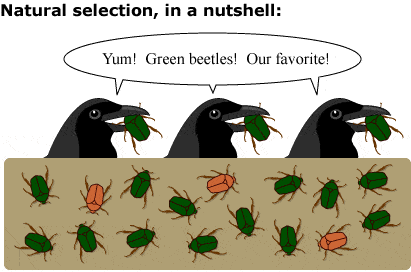
How do you "win" at natural selection?

a)

survive

b)

go extinct

c)

survive & reproduce

9.

What word describes a trait that helps an organism survive in its environment?

a)

natural selection

b)

mutation

c)

camouflage

d)

adaptation

10.
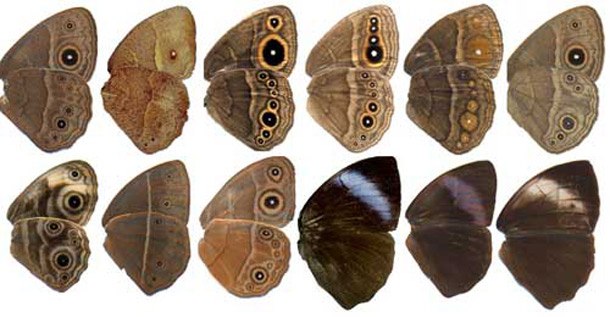
These moths are all the same species. The differences between their wings is an example of ________________
a)
Natural Selection
b)
Variation
c)
Homeostasis
d)
Extinction
11.
Mutations are important because they bring about
a)
death of the organism in which they develop
b)
genetic variation needed for a population to evolve
c)
benefits for the individual, not for the population
d)
Hardey-Weinberg equilibrium within a population
12.

Individuals undergo evolution.

a)

True

b)

False

13.
Which of the following is a factor in natural selection?
a)
Individuals of species compete with one another to survive.
b)
All species are genetically diverse.
c)
Individuals better able to adapt to changes leave more offspring.
d)
All are correct 
14.

A population is

a)

a group of similar species in different areas

b)

a group of the same species in the same geographic area.

c)

a group of several species in the same geographic area

d)

a group of several species along with their abiotic factors in a small area.

15.
Which of the following will increase the size of a population?
a)
emigration and births
b)
immigration and deaths
c)
immigration and births
d)
emigration and deaths
16.

Identify which image below is showing a population:

a)
b)
c)
d)
17.
What does biodiversity mean?
a)
Only one species in an area.
b)
The different amount of species in an area
c)
All abiotic life
d)
Nitrogen fixation
18.
What is the process of which humans breed organisms for certain traits?
a)
artificial selection
b)
descent without modification
c)
inheritance of acquired characteristics
d)
natural selection
19.
Survival of the Fittest and Evolution were proposed by what scientist?
a)
Charles Darwin
b)
Albert Einstein
c)
Steven Hawking
d)
Isaac Newton
20.
Two organisms that are closely related would have
a)
very similar DNA sequence
b)
exactly the same DNA sequences
c)
no proteins in common
d)
completely different DNA sequence
21.
Only populations can evolve.
Individuals can not evolve.
a)
True
b)
False