
 Worksheets
A2 Unit 1A Review
Total questions: 56
Worksheet time: 2hrs 19mins
Express the following in Interval Notation
-8 ≤ x < 8
[-8, 8]
[-8,8)
(-8, 8]
(-8, 8)
x < 8




Which graph has a y-intercept above the x-axis?
Cual grafica tiene un y-intercept arriba del x-axis?
SELECT ALL THAT APPLY
A
B
C
E
F
Which graph has a zero at x=0 & x=4?
Cual grafica tiene un zero en x=0 & x=4?
SELECT ALL THAT APPLY
G
I
D
E
F
Which graph has no zeros?
Cual grafica tiene no tiene zeros?
SELECT ALL THAT APPLY
C
I
D
E
F
Which graph has a maximum value at y=4?
Cual grafica tiene un maximum at y=4?
SELECT ALL THAT APPLY
A
I
B
E
F
Which graph has a minimum?
Cual grafica tiene un minimum?
SELECT ALL THAT APPLY
H
B
C
E
G
Which graph has an axis of symmetry at x=2?
Cual grafica tiene un axis de simmetria en x=2?
SELECT ALL THAT APPLY
A
B
G
H
I
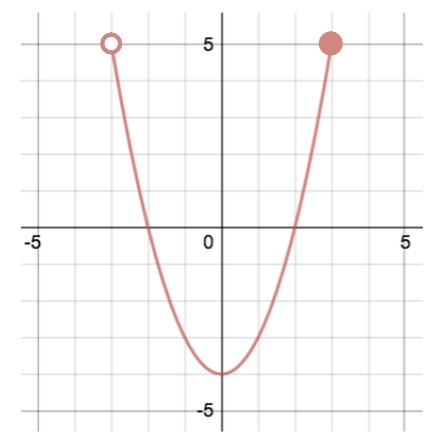


What is the increasing interval for the function below?
(−∞,∞)
(−∞,2]
(−∞,6]
(−6,6)


What is the increasing interval on the function shown?
(−∞, 1)
(−∞, 2)
(2, ∞)
(1, ∞)

Where is the function decreasing?
(−∞,−1)
(−1,∞)
(−∞,3)
(3,∞)

Where is the function increasing?
(2,∞)
(−∞,1)
(−∞,2)

What is the increasing interval on the function shown?
(−∞, −3)
(−∞, −4)
(−4, ∞)
(−3, ∞)

What are the x-intercepts of this function?
0 and 2
-4 and 0
2 and 3
0 and 4

Write the interval that represents the negative portion of the function?
(-2,1)
(-0.5,-3.5)
(−∞,−2); (1,∞)
(-3,0)

Where is the function positive?
Nowhere
(0.5, 2)
(-3, 0.5); (2, 5]
(−∞,0.5) and (2,∞)

Where is the function positive?
(-∞,5]
(0, ∞)
(-∞,2]
(-∞,0)

Where is the function negative?
(-∞,1)
(-∞,∞)
(1,∞) and (-∞,1)
(-1,∞)
x-intercepts are also called:
Choose ALL that apply!
Solutions
Roots
Zeros
Parabolas
Puppies

Does this graph have a minimum or maximum? What point?
minimum at (-3, -5)
minimum at (3, 5)
maximum at (-3, -5)
maximum at (3, 5)

Does this graph have a minimum or maximum? What point?
Minimum at (0, 0)
Minimum at (0, 2)
Maximum at (0, 0)
Maximum at (0, 2)

What is the x-intercept(s)?
(0, 6)
(6, 0)
(2, 1)
There is no x-intercept.

What is the y-intercept?
(0, 5)
(5, 0)
(0, -5)
(-5,0)

What is the y-intercept?
(-11, 0)
(0, -11)
(11, 0)
(0, 11)


Describe the transformation of the equation below from the absolute value parent function.
y=∣x−4∣
Describe the transformation of the equation below from the absolute value parent function.
f(x)=∣x+3∣
Left 3
Right 3
Up 3
Down 3

Choose the equation that best matches the graphed function.
f(x)=∣x∣+2
f(x)=∣x∣−2
f(x)=−∣x∣
f(x)=−∣x∣+2
Describe the transformation of the equation below from the absolute value parent function.
y=∣x∣+3
Left 3
Right 3
Up 3
Down 3
Write the equation for an absolute value function that shifts down 9 from the parent function, y=∣x∣ .
y=∣x∣−9
y=∣x−9∣
y=−9∣x∣
y=∣x∣+9
Describe the transformation of the equation below from the absolute value parent function.
y=∣x−1∣+5
left 1, up 5
left 1, down 5
right 1, up 5
right 1, down 5
Choose the graph that matches the equation.
y=∣x−1∣


y=x
y=∣x∣
y=x2
y=2x
Describe the transformation of the equation below from the absolute value parent function.
y=∣x∣+10

What is the equation of the function in the graph?
f(x)=∣x+2∣
f(x)=∣x+2∣+2
f(x)=∣x−2∣+2
f(x)=∣x−2∣


What is the domain interval for the green piece of this function?
-2 < x ≤ 1
-1 < x ≤ 0.5
x > -2
x ≤ 1

Evaluate f(0)
0
19
9
-19
Functions that are made up of distinct "pieces" of other functions defined over different intervals are called
Absolute Value Functions
Piecewise Functions
Exponential Functions
Quadratic Functions

Graph


Match the graph with the correct equation.


Match the graph with the correct equation.


Match the graph with the correct equation.

