Worksheets
Earth Science Beginning of Course Benchmark
Total questions: 50
Worksheet time: 3hrs 30mins
natural solid substance found in the earth crust
fossils
weathering
minerals
magma
rock once melted, cooled and hardened
metamorphic rock
sedimentary rock
fossils
igneous rock
any type of rock changed by heat and pressure
metamorphic rock
sedimentary rock
fossils
igneous rock
a rock that forms from material that is settled into layers
metamorphic rock
sedimentary rock
fossils
igneous rock

process of rocks changing into other types of rocks
recycling
rock cycle
water cycle
weathering
the movement of the Earth's plates on the mantle
faults
minerals
sand
plate tectonics
the original continent that was all continents combined
Australia
Pangaea
Antarctica
Gondwanaland

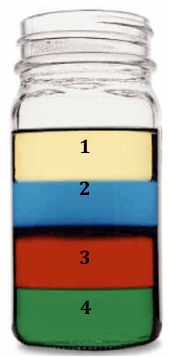
The outermost layer of the earth's structure is indicated by the number ....
1
2
3
4
A physical feature of Earth's surface.
Deposition
Plate
Fault
Landform
An opening in Earth's crust through which lava flows.
Continental Drift
Landform
Earthquake
Volcano
A shaking of the ground caused by sudden release of energy in Earth's crust.
Erosion
Volcano
Earthquake
Deposition
The remains or traces of past life found in Earth's crust.
Erosion
Fossils
Crust
Magma

What process is shown by letter B in the diagram?
condensation
transpiration
evaporation
precipitation
During evaporation, water changes from a _________ to a __________.
solid, liquid
gas, liquid
liquid, gas
liquid, solid

What process is show by letter A in the diagram?
condensation
evaporation
accumulation
precipitation
Water that is constantly moving and recycled above, on, and under the Earth is called ___.
evaporation
infiltration
run off
water cycle
What are clouds made of?
dry air
water

What are formed when water vapor condenses?
Clouds
Mountains
Transpiration
Valleys
Why is the temperature lower at night than during the day?
There are more clouds at night to block the sun's rays
Winds blow harder at night
The temperature depends on energy from the sun
There is less water in the air at night
Why can't you see the water vapor in the air?
It exists as a clear, colorless gas
It's all been condensed
There is very little of it
It's all far away, in the upper atmosphere
Why does it tend to be cool at the Earth's poles?
They are farthest from the sun
They have high absolute humidity
They have the worst weather
Sunlight strikes them at extreme angles
How does air move?
Warm air rises and cool air sinks
Warm air sinks and cool air rises

When Earth spins on its axis it is called
resolution
revolution
umbra
rotation
geostationary orbit

Which are the terrestrial planets?
Choose TWO answers.
Mars and Jupiter
Earth and Saturn
Venus and Mercury
Uranus and Pluto
Earth and Mars

The sun produces energy in its core through a process called:
nuclear fusion
nuclear fission
convection
radiation

Which of the planets are the gas giants?
Choose TWO answers.
Earth and Venus
Mars and Mercury
Uranus and Saturn
Jupiter and Neptune

A huge group of single stars, star clusters, dust, and gas bound together by gravity is called
quasar
galaxy
globular cluster
eclipsing binaries
What type of surface do the first four planets have?
Rock
Liquid
Gas
Gas and Liquid
Minerals are inorganic which means that
they were once parts of living things.
renewable
they were never part of anything living.
they are nonrenewable

a naturally occurring, non-living solid that has a specific chemical make-up and a repeating structure.
rock
mineral
stone
mountain
What is an observation?
A scientific statement based on ideas
Using your senses to notice what is going on around you
To be unaware of your surroundings
The question that you want an answer to.


What step does every scientific experiment begin with?
hypothesis
question/problem
procedures
conclusion

What two things determine the gravity of an object?
mass & weight
mass & distance
density & mass
volume & distance