
 Worksheets
Practice Quiz - Byzantine Empire 2023
Total questions: 20
Worksheet time: 9mins
Constantine relocated the capital of the Roman Empire to Byzantium and then renamed it...

1100
110
550
5500

Which emperor organized and updated old Roman laws to a create laws that lasted 900 years?
it was a strategic location for trade, and military protection
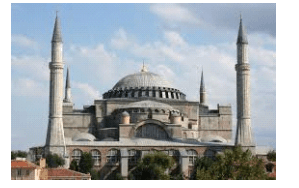
This Byzantine Church is a classic example of the cultural diffusion of Greek, Christian and Islamic design...
The Byzantine Empire reached its greatest territory and power under:
Which emperor converted to Christianity prevented the persecution of the religion in New Rome?
Justinian
Constantine
Julius Caesar
Augustus

The Byzantine Empire finally came to an end in 1453 when the ______________ Turks took the city of Constantinople with the use of gunpowder and cannons.
Persian
Kurdish
Ottoman
Armenian


Which of the following best describes the Byzantine territory at the height of the empire?
A. The empire was almost entirely located in Eastern Europe.
B. The empire was land-locked and could not facilitate travel by water.
C. The empire consisted of territories on multiple continents and in multiple regions.
D. The empire controlled territories that were isolated with no access to travel or trade.
Which of the following is an example of how the Byzantine Empire was the same as the old Roman Empire?
A. In both, Constantinople became a center for art and architecture.
B. Both were heavily influenced by Greek culture and spoke the Greek language.
C. Both had laws that that ruled civil life.
D. Both were Christian.

Using the map, which of the following statements BEST explains the major military influence of Justinian and his general Belisarius?
A. They established the first Byzantine territories in Africa and Europe.
B. They expanded trade by establishing territories along the Mediterranean Sea.
C. They contributed to a decline in the number of Byzantines practicing Christianity.
D. They expanded the Byzantine Empire by conquering much of the old Roman Empire.
Which of the following is a major contribution of the Byzantine Empire?
A. The return of the Roman Empire to its former glory.
B. The establishment of democracy and the end of totalitarian rule.
C. The unification of Christian leaders across the Eurasian continent.
D. The continuation and expansion of various aspects of Greek and Roman culture.
Which of the following is the BEST example of the lasting impact of the Byzantine Empire?
A. The Pope continues to serve as the leader of Rome.
B. Justinian's Code became a foundation of many European legal codes.
C. Many buildings constructed during the height of the empire still stand.
D. The Greek language is still spoken in many territories of Eastern Europe.

Which of the following statements completes the diagram?
A. Prosperity of the Byzantine Empire
B. Collapse of the Roman Empire
C. Prosperity of the Roman Empire
D. Collapse of the Byzantine Empire

Who was the famous lady that influenced her husband to increase some legal rights for women?

Byzantine art pictured here is called?
decoupage
mosaic
stained glass
gothic architecture
When the Roman Empire split, there were two capitals, one in Rome and one in Constantinople for many years. What languages did they speak?
Latin in Rome and Latin in Constantinople
Italian in Rome and Italian in Constantinople
Latin in Rome and Greek in Constantinople
Greek in Rome and Greek in Constanople

