

wayground logo

Free Printable Worksheets

Font size

S
M
L
XL
Worksheets

Intro to Chemistry

Total questions: 27

Worksheet time: 18mins

Name
Class
Date
1.
The positive particles of an atom are 
a)
electrons 
b)
positrons 
c)
neutrons 
d)
protons 
2.
Particles in an atom that are neutral and have no charge are 
a)
negatrons 
b)
electrons 
c)
neutrons 
d)
protons 
3.
What is the smallest?
a)
worm
b)
molecule
c)
galaxy
d)
atom
4.
What does the nucleus consist of?
a)
Protons + Electrons
b)
Neutrons + Electrons
c)
Atoms
d)
Protons + Neutrons
5.
What are the 3 subatomic particles that make-up the atom?
a)
protons, neutrons, and isotopes
b)
neutrons, isotopes, and electrons
c)
positives, negatives, and electrons
d)
protons, neutrons, and electrons
6.
Anything made of matter must _____________________.
a)
take up space and have mass
b)
have mass and be a solid
c)
be a solid and not move
d)
take up space and be a liquid
7.
a)

Solid

b)

Liquid

c)

Gas

8.
a)

Solid

b)

Liquid

c)

Gas

9.
a)

Solid

b)

Liquid

c)

Gas

10.

The branch of chemistry that deals with laws and theories to understand structure and changes of matter is called ________________

a)

Analytical Chemistry

b)

Industrial Chemistry

c)

Physical Chemistry

d)

Nuclear Chemistry

11.

The branch of chemistry that deals with elements and their compounds except organic compounds is called

a)

Organic Chemistry

b)

Inorganic chemistry

c)

Analytical Chemistry

d)

Physical Chemistry

12.

The study of carbon containing compounds.

a)

Organic Chemistry

b)

Inorganic Chemistry

c)

Physical Chemistry

d)

Biochemistry

13.

The identification of the components and composition of materials refers to___________________________

a)

Biochemistry

b)

Physical Chemistry

c)

Organic Chemistry

d)

Analytical Chemistry

14.

The study of substances and processes occurring in living things.

a)

Biochemistry

b)

organic Chemistry

c)

inorganic Chemistry

d)

Applied Chemistry

15.

____________ is the branch of chemistry that would analyze new chemicals made from carbon-containing building blocks to identify its properties and use. (Select all that apply.)

a)

Inorganic Chemistry

b)

Organic Chemistry

c)

Biochemistry

d)

Analytical Chemistry

16.

studying the process of photosynthesis in plants

a)

biochemistry

b)

inorganic

c)

analytical

17.

Anything that has mass and occupies space

(a)  

18.

Which branch of Science is related with "Chemical reactions"?

a)

Physics

b)

Biology

c)

Chemistry

19.

____________ is the branch of chemistry that would study enzymes used in the digestion of food.

a)

Inorganic Chemistry

b)

Biochemistry

c)

Physical Chemistry

20.

Which among the following is a NOT matter?

a)

Air

b)

Gold

c)

Water

d)

Heat

21.
The movement of gas molecules is greatly affected by _________.
a)
the shape of the container
b)
size of the container
c)
temperature of the container
22.
The energy of an object as it is in motion is defined as
a)
Kinetic Theory
b)
Kinetic energy
c)
Potential energy
d)
Electric energy
23.
Gas molecules can easily be compressed  because ___________. 
a)
gas molecules are soft
b)
gas molecules are far apart
c)
gas molecules follow the shape of the container
24.

The kinetic theory states

a)

Particles won't move if you don't apply energy to it.

b)

Particles only move in liquids and gases.

c)

Particles are always in motion.

d)

At the same temperature the object that has the most mass heats quicker.
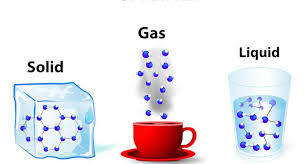
25.
In which state of matter are the particles moving the least random
a)
Gas
b)
Liquid
c)
Solid
d)
Plasma
26.
In which state of matter are the particles only vibrating?
a)
Gas
b)
Liquid
c)
Solid
d)
Plasma
27.
Of these three states of matter, which one has the most kinetic energy? 
a)
Solid 
b)
Liquid 
c)
Gas
