
NEW
Font size
 Worksheets
U2W1 Reading
Total questions: 13
Worksheet time: 39mins
Which word has almost the same meaning as the word resolve?
excavate
inhabit
settle
visit
Which word is defined as:
NOUN - something formed by joining together
NOUN - a confederation
convention
proposal
situation
union
What does the word convention mean?
an original concept or plan
an uncommon occurence
a public music performance
a formal meeting for a purpose
Representatives are people
chosen to act or speak for others
given a particular responsibility
who organize important events
who bargain for better deals
Which word has the OPPOSITE meaning of the word debate?
agree
dispute
ignore
share
Which word has almost the same meaning as the word proposal?
burden
expectation
proof
recommendation
What does the word committees mean?
reasons for doing something
actions designed to promote friendship
groups of people chosen to do certain work
large plots of land cultivated for a particular reason
What does the word situation mean?
a lack of funds
a condition or state of affairs
an invention with no real purpose
a position taken to show opposition

Why could many people not pay the taxes being raised to repay the country's debt?
(PAGE 98)
They were too poor.
They did not use cash.
They did not make enough money.
They did not have enough goods to trade.

What was the benefit of creating a government that consisted of three parts that shared power?
(PAGE 101)
It would help everyone get along.
No one would have too much work to do.
No part would be more powerful than the others.
Each part would only have to work for one third of the year.
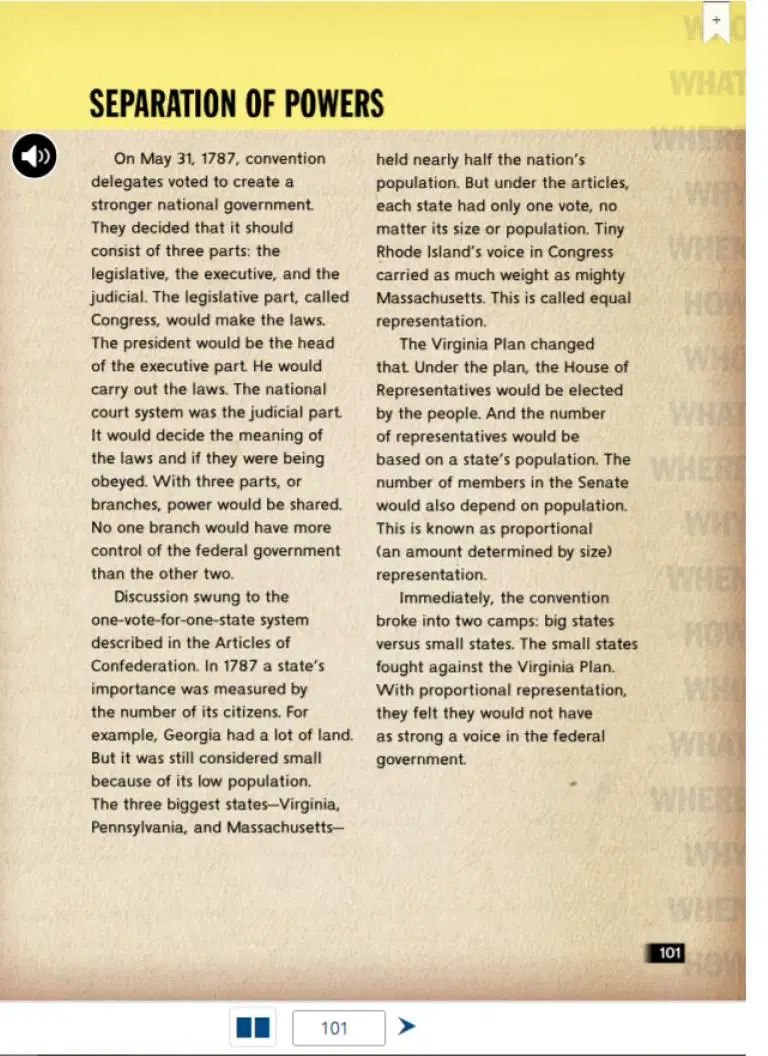
How was equal representation different from proportional representation?
(PAGE 101)
Each state had one vote in equal representation, but in proportional representation, the number of votes would depend on a state’s population.
Each state had one vote in proportional representation, but in equal representation, the number of votes would depend on a state’s population.
The governor of each state had one vote in equal representation, but in proportional representation, the legislature casted the vote.
The governor of each state had one vote in proportional representation, but in equal representation, the legislature casted the vote.
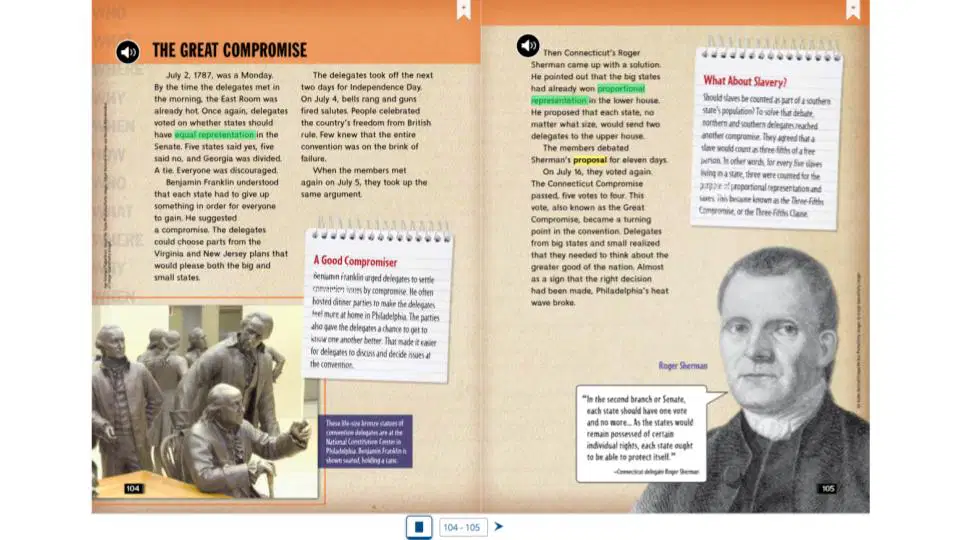
Which sentence best explains what the section “The Great Compromise” is about?
(PAGE 105)
The Great Compromise decided that for every fi ve slaves living in a state, three were counted for the purpose of proportional representation.
The Great Compromise decided that one house would have proportional representation and the other would have equal representation.
The Great Compromise decided that for every three slaves, five were counted for the purpose of proportional representation.
The Great Compromise decided that both houses would have proportional representation.

What plan included what came to be known as the electoral college?
(PAGE 109)
Connecticut
New Jersey
Virginia
Wilson's

