Wayground logo

Free Printable Worksheets

Font size

S
M
L
XL
Worksheets

First Six Weeks Exam Review

Total questions: 105

Worksheet time: 2hrs 11mins

Name
Class
Date
1.
The natural chemical or physical processes that breaks down rock on Earth's surface.
a)
weathering
b)
erosion
c)
deposition
d)
jackhammering
2.
The process by which water, ice, wind or gravity moves weathered rock and soil from one place to another.
a)
weathering
b)
erosion
c)
deposition
d)
dumptruck
3.
This type of weathering occurs when rocks weaken then break down due to chemical changes in the composition of the rock.
a)
mechanical weathering
b)
chemical weathering
c)
erosion weathering
d)
deposition
4.
How might a weathered mountain appear different than an unweathered mountain?
a)
Weathered mountain would be taller.
b)
Weathered mountain would be rounder and less jagged.
c)
Weathered mountain would be more jagged and less rounded.
d)
Weathered mountain would have no trees.
5.
Which process of biological weathering has plants grow roots into crevices of rock and cause the rock to break apart?
a)
carbonation
b)
root wedging
c)
hydratoin
d)
oxidation
6.
Which process of chemical weathering has oxygen react with minerals, especially those that contain iron, and cause them to break down?
**Rust is an example of this process.**
a)
Oxidation
b)
Carbonation
c)
Hydation
d)
Hydrolysis
7.
Which process of chemical weathering has carbon from the air or in the soil dissolve in water to make a weak acid that can dissolve rock?
a)
Hydration
b)
Hydrolysis
c)
Oxidation
d)
Carbonation
8.
What is the process of movement of soil and/or sediment from one location to another?
a)
Erosion
b)
Weathering
c)
Deposition
9.
What is the geological process by which sediment and soil builds up in an area?
a)
Erosion
b)
Weathering
c)
Deposition
10.
The diagrams  shows a natural process that weathers rock.
 Which statement best explains why this process results in weathering?
a)
frozen water acts as a solute
b)
water expands when it freezes
c)
the mass of water increases when it freezes
d)
frozen water dissolves most types of rock
11.
The formation of stalactites and stalagmites in a cave as water mixed with carbon dioxide creates carbonic acid, which dissolves away the limestone, is an example of:
a)
mechanical weathering
b)
chemical weathering
12.
Potholes forming in the road after a cold winter is an example of:
a)
mechanical weathering
b)
chemical weathering
13.
How is mechanical weathering different from chemical weathering?
a)
Chemical weathering happens over much shorter time frame than mechanical weathering.
b)
Chemical weathering changes the chemical composition of rocks; mechanical weathering does not.
c)
Chemical weathering occurs only in tropical climates; mechanical weathering occurs only in cool climates.
d)
Chemical weathering occurs only in the mountains; mechanical weathering occurs only on flat land.
14.

Over time wind has carved out this rock feature. What type of weathering and specific example best describes this process?

a)

Chemical, Dissolving

b)

Mechanical, Pressure Release

c)

Mechanical, Abrasion

d)

Chemical, Abrasion

15.

Rusting happens to metal but can also occur on rocks and is caused by exposure to oxygen. Is this type of weathering mechanical or chemical, and what is the scientific name for this type of weathering?

a)

Clay formation, which is mechanical

b)

Hydrolosis, which is chemical

c)

Oxidation, which is chemical

d)

Oxidation, which is mechanical

16.
How many continents are there in the world?
a)
4
b)
5
c)
6
d)
7
17.
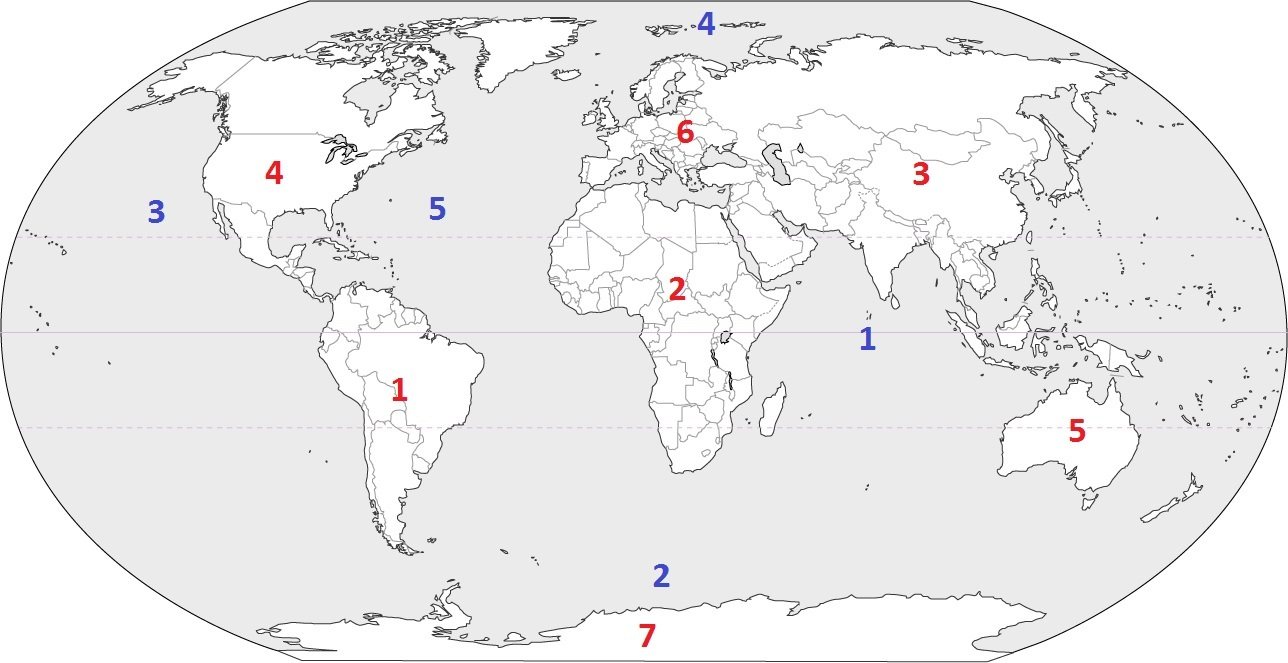
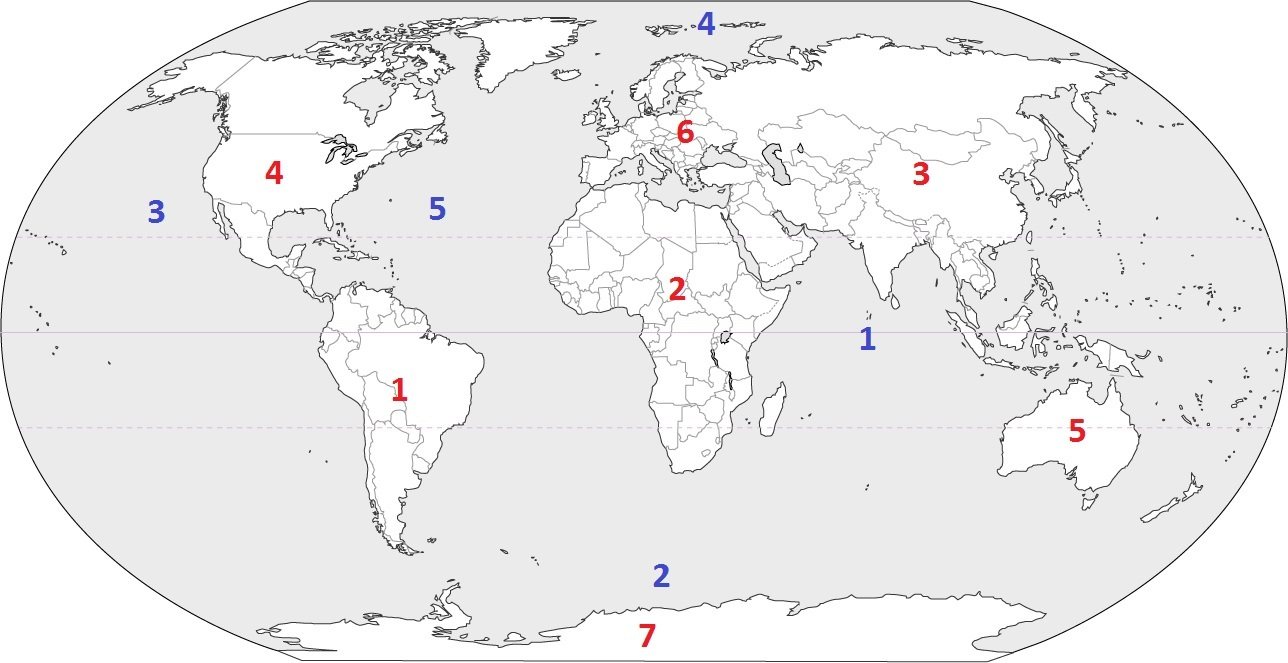
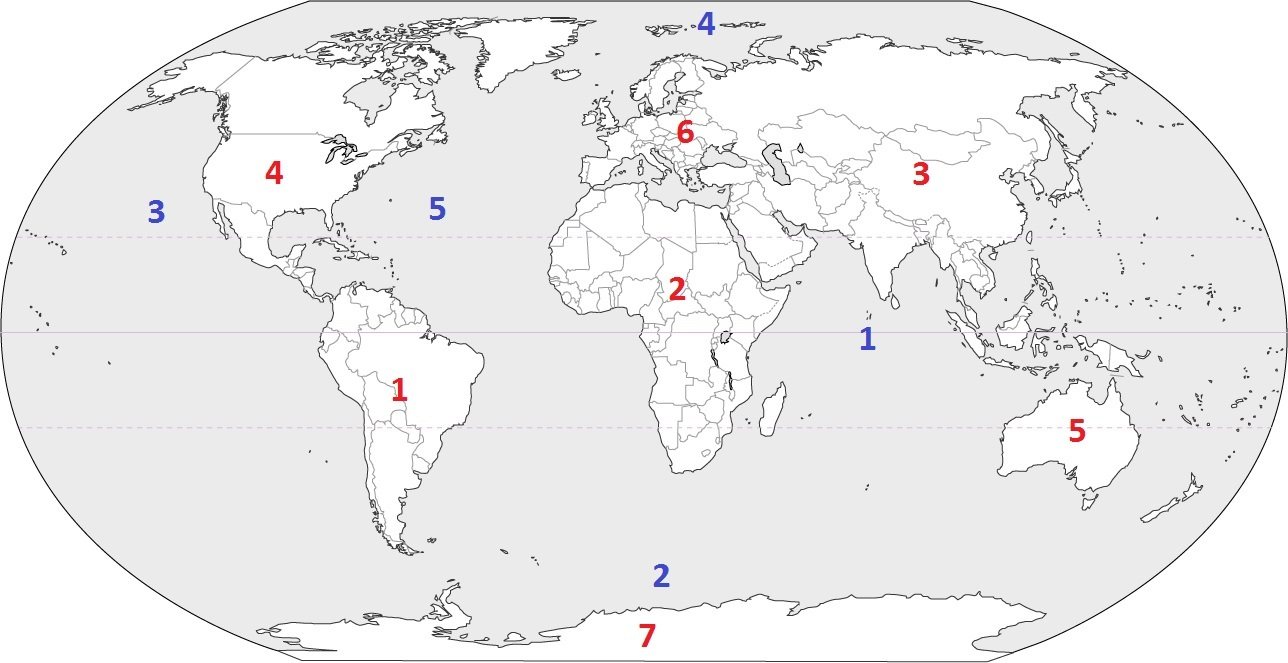
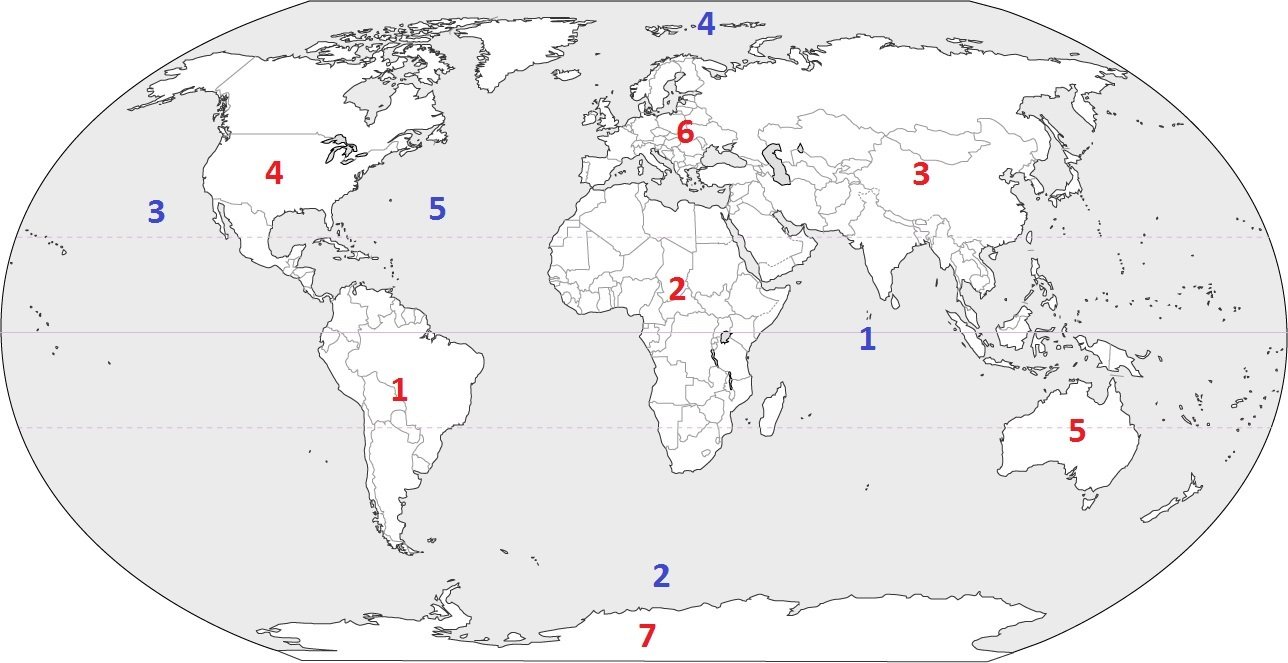
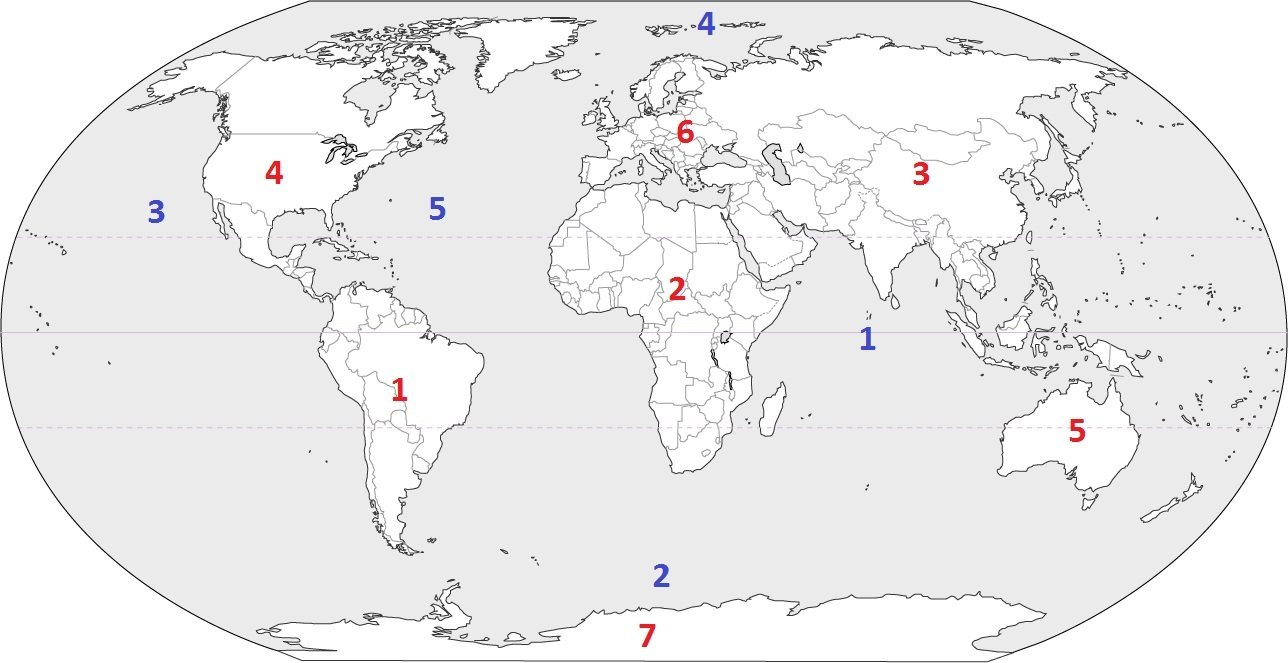
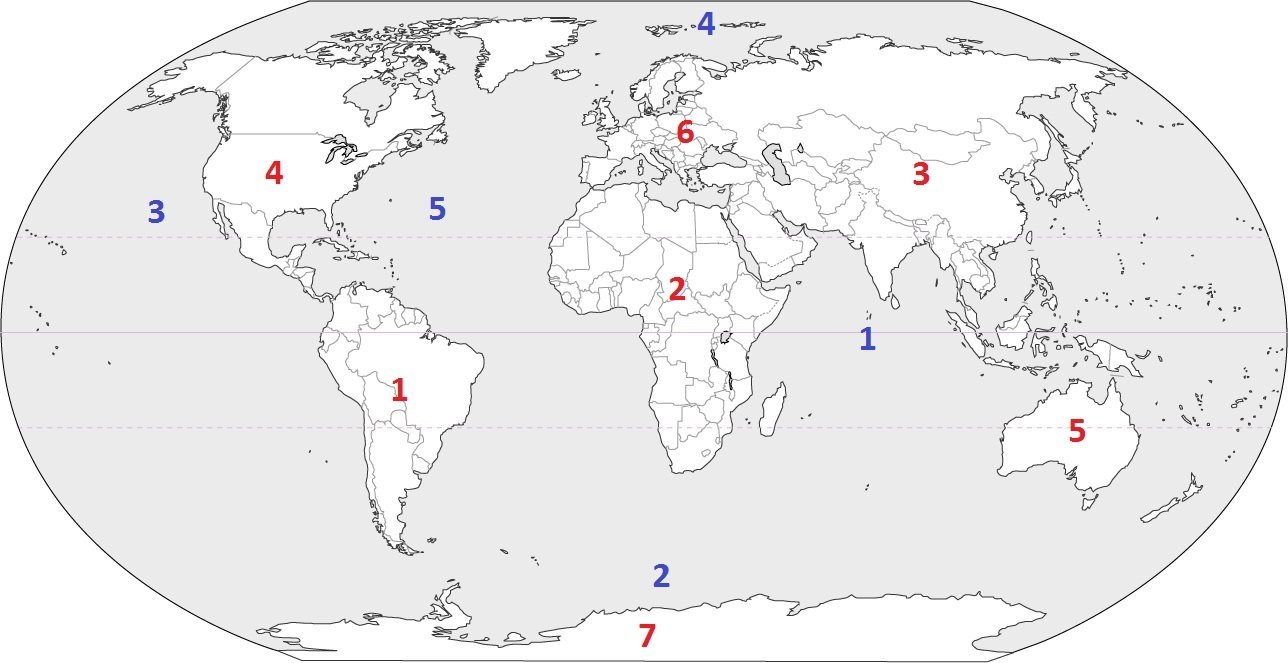
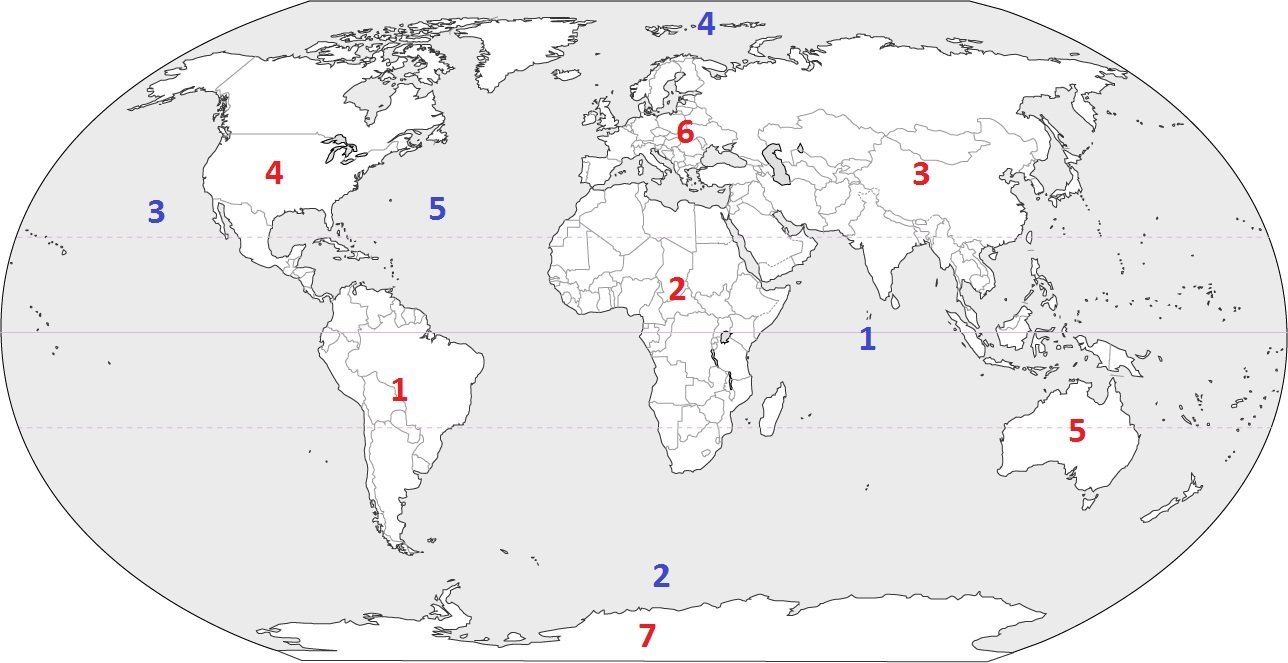
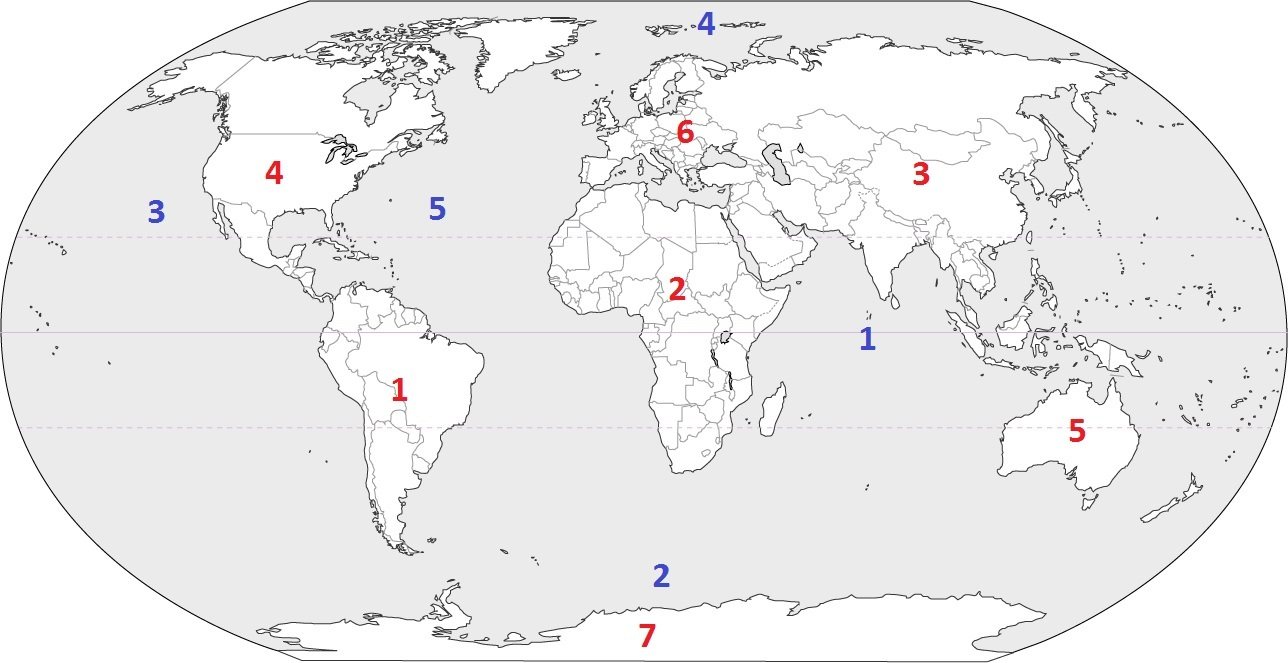
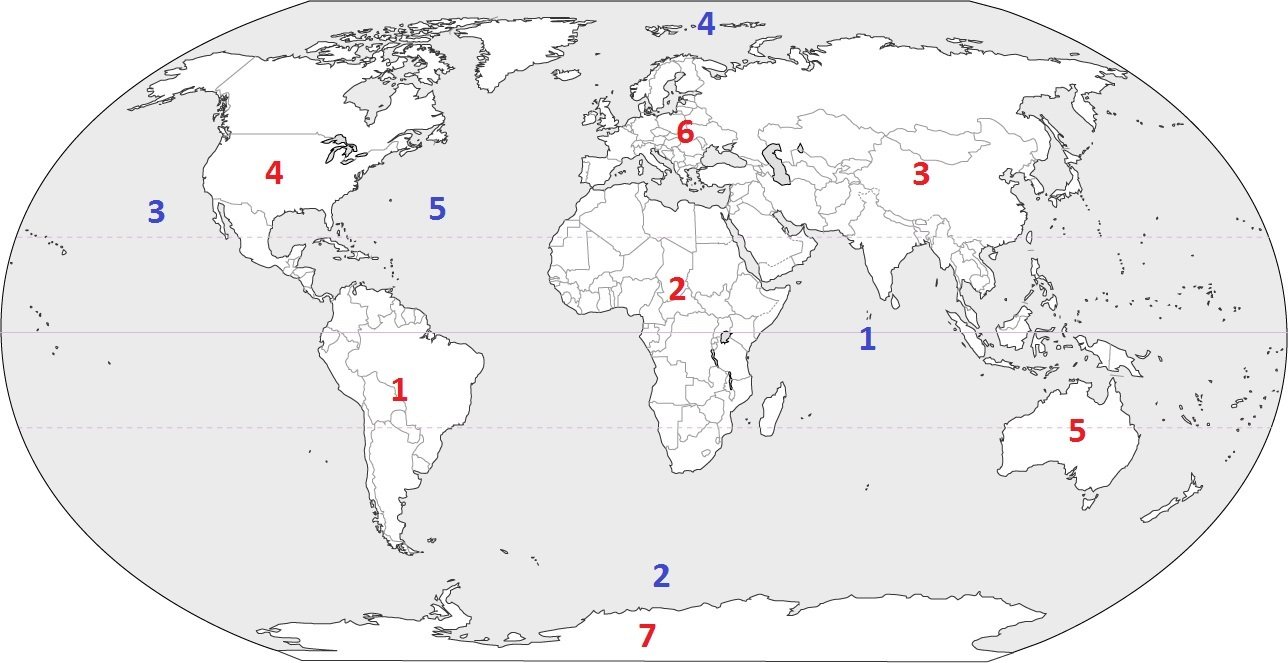
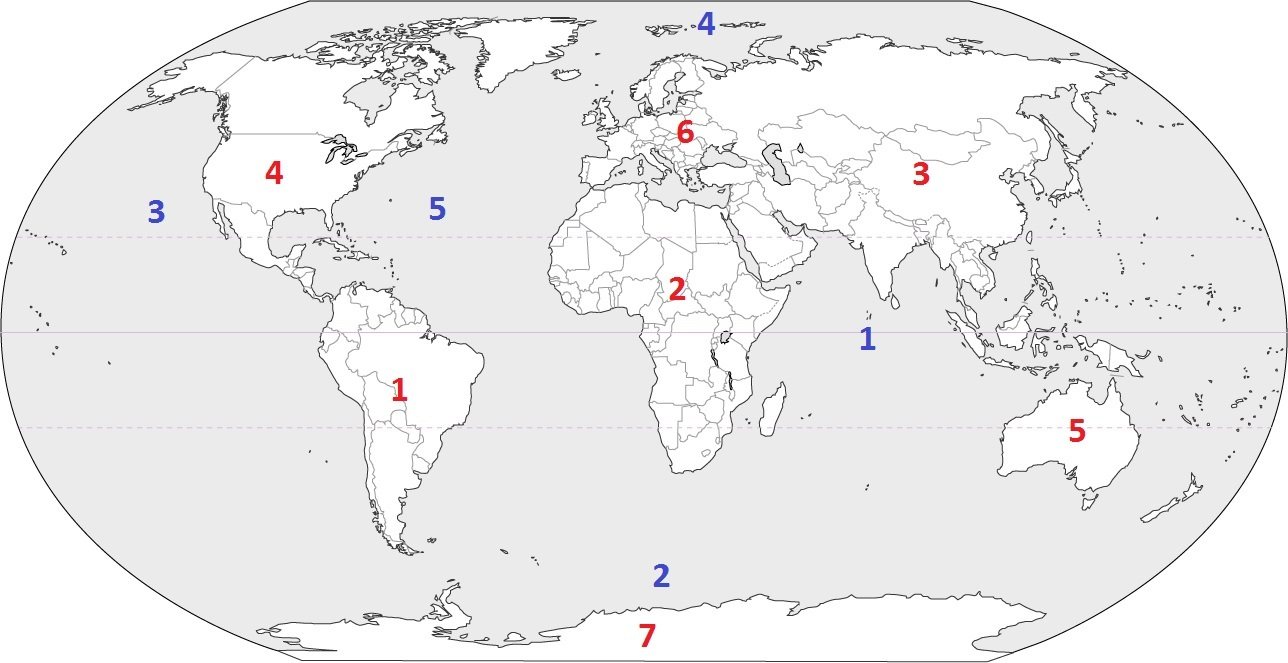
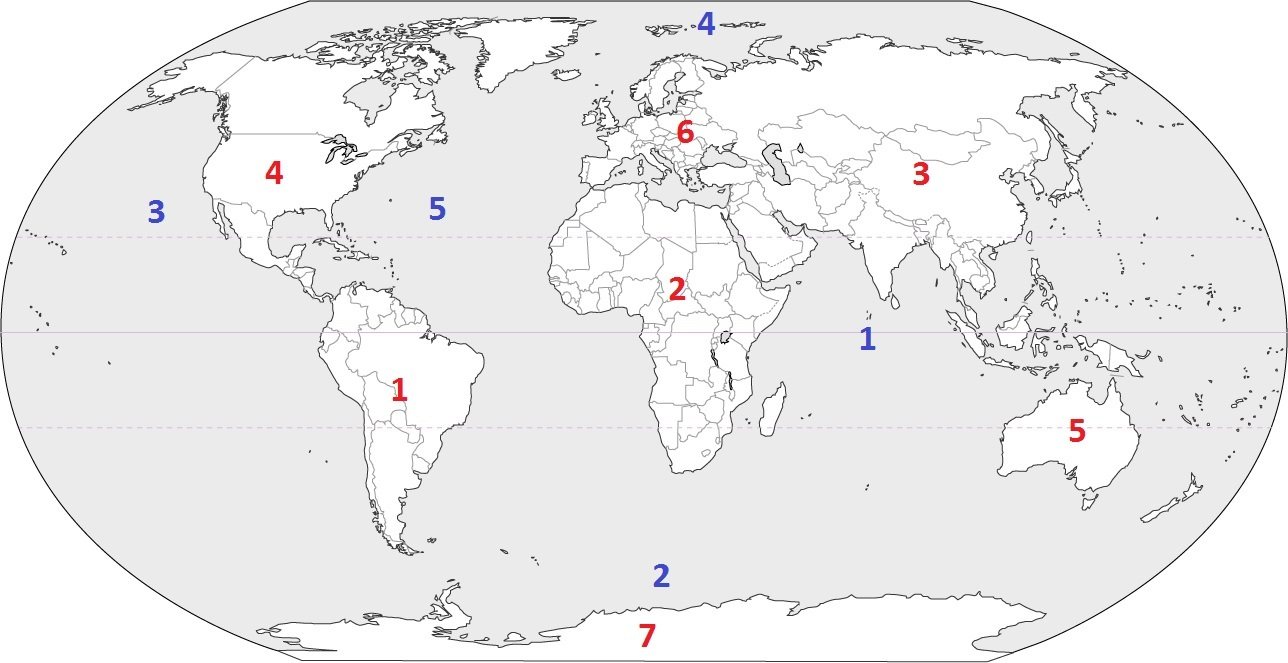
Which continent is located at #3?
a)
Australia
b)
Asia
c)
Europe
d)
South America
18.
Which continent is located at #5?
a)
South America
b)
Asia
c)
Australia
d)
Antarctica
19.
Which continent is located at #7?
a)
Asia
b)
Africa
c)
Australia
d)
Antarctica
20.
Which continent is located at #4?
a)
South America
b)
North America
c)
Europe
d)
Africa
21.
Which continent is located at #1?
a)
North America
b)
Antarctica
c)
South America
d)
Asia
22.
Which continent is located at #6?
a)
Asia
b)
Europe
c)
Africa
d)
Antarctica
23.
Which continent is located at #2?
a)
Africa
b)
South America
c)
Australia
d)
Europe
24.
Which continent is home of the Sahara Desert and is considered the hottest?
a)
South America
b)
Europe
c)
Africa
d)
Australia
25.
On this continent, you can find animal species such as penguins, seals and some birds. This is the coldest continent.
a)
North America
b)
Antarctica
c)
South America
d)
Europe
26.
This continent is covered by large rainforests and is the wettest.
a)
North America
b)
Asia
c)
South America
d)
Africa
27.
This is the smallest continent, farthest away from the others where you may find koalas and kangaroos.
a)
Europe
b)
Africa
c)
South America
d)
Australia
28.
Identify the ocean at location #3
a)
Atlantic Ocean
b)
Arctic Ocean
c)
Pacific Ocean
d)
Indian Ocean
29.
Identify the ocean at location #5
a)
Atlantic Ocean
b)
Southern Ocean
c)
Pacific Ocean
d)
Arctic Ocean
30.
Identify the ocean at location #1
a)
Southern Ocean
b)
Arctic Ocean
c)
Atlantic Ocean
d)
Indian Ocean
31.
Identify the ocean at location #4
a)
Indian Ocean
b)
Pacific Ocean
c)
Arctic Ocean
d)
Atlantic Ocean
32.
What is this object known as?
a)
map symbol
b)
map key
c)
map scale
d)
compass rose
33.
What is a map scale?
a)
a tool to measure distance
b)
a tool to tell direction
c)
a tool to start a fire
d)
a tool to build a house
34.
Explains what the symbols on a map represent
a)
Bar Scale
b)
Map Key/Legend
c)
Compass Rose
d)
Parallels
35.
Name the boundary
a)
convergent boundary
b)
divergent boundary
c)
transform boundary
d)
sergent boundary
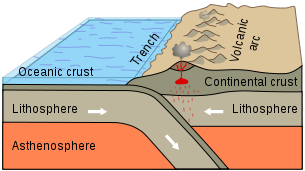
36.
Name the boundary
a)
convergent boundary
b)
divergent boundary
c)
transform boundary
d)
sergent boundary
37.
Name the boundary
a)
convergent boundary
b)
divergent boundary
c)
transform boundary
d)
sergent boundary
38.
What landform is created when two continental plates collide? 
a)
Ocean Basin
b)
Volcano
c)
Canyon
d)
Mountain Range 
39.
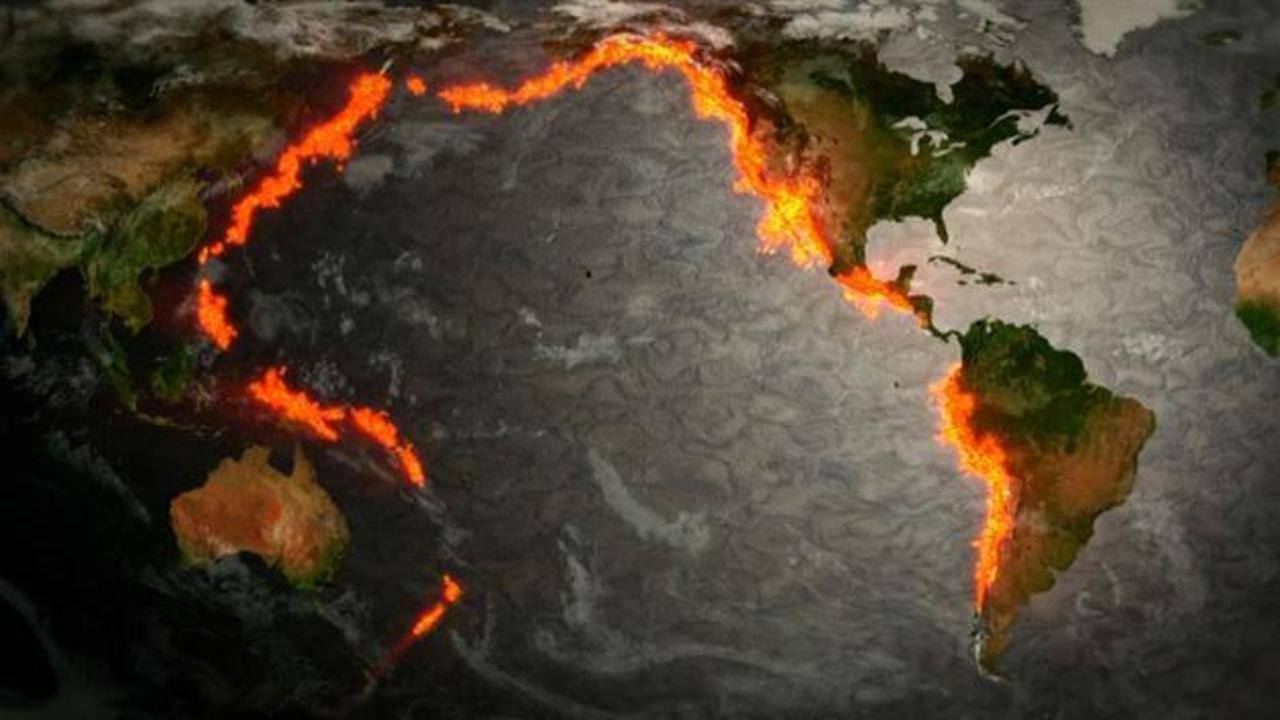
The Pacific Ring of Fire is where most of the earth's  ____ are found.
a)
earthquakes
b)
volcanoes
c)
earthquakes and volcanoes
40.
A rift valley forms at this type of plate boundary.
a)
convergent
b)
divergent
c)
transform
41.
The three types of plate boundaries are
a)
basaltic, granitic and andesitic
b)
continental, oceanic, and spreading
c)
convergent, divergent and transform
42.
A plate boundary where two plates move away from each other is called
a)
Divergent Boundary
b)
Convergent Boundary
c)
Transform Boundary
d)
Subduction
43.
Scientists hypothesize that a super continent existed 200 million years ago.  This continent is called
a)
America
b)
Super Earth
c)
Pangea
d)
Eurasia
44.
A Plate Boundary where two plates move toward each other is called
a)
Convergent Boundary
b)
Divergent Boundary
c)
Transform Boundary
d)
Subduction
45.
When pressure builds between two tectonic plates, it can suddenly release causing a (an) ______________________
a)
Earthquake
b)
Volcano
c)
Convection Current
d)
Gravitational Pull
46.

Theory that explains how all the land was joined together and drifted apart.

a)

Theory of evolution

b)

Theory of earth science

c)

Theory of Continental drift

d)

Theory of Divergence

47.
Earthquakes and volcanoes are most likely found in which locations?
a)
At plate boundaries
b)
in oceans
c)
in the middle of continents
d)
in the middle of plates
48.
Transform boundaries are most likely to produce what phenomenon?
a)
volcanoes
b)
deep sea trenches
c)
underwater mountain ranges
d)
earthquakes
49.
Which ocean in the world is also known as the "Ring of Fire"
a)
Atlantic
b)
Indian
c)
Arctic
d)
Pacific
50.
What feature forms when two continental lithospheric plates collide?
a)
Rift Valley
b)
Folded Mountains
c)
Volcanic Mountains
d)
Mid Ocean Ridges
51.

A plate boundary where two plates move toward each other.

a)

trench

b)

ridge

c)

fault

d)

split

52.

Columbus believed that the world was

a)

1/4 its actual size

b)

flat

c)

egg shaped

d)

one of many parallel worlds

53.

In what year did Cristopher Columbus find America?

a)

in 1492

b)

On Octber 12th of 2019

c)

1990

d)

2020

54.

What is the true shape of the Earth?

a)

Oblate spheroid

b)

Sphere

c)

Flat

d)

Round

55.

The world is divided between the Northern and Southern ___________.

a)

Equator

b)

Hemispheres

c)

Continents

d)

Oceans

56.

The imaginary line that divides the Earth into two parts is called the ________.

a)

Equator

b)

Hemisphere

c)

Prime Meridian

d)

North Pole

57.

North America is located in which hemisphere?

a)

Northern

b)

Southern

58.
A __________ tells you what each symbol on the map stands for.
a)
legal
b)
lobster
c)
legend
d)
langoustine
59.
What type of map
a)
physical
b)
political
c)
climate
d)
historical
60.
The study of the Earth and the way people live and use it.
a)
Geology
b)
Genome
c)
Geography
d)
Geode
61.
Which imaginary line divides the Earth into the eastern and western hemispheres?
a)
Prime Meridian
b)
Equator
c)
Axis
d)
North Pole
62.
Which imaginary line divides the Earth into the northern and southern hemispheres?
a)
Prime Meridian
b)
Equator
c)
Axis
d)
North Pole
63.
What does "geo" mean?
a)
earth
b)
water
c)
stone
d)
None of these
64.

_________ show the Earth as a SPHERE.

a)

Maps

b)

Globes

c)

Compass rose

65.

_________________ show the Earth as FLAT.

a)

Maps

b)

Globes

c)

Compass rose

66.

This is the:

a)

Map

b)

Scale

c)

Key

67.

Which of the type of map is this?

a)

Physical map

b)

Political map

c)

Road map

d)

Useless map

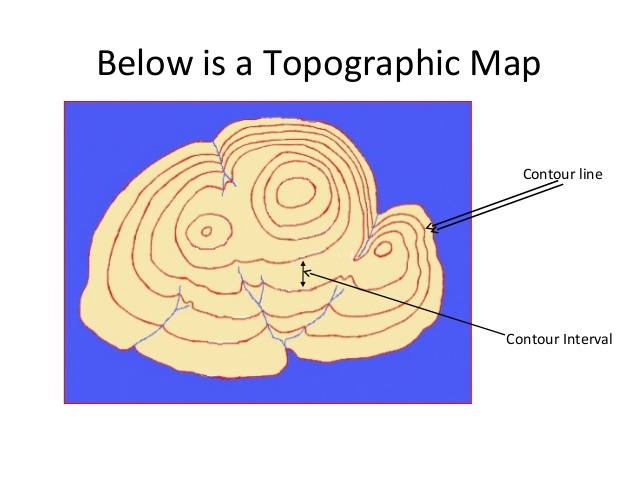
68.
What do close contour lines represent on a map?
a)
waterfall
b)
steep area
c)
flatter area
d)
river
69.
What do contour lines that are farther apart represent?
a)
waterfall
b)
steep area
c)
flatter area
d)
river
70.
How many mountain tops does this map have?
a)
one
b)
two
c)
three
d)
four
71.
This is what type of map?
a)
Cartogram
b)
Dot
c)
Choropleth
d)
Political
72.
Which most accurately displays the size, shape, and location of continents and oceans?
a)
Globe
b)
Mercator Projection
c)
Goode's Homolosine
d)
Robinson
73.

The very top of the earth where all of the lines of longitude meet

a)

cylinder

b)

globe

c)

spheroid

d)

South Pole

e)

North Pole

74.

very bottom of the earth where all of the lines of longitude meet

a)

Equator

b)

Prime Meridian

c)

spheroid

d)

South Pole

e)

North Pole

75.

a person who draws or produces maps

a)

cartographer

b)

geographer

c)

stenographer

d)

photographer

76.

What type of event will occur at this boundary?

a)

Earthquake

b)

Volcano Eruption

c)

Tornado

d)

Mountain Building

77.

What is the correct order (starting from the surface) of Earth’s layers?

a)

crust, outer core, inner core, mantle

b)

mantle, outer core, inner core, crust

c)

crust, mantle, outer core, inner core

d)

outer core, inner core, crust, mantle

78.

The geological theory of _______ states that pieces of Earth’s lithosphere are in constant, slow motion.

a)

subduction

b)

plate tectonics

c)

deep-ocean trenches

d)

sea-floor spreading

79.
What are Tectonic Plates?
a)
A continent 
b)
The Trees in Vietnam 
c)
ThE PlaTES That MoVE uNdERGRound :)
d)
The Plates that move the Continents
80.
Why are there 365 1/4 (365.25) days in a year?
a)
Earth's rotation takes this long.
b)
The tilt of the Earth.
c)
Earth's revolution takes this long.
d)
Our tilt is 23 degress.
81.
Day and night are caused by 
a)
Earth's revolution around the sun
b)
Earth's rotation on its axis
c)
the tilt of the earth
d)
Earth's involvement in eclipses
82.
A year is measured by
a)
Earth's revolution around the sun
b)
Earth's rotation on its axis
c)
the tilt of the earth
d)
Earth's involvement in eclipses
83.
How long does it take for the earth to complete one rotation?
a)
365 1/4 days
b)
24 hours
c)
30 days
d)
one decade
84.
What causes the seasons to change?
a)
The Earth's distance from the Sun
b)
The waming and cooling of Earth's core
c)
The Earth's tilt in relation to the sun
d)
The Earth rotation on its axis.
85.
Imaginary line through the center of the earth (from the north pole to south pole)
a)
axis
b)
orbit
c)
pole
d)
tilt
86.

What is it called when the Earth's nights and days are equal in time?

a)

aquifer

b)

equinox

c)

equal nights

d)

equinix

87.

What is the name given to the longest day of sunlight in the Northern Hemisphere?

a)

solstice

b)

equinox

c)

midnight sun

d)

axis

88.

What is climate?

a)

weather

b)

rain, sleet, snow, or hail

c)

average weather in a region over a long period of time

d)

the amount of ice cream available in a city

89.
What is going on with the atmosphere at any particular time.
a)
Weather
b)
Climate
90.
Daily temperature, daily rainfall, daily amount of sunshine
a)
Weather
b)
Climate
91.

What question could students answer after reading this map?

a)

What is the temperature in Alaska?

b)

What is the climate for the majority of the U.S.?

c)

What is the difference in population of the Northern hemisphere compared to the Southern hemisphere?

d)

Which city has the most rainfall for the month of September?
92.
_______ affects weather because the further north or south you go from the Equator, the less solar energy (heat).
a)
altitude
b)
latitude
c)
sunlight
d)
atmosphere
93.
What is sediment?
a)
the process of rocks being broken down and carried away
b)
bits of rock, sand, and silt caused by the weathering of rocks
c)
the top layer of the soil
d)
decaying plant or animal material 
94.
What is an enormous mass of ice moving over land?
a)
Ice wedging
b)
Glacier
c)
Iceberg
d)
Dune
95.
Subduction zones occur on Earth where dense oceanic crust dives under more buoyant continental crust. These boundaries are characterized by a deep ocean trench next to a high continental mountain range, large numbers of earthquakes and volcanoes. All of this is further evidence for the
a)
big bang theory.
b)
theory of plate tectonics.
c)
origin of the species.
d)
theory of natural selection.
96.
There are three types of plate boundaries. Which choice is NOT a type of plate boundary?
a)
convergent
b)
thrust
c)
divergent
d)
transform
97.

Describe the air on the windward side of a mountain.

a)

dry

b)

hot

c)

moist

d)

cold

98.

Describe the air on the leeward side of a mountain.

a)

cold

b)

warm

c)

dry

d)

moist

99.

The leeward side of the mountain in in the

a)

rain shadow

b)

way

c)

river

d)

rainbow

100.

The air on the windward side of a mountain is moist because it is close to

a)

an ocean

b)

a puddle

c)

a desert

d)

a river

101.

Most moisture falls on the _________ side.

a)

leeward

b)

windward

c)

rain shadow

d)

altitude

102.

The leeward side is _____________ a body of water.

a)

facing

b)

next to

c)

not near

d)

around

103.

As altitude increases, the air gets

a)

hotter

b)

wetter

c)

thicker

d)

cooler

104.

Which side of the mountain usually gets deserts and why?

a)

windward, because of rising, moist air

b)

leeward, because of rising, dry air

c)

windward, because of sinking, moist air

d)

leeward, because of sinking, dry air

105.

What is the windward side of a mountain?

a)

The wet side that is upwind of the mountain.

b)

The side of the mountain with the most people.

c)

The dry side that is downwind of the mountain.

d)

The side of the mountain with the rain shadow.