
 Worksheets
Living Environment Quiz #1 Review
Total questions: 40
Worksheet time: 28mins
Name
Class
Date
1.

What word describes when water is attracted to other substances?
a)
cohesion
b)
adhesion
c)
capillary action
d)
surface tension
2.

What two elements make up water?
a)
Helium and oxygen
b)
Hydrogen and oxygen
c)
helium and carbon
d)
oxygen and carbon
3.

Attractions between the negative Oxygen atom of one water molecule and the positive Hydrogen atom of another water molecule are called
a)
Covalent bonds
b)
Ionic bonds
c)
Polar bonds
d)
Hydrogen bonds
4.
Why does ice float?
a)
As water freezes, it expands and its density decreases.
b)
As water freezes, it takes up more hydrogen from the atmosphere, causing it to have a greater buoyancy.
c)
As water freezes, air becomes trapped between the hydrogen bonds of water molecules.
d)
As water freezes, it takes up more oxygen from the atmosphere, causing it to have a greater buoyancy.
5.
Water is a universal solvent because it...
a)
It can be found anywhere
b)
It freezes when it gets cold
c)
floats when frozen
d)
Dissolves most substances
6.
Large bodies of water, such as lakes and oceans, do not quickly fluctuate in temperature. What is the reason for this phenomenon?
a)
Water is an acid.
b)
Water is a versatile solvent.
c)
Water has a high heat capacity.
d)
Water acts as a buffer.
7.

Small insects can walk across the surface of calm water. Their feet push the surface of the water down slightly, somewhat like a person walking across a trampoline, but they do not break the surface. What is the best explanation for why this happens?
a)
The insects are light enough so that they do not break the hydrogen bonds holding the water molecules together
b)
The insects actually use their wings to hover slightly above the water's surface and they only skim it with their feet
c)
The insects' feet are non-polar, so they are repelled by the polar water molecules and are pushed away from the water's surface
d)
The insects are small enough to see the individual water molecules, so they are able to step carefully from one molecule to the next
8.
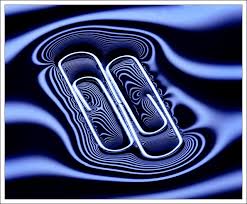
The tightness across the surface of water that enables paper clips to float is ____________.
a)
adhesion
b)
capillary action
c)
surface tension
d)
polarity
9.
Which statement explains why water molecules stick together?
a)
both sides are negative
b)
one side has a positive charge and the other side has a negative charge
c)
one side has a negative charge adn the other side has a neutral charge
d)
both sides are positive
10.

When a molecule has an opposite electrical charge on each end, it is known as what?
a)
cohesion
b)
polar molecule
c)
hydrogen bond
d)
solution
11.
Water beads up on the surface of a penny because of what property?
a)
Adhesion
b)
High Surface Tension
c)
Universal Solvent
d)
Changes in Density
12.
Green plants produce their own food through the process of photosynthesis.
a)
All living things use energy
b)
All living things contain cells
c)
All living things maintain homeostasis
d)
All living things grow
13.
A camel has eyelashes that work to keep the dust and sand out of its eyes.
a)
All living things adapt to their environment
b)
All living things grow
c)
All living things have cells
d)
All living things use energy
14.
Over three years, Tim's height has increased from 5'4" to 5'11".
a)
All living things contain cells
b)
All living things maintain homeostasis
c)
All living things use energy
d)
All living things grow
15.
The roots of a plant grow towards a source of ground water.
a)
All living things use energy
b)
All living things reproduce
c)
All living things respond to their environment
d)
All living things grow
16.
YOU are a multi-celled organism but an amoeba is a single celled organism.
a)
All living things have cells
b)
All living things grow
c)
All living things use energy
d)
All living things respond to their environment
17.
Living things are made up of units called
a)
DNA
b)
Cells
c)
Homeostasis
d)
Seeds
18.
Living things are based on a universal genetic
code. What molecule is responsible for that code?
a)
RNA
b)
Lipid
c)
Protein
d)
DNA
19.
Rocks are not living because
a)
they never move
b)
they aren't needed for humans
c)
they are not made of cells
d)
they don't break down
20.
Information gathered using your 5 senses.
a)
Observation
b)
Inference
21.
Mini conclusion used to explain what you see, hear, or experience.
a)
Observation
b)
Inference
22.
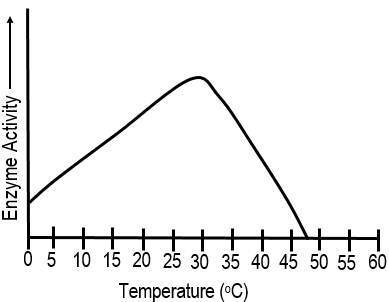
Based on the graph, what is the optimum temperature for this enzyme?
a)
15 C
b)
40 C
c)
30 C
23.
What happens when enzymes are heated to a high temperature?
a)
The enzymes die.
b)
The shapes of the enzyme are altered or denatured
c)
The enzymes' amino acid sequence changes.
d)
The enzymes remain the same
24.
Enzymes are
a)
nucleic acids
b)
proteins
c)
lipids
d)
carbohydrates
25.
Which is the strongest acid?
a)
ph of 1
b)
ph of 4
c)
ph of 7
d)
ph of 9
26.
A solution with a pH of 9 is a(n) ___.
a)
Acid
b)
Base
27.
What is a substance called if it speeds up a chemical reaction?
a)
reusable
b)
catalyst
c)
specific
d)
fragile
28.
With what 3 letters do enzymes typically end?
a)
-ose
b)
-ase
c)
-ese
d)
-tic
29.
Each enzyme only has 1 substrate that will fit its active site. What is this called?
a)
reusable
b)
catalyst
c)
specific
d)
fragile
30.
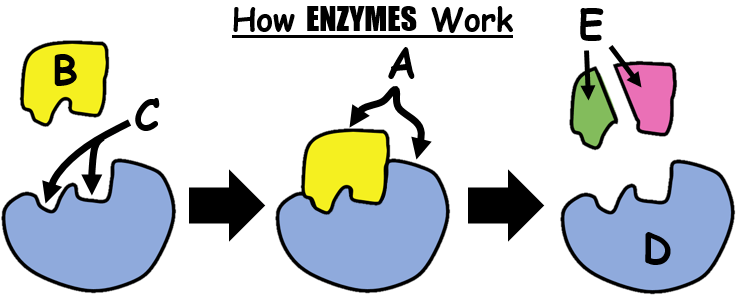
Letter D...
a)
active site
b)
enzyme
c)
substrate
d)
products
31.
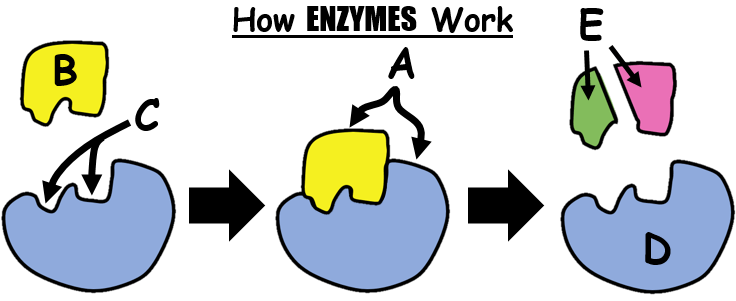
Letter B...
a)
active site
b)
enzyme
c)
substrate
d)
products
32.
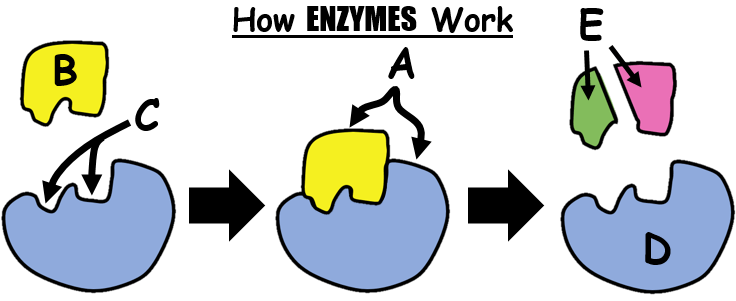
Letter C...
a)
active site
b)
enzymes
c)
substrate
d)
products
33.
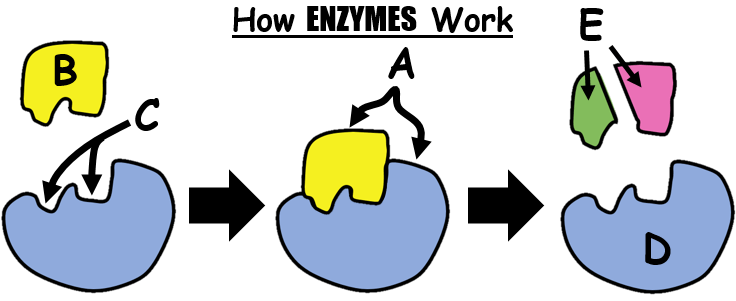
Letter E...
a)
active site
b)
enzyme
c)
substrate
d)
products
34.
What happens when enzymes are heated to a high temperature?
a)
The enzymes die.
b)
The shape of the enzyme are changed and it denatures
c)
The enzymes' amino acid sequence changes.
d)
The enzymes remain the same
35.
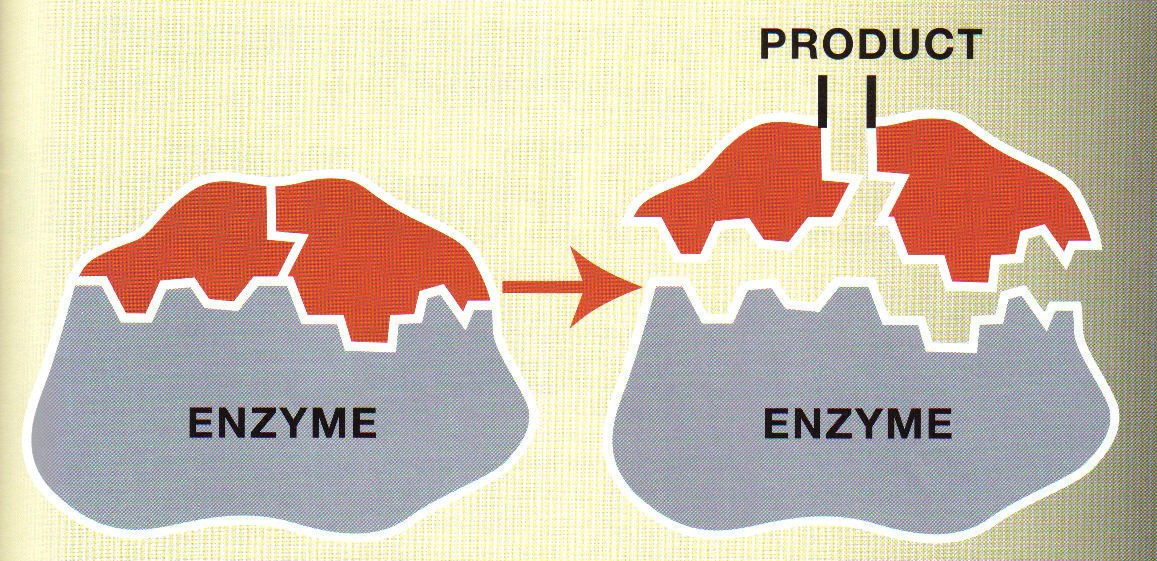
The molecule an enzyme is working on is called the:
a)
Substrate
b)
Solvent
c)
Allosteric Inhibitor
d)
CoEnzyme
36.
Which of these is NOT true?
a)
Enzymes can denature (change shape) when the temperature gets too high.
b)
Enzymes can only be used once in a chemical reaction.
c)
Extreme pH can denature enzymes.
d)
Enzymes speed up chemical reactions.
37.
What is the function of an enzyme?
a)
enzymes break themselves into small pieces
b)
enzymes slow down chemical reactions
c)
enzymes speed up chemical reactions
d)
enzymes combine products to form reactants
38.
What happens to an enzyme when it is denatured?
a)
Activation energy is lowered.
b)
It becomes stronger.
c)
It loses its shape.
d)
Activation energy is raised.
39.
Enzymes will make a reaction go _______ and use ______ energy.
a)
faster, less
b)
faster, more
c)
slower, less
d)
slower, more
40.
What are two factors that can affect an enzymes ability to function?
a)
Temperature and pH
b)
Hot and Cold
c)
Dry and Humid
d)
None of the above
100 %

