
 Worksheets
Mass, Volume, and Density Review
Total questions: 47
Worksheet time: 34mins
Mass, Volume and density are all properties of what?
Gravity
Formulas
Matter
Weight
What does Matter make up?
solids
gases
liquids
all of the above
Mass is measured using what?
scale
glass
graduated cylinder
displacement
A graduated cylinder is used to measure the volume of what?
plasma
liquid
solid
gas
What does density measures?
how much liquid is in an object
how tightly packed an objects particles are
The amount of space an object takes up
the amount of matter contained in an object

What is the volume of the water in the graduated cylinder? (TYPE THE NUMBER ONLY - DON'T TYPE MILLILITERS BEHIND THE NUMBER)
(a)
What does density tell you about an object?
how big it is
if it will sink or float
how heavy it is
what color it is
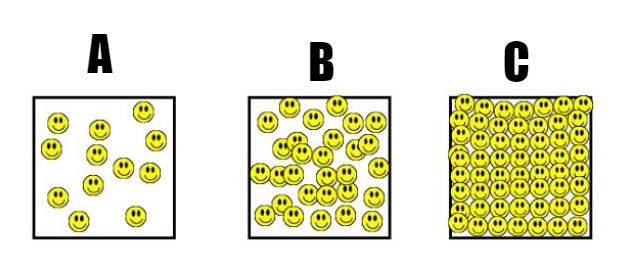
Which box shows the particles of an object that is the MOST DENSE?
A
B
C
they are all the same
If an object is more dense than water, what will it do when placed in water?
it will disappear
it will sink
it will float
it will break apart

Which one is lighter?
tennis ball
scale
book
What is volume?
how heavy something is
how much space something has
the shape of an object
how much matter is in an object

How many milliliters of liquid are in this graduated cylinder?
5 ml
10 ml
6 ml
9 ml

What is the volume of this container?
22 ml
20 ml
25 ml
30 ml

What is the mass of this banana?
100 g
400 g
200 g
150 g

What is the mass of this orange?
100 g
200 g
150 g
250 g

The curved surface at the top of a column of water is called the __________ .
arch
meniscus
bowl
scoop

303.4 g
370.4 g
373.0 g
373.4 g

How much water has been displaced in the image shown?
80 mL
65 mL
20 mL
10 mL

What is the volume of the fish?
18.0 ml
6.0 ml
38.0 ml
Q.
What is mass?
The amount of matter an object has.
The force of gravity pulling down on you.
A large number of objects crowded together
The density of an object compared to the density of another object (will it sink or float?)
physical properties
volume
matter
relative density

In this picture: What is the correct order of the states of matter?
Solid, Liquid, Gas
Gas, Liquid, Solid
Liquid, Gas, Solid
Solid, Gas, Liquid

The diagram shows the arrangement of particles in a _______
solid
liquid
gas

A physical property of matter that students are most likely investigating.
Mass
Volume
Density
Length

The fork is-
Less dense than water
More Dense than the apple
Has the same density as the apple

The rubber ball is-
Less dense than the water
The same density as the scissors
More dense than the marbles
What tool measures mass?
Triple beam balance
Measuring spoons
beaker
graduated cylinder

What physical property of the floatie can we observe?
Solubility
Mass
Density
Conductivity

Is the pizza's mass-
Increasing
Decreasing
Matter is anything that has mass and __________.
is nonliving
takes up space
is living
is made up of water or air
Which of these are made up of matter?
water
a piece of paper
a chair
air
all of the above

Select the physical properties of this bowling ball that you can observe in the picture.
Check all that are true.
red
magnetic
round
shiny
breakable
Physical properties of matter can be __________.
determined using the five senses
measured
discovered with a test or experiment
all of the above
These models show the movement and organization of particles in three states of matter. Which set of models is labeled correctly?


The amount of space an object takes up.
Mass
Volume
Density
Displacement


What is the name of this metric tool?
Triple Beam Balance
Graduated Cylinder
Massometer
Triple beam balances measure ________________.
Volume
Length
Mass
The abbreviation "g" stands for ___________.
ounces
gorillas
pounds
grams

Find the mass.
550.4 g
559.4 g
550.6 g

Find the mass.
5 g
0.5 g
0.2 g

Find the mass.
285.3 g
275.5 g
275.3 g

What is the value on the balance?
480.5 g
840.05 g
408 g

What is the value on the balance?
240.0 g
142.0 g
100.4 g

What is the value on the balance?
444.0 g
144 g
140.1 g

What is the value on the balance?
354.6 g
430 g
645.3 g

