wayground logo

Free Printable Worksheets

Font size

S
M
L
XL
Worksheets

State and Physical properties of Matter

Total questions: 28

Worksheet time: 16mins

Name
Class
Date
1.
At higher temperatures
a)
particles in an object have less energy
b)
particles in an object move faster
c)
a gas contracts
2.
Which form of matter does not take the shape of its container?
a)
liquid
b)
gas
c)
solid
d)
air
3.
How is a gas defined?
a)
Indefinite shape, indefinite volume
b)
Definite shape, definite volume
c)
Found in stars
d)
Definite volume, indefinite shape
4.

Particles of a liquid

a)

are tightly packed together and stay in a fixed position.

b)

are free to move around one another but still touch.

5.

The slower the particles in a substance move,

a)

the colder it is.

b)

the warmer it is.

c)

the more energy it has.

6.

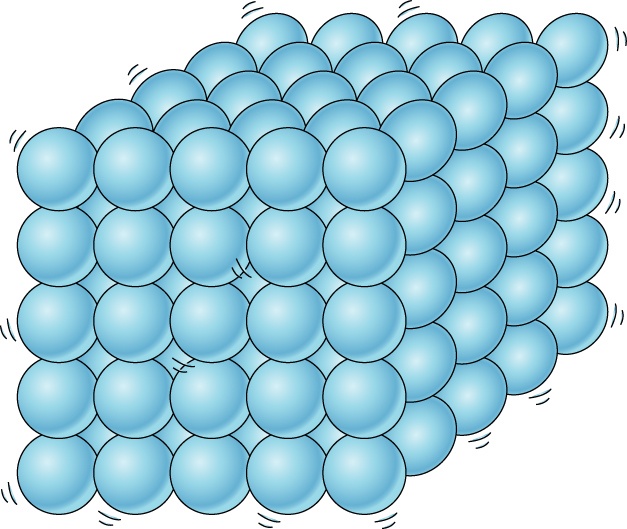
What state of matter?

a)

Solid

b)

Liquid

c)

Gas

d)

Plasma!!!

7.

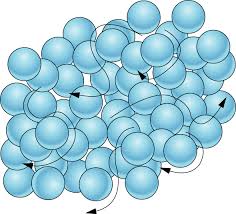
What state of matter?

a)

Solid

b)

Liquid

c)

Gas

8.

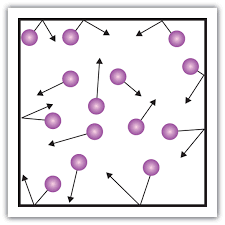
What state of matter?

a)

Solid

b)

Liquid

c)

Gas

9.
When the temperature of matter increases the particles...
a)
speed up and move closer
b)
speed up and move farther apart
c)
slow down and move closer together
d)
slow down and move farther apart
10.

What is the phase change of a solid to a liquid?

a)

freezing

b)

melting

c)

boiling

d)

condensation

11.
5. What is it called when a solid turns directly into a gas?
a)
Sublimation
b)
Condensation
c)
Liquid
12.
7. All phase changes (changing states) requires energy to be added or taken away.
a)
True
b)
False
13.
Change from Gas to Solid is called........
a)
Sublimation
b)
Deposition
c)
Fusion
d)
condensation
14.

Change from Liquid to Solid is called ...

a)

fusion

b)

Freezing

c)

sublimation

d)

evaporation

15.
Change from gas to liquid...
a)
condensation
b)
evaporation
c)
expansion
d)
movement
16.

Change from liquid to gas is called....

a)

expansion

b)

evaporation

c)

condensation

d)

sublimation

17.

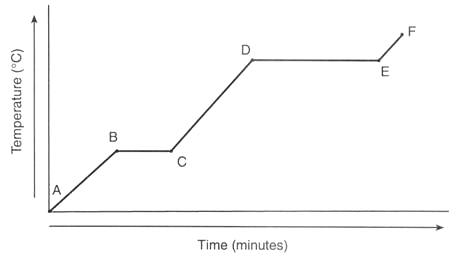
What state/phase is the object likely from points A to B?

a)

Solid

b)

Liquid

c)

Gas

d)

Plasma

18.

What is happening to the particles in the substance between points D and E?

a)

Melting

b)

Freezing

c)

Vaporizing

d)

Sublimating

19.

Where on the graph are phase changes taking place?

a)

1

b)

2

c)

3

d)

4

e)

5

20.
Are there molecules moving in a solid brick?
a)
yes
b)
no
c)
maybe
d)
not sure
21.
What is an example of sublimation?
a)
Ice cream melting
b)
Dry ice
22.
Sublimation is
a)
when solid turns into gas
b)
when gas turns into plasma
c)
when liquid turns into gas
d)
when gas turns into solid
23.

The temperature at which a SOLID becomes a LIQUID.

a)

melting point

b)

freezing point

c)

viscosity

d)

solubility

24.

Properties that can be observed directly or measured without changing the chemical identity of the substance.

a)

chemical properties

b)

soluable properties

c)

density properties

d)

physical properties

25.

A fluid's resistance to flow.

a)

solubility

b)

melting point

c)

viscosity

d)

friction

26.

Which of the following is an example of a physical property?

a)

mass

b)

shape

c)

luster

d)

all of these are physical properties

27.

The temperature at which a LIQUID becomes a GAS.

a)

melting point

b)

condensation

c)

boiling point

d)

cooling point

28.

Measure of compactness or consistency of a material.

a)

volume

b)

density

c)

solubility

d)

properties