
 Worksheets
Reviewer in MATH 7
Total questions: 113
Worksheet time: 3hrs 42mins
What do you call the illustration used to represent the relationships between sets?
Circle Graph
Venn Diagram
Pie Chart
Circle Diagram

What operation is being shown by the shaded region?
A−B
A′
A∪B
A∩B

What operation is being shown by the shaded region?
A − B
B′
A∪B
A∩B

What is U = ?
{6, 14, 20}
{2, 4, 8, 10, 12, 16, 18}
{2, 4, 6, 8, 10, 12, 14, 16, 20}
{2, 4, 6, 8, 10, 12, 14, 16, 18, 20}
What is B - A = ?
{2, 4, 12}
{8, 10, 16}
{6, 14, 20}
{18}
What is B' = ?
{2, 4, 12, 18}
{8, 10, 16, 18}
{6, 14, 18, 20}
{18}
What is (A U B)' = ?
{2, 4, 12, 18}
{8, 10, 16, 18}
{6, 14, 18, 20}
{18}
The Universal Set = { -4, -3, -2, -1, 0, 1, 2, 3 ,4} and A = {0}.
What is the complement of A?
{-4, -3, -2, -1, 0, 1, 2, 3}
{-3, -2, -1, 1, 2, 3}
{-4, -3, -2, -1, 1, 2, 3, 4}
{-4, -3, -2, -1, 1, 2, 3}
The Venn diagram for A∪B is represented in green as
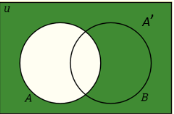
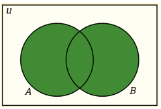
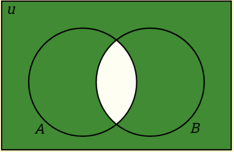
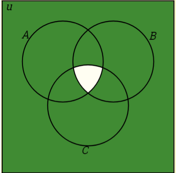

Identify the shaded area...
A
B
A'
B'
Given the sets
A = {2, 3, 4, 5} and B = {2, 4, 5, 6}
What is A∪B ?
{2, 4, 5}
{2, 3, 4, 5, 6}
{3}
{6}
Given the sets
A = {a, b, c, d, e} and B = {a, c, d, f}
What is A ∩ B ?
{a, c, d}
{a, b, c,d e, f}
{b, e}
{f}
Given the sets
U = {a, b, c, d, e, f, g, h, i, j}
A = {a, c, e, g, i} and B = {b, c, d, e, f}
What is B′ ?
{a, b, c, d, e, f, g, i}
{b, d, f, h}
{a, g, h, i, j}
{c, e}
If A = {1, 3, 5, 7, 9} and B = {2, 3, 5, 7}, what is A ∪ B?
{3, 5, 7}
{2, 3, 5, 7}
{2, 3, 5, 7, 9}
{1, 2, 3, 5, 7, 9}
If A = {1, 3, 5, 7, 9} and B = {2, 3, 5, 7}, what is A ∩ B?
{3, 5, 7}
{2, 3, 5, 7}
{2, 3, 5, 7, 9}
{1, 2, 3, 5, 7, 9}
The Universal Set = { -4, -3, -2, -1, 0, 1, 2, 3 ,4} and A = {0}.
What is the complement of A?
{-4, -3, -2, -1, 0, 1, 2, 3}
{-3, -2, -1, 1, 2, 3}
{-4, -3, -2, -1, 1, 2, 3, 4}
{-4, -3, -2, -1, 1, 2, 3}
It is an operation on sets that contains elements that are common to both sets.
Complement of a Set
Difference of Two Sets
Intersection of Sets
Union Sets
What does this symbol ( ∪ ) represent in set theory?
Union
Intersection
Disjointed
Subset
What is the cardinal of the set, H = {w, o, n, d, e, r, f, u, l}
10
9
8
7
It is an operation on sets that contains all elements of both sets without repeating element/s.
Complement of a Set
Difference of Two Sets
Intersection of Sets
Union Sets
It is an operation on sets that contains elements belong to set A, but do not belong to set B.
Complement of a Set
Difference of Two Sets
Intersection of Sets
Union Sets
Given the sets
A = {2, 4, 6, 8} and B = {3, 4, 5, 6, 7}
What is B − A ?
{2, 3, 4, 5, 6, 7, 8}
{4, 6}
{8}
{3, 5, 7}
if U = { red, blue, green, yellow, purple}
A = {red, blue,yellow}
what is A'?
A' = {green, purple}
A' = {purple}
A' = {blue, red, purple}
A' = {red, blue green}
Given P = {apple, orange, banana, mango} and
Q = {orange, mango, watermelon}, what is P
P ∪ Q = {apple, orange, banana, mango}
P ∪ Q = {apple, orange, banana}
P ∪ Q =
P ∪ Q = {apple, orange, banana, mango, watermelon}
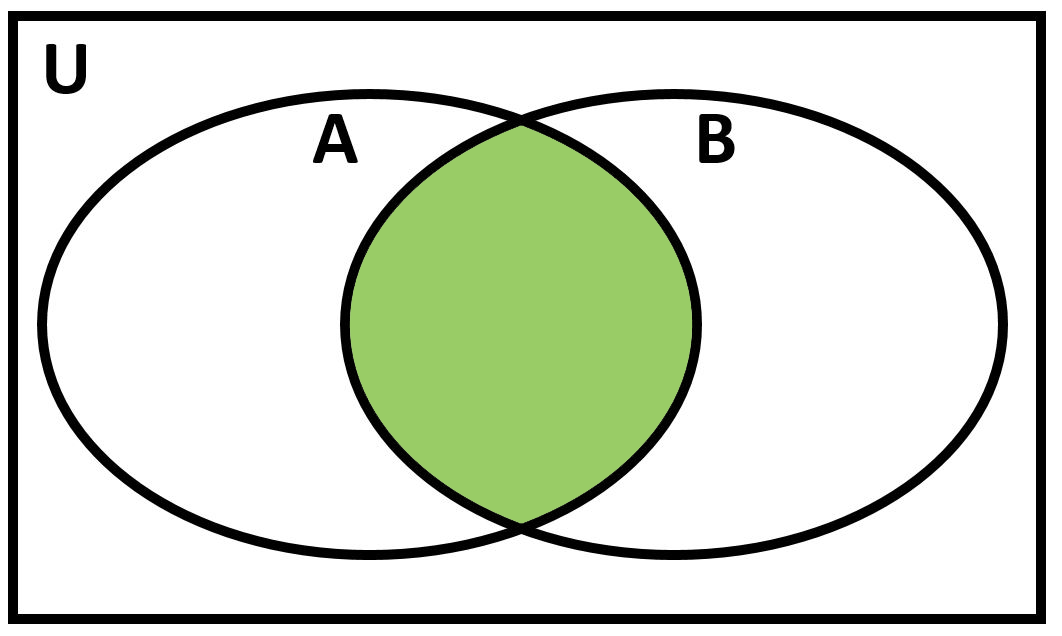
Which of the following operations on sets describes the given Venn Diagram?
A ∪ B
A ∩ B
A − B
A′
Given the sets
A = {a, b, c, d, e} and B = {a, c, d, f}
What is A ∩ B ?
{a, c, d}
{a, b, c,d e, f}
{b, e}
{f}
Given the sets
U = {a, b, c, d, e, f, g, h, i, j}
A = {a, c, e, g, i} and B = {b, c, d, e, f}
What is B′ ?
{a, b, c, d, e, f, g, i}
{b, d, f, h}
{a, g, h, i, j}
{c, e}
If A = {1, 3, 5, 7, 9} and B = {2, 3, 5, 7}, what is A ∪ B?
{3, 5, 7}
{2, 3, 5, 7}
{2, 3, 5, 7, 9}
{1, 2, 3, 5, 7, 9}
The Universal Set = { -4, -3, -2, -1, 0, 1, 2, 3 ,4} and A = {0}.
What is the complement of A?
{-4, -3, -2, -1, 0, 1, 2, 3}
{-3, -2, -1, 1, 2, 3}
{-4, -3, -2, -1, 1, 2, 3, 4}
{-4, -3, -2, -1, 1, 2, 3}
Given the universal set, ξ = {2, 3, 4, 5, 6, 7, 8, 9, 10}. Set P={3,5,7,9}, Set Q={2,3,5,7} and Set R ={2,4,6,8,10}. List all the elements of (P∩Q)'.
{5,7}
{2,4,6,8,10}
{2,4,6,8,9,10}
{2,9}
From a group of students, there are 21 students who like swimming, 24 students who like badminton, and 15 students like them both. If there is no students who do not like swimming or badminton. How many students are in the group?
30
50
40
60
From 40 students, it is known: 30 students like mathematics, 28 students like physics, and 20 students like both of them. How many students like neither maths nor physics?
10
5
8
2
From 30 girls, it is known that 12 girls love sewing, 18 girls love cooking, and 7 girls like neither sewing nor cooking. How many girls who like sewing and cooking?
5
11
7
15
A school has a sport contingent consisting of 20 people. There are 15 members of soccer team and 8 members of volley team. How many participants who are the members of both soccer and volley teams?
1
3
2
4

What is another name for the counting numbers?
Basic
Natural
Obvious
Easy

A rational number _____ be written as a fraction. If it is written as a decimal, the decimal ________ or _______ .
Cannot; never terminates; never repeats.
Cannot; terminates; repeats
Can; terminates; repeats
Can; terminates; never repeats

Irrational numbers _______ be written as fractions. If they are written as decimals, the decimals ________ and _______ .
Cannot; never terminate; never repeat
Cannot; terminate; never repeat
Can; terminate; repeat
Can; never terminate; repeat

Whole numbers are the natural numbers and _____.
Negative numbers
Fractions
Zero
Non-terminating decimals

What set do the numbers 0, 95, and √144 belong to?
Natural
Integer
Whole
Rational

Which of the following numbers is NOT an integer?
- √36
0
8/4
-0.15

Which list shows only natural numbers?
0, 1, 2, 3, 4, ...
1, 2, 3, 4, ...
-3, -2, -1, 0, 1, 2, 3, ...
All numbers are natural numbers

To which of the following sets of numbers does √196 belong?
I. Natural Numbers
II. Integers
III. Rational Numbers
IV. Irrational Numbers
I only
I, II, and III only
III only
IV only

True or False: If a number is classified as an integer, it must also be a whole number.
True
False

True or False: The set of irrational numbers is a subset of rational numbers.
True
False

True or False: Every natural number (aka counting number) is an integer.
True
False

True or False: Every whole number is a rational number.
True
False
Find the opposite of -6
-6
+6
none
Find the opposite of 0
+0
-0
none
Find the opposite of 150
150
-150
+150
Find the opposite of -32
-32
32
+32
Compare -35 ___ -17
>
<
=
Compare 9 ___ -90
<
>
=
Compare -20 ___ 0
<
>
=
Compare 20 ___ 0
<
>
=
Compare 1 ___ +1
<
>
=
Find ∣−25∣
-25
25
∣25∣
Find ∣−15∣
15
-15
∣15∣
Find ∣0∣
+0
0
-0
Find - ∣3∣
3
∣3∣
-3
Find ∣999∣
-999
999
+999
Set of numbers ordered from least to greatest
{-1, -2, -8, 8 , 3}
{-8, -1, -2, 3, 8}
{-8, -2, -1, 3, 8}
Set of numbers ordered from least to greatest
{-20, 0, -18, -35, 2}
{0, 2, -18, -20, -35}
{-35, -20, -18, 0, 2}
Set of numbers ordered from greatest to least
{40, 12, -10, -19, -30}
{40, -30, 12, -10, -19}
{-30, -19, -10, 12, 40}
Set of numbers ordered from greatest to least
{99, 98, 96, -93, -94}
{99, 98, 96, -94, -93}
{-94, -93, 99, 98, 96}
Identify each solution as rational or irrational.
74+−31
Rational
Irrational
The product of two irrational numbers is always an irrational number.
Always True
Sometimes True
Never True
Choose the best description of the number 10.5
real and whole
real and irrational
real and rational
real and integer
The difference of two rational numbers is always a rational number.
Always True
Sometimes True
Never True
The product of a irrational and an rational number is always rational.
Always True
Sometimes True
Never True
An integer is a whole number.
Always True
Sometimes True
Never True
A natural number is a rational number.
Always True
Sometimes True
Never True
An irrational number is an integer.
Always True
Sometimes True
Never True
The sum of a rational and irrational number is always irrational.
Always True
Sometimes True
Never True
An irrational number multiplied by 0 will result in an irrational number.
Always True
Sometimes True
Never True
Identify the solution as rational or irrational.
4×52
Rational
Irrational
Choose the best description of the number 0
Real, whole, integer, rational
real and irrational
real and rational
real and natural
Choose the best description of the number 2 .
Real and irrational
Real and rational
Real and integer
Real and whole
Choose the best description of the number -29.
Real and irrational
Real and integer
Real and natural
Real and whole
Which is the best description of a rational number?
A number that is a whole number.
A number that can be written as a fraction.
A number that cannot be written as a fraction.
A number that is a natural number.
Which is the best description of an irrational number?
A number that is an integer.
any number other than zero.
A number that can be written as a fraction.
A number that cannot be written as a fraction.
Which sum will result in an irrational number?
3+8
7+9
71+52
98+83
Which product will result in a rational number?
π×54
53(32)
π×π1
7(π)
l 4x−3 l = 17
l x−6 l + 4= 10
−2|−2r − 4| = -12
{3,1}
{-5,1}
{-3}
No Solution
| x + 9 | = -5
2 lx−4l+8=18
Solve the following equation:
|−2n| + 10 = −50
{30, −30}
{20, −20}
{−5, 5}
No Solution
Solve the following equation:
|−2n| - 30 = −20
{10, −10}
{20, −20}
{−5, 5}
No Solution
l 2x−1 l = 9
Solve the following equation:
3| −8x| + 8 = 80
{−7/3, 7/3}
{−3, 3}
{11/3, −11/3}
No Solution
Solve the following equation:
|2x – 3| + 5 = 10.
{−1, 1}
{−1, 4}
{−1, −4}
{1, 4}
9
-9
15
-15
Give the sum: 23 + 100 + (-56) + (-90) + 74
61
41
51
71
Add these integers: 0, -1,-1,-1, 2,-1,2
0
1
-1
2
-15 - (-2)
-19 - 19
-38
Find the values of (−4)×(−5)
−9
9
20
−20
Find the value of 2×(−1)×(−3)
6
−6
−5
5

Evaluate −6(−4)(3)(−2)
12
4
-6
-4
Evaluate (2)(−6)−9(−3)(−4)
-9
-8
9
6

