
 Worksheets
Alg U123-24 Functions and Arithmetic Sequences
Total questions: 96
Worksheet time: 24hrs 0mins
Which graph best represents the equation y = -3x + 4?
Hint: Identify the slope and y-intercept!


What is the equation for this graph?
y=x
y=x1
y=x+2
y = 2x
y=−x

Is this a function?

Is this a function?

Is this a function or not a function?

Is the graph continuous or discrete?
discrete
continuous

Is the graph continuous or discrete?
Discrete
Continuous

What is the RANGE of this graph?
-7 < x < 5
-7 ≤ y < 5
-3 < x < 1
-3 ≤ y < 1

What is the DOMAIN of this graph?
-4 ≤ x ≤ 3
-1 ≤ x ≤ 4
4 < x < 3
-1 < x < 4

What is the DOMAIN of this graph?
x < -3
x ≤ -3
x > -3
x ≥ -3

What is the RANGE of this graph?
y ≥ 6
y≤6
-10 ≤ y ≤ 6
-10 ≤ x ≤ 6

Is the graph continuous or discrete?

Is the graph continuous or discrete?

Is the following function increasing, decreasing, constant, or a combination?
Increasing
Decreasing
Constant
Combination

Is the following function increasing, decreasing, constant, or a combination?
Increasing
Decreasing
Constant
Combination
Is the graph continuous or discrete?

Which section is neither increasing nor decreasing but is constant?
D
A
F
B

Find the rate of change
21
2
-2
−21

What is the common difference of the given arithmetic sequence:
–2, 5, 12, 19, 26, . . . ?
–2
3
5
7
Which of the following sequences is an arithmetic sequence?
5, 12, 21, 32, 45, . . .
3, 6, 12, 24, 48, . . .
–8, –5, –2, 1, 4, . . .
12, 7, 11, 6, 10, 5, . . .
Which of the following sequences is NOT an arithmetic sequence?
25, 13, 1, –11, –23, . . .
9, 15, 21, 27, 33, . . .
–12, –4, 4, 12, 20, 28, . . .
–4, 5, 18, 35, 56, 81, . . .
Given a1=−5 and an=an−1+3 , what are the first 4 terms in the sequence?
-5, -2, 1, 4
-5, -8, -11, -14
3, -2, -7, -12
3, -15, 75, -375
Which of the following sequence is NOT an arithmetic?
25, 13, 1, –11, –23, . . .
9, 15, 21, 27, 33, . . .
–12, –4, 4, 12, 20, 28, . . .
–4, 5, 18, 35, 56, 81, . . .
What is the common difference of the given arithmetic sequence:
–26, –17, –8, 1, 10, 19, . . .?
–9
–10
9
10
Type AS if the given sequence is an arithmetic and NAS if it not an arithmetic sequence:
8, –7, –22, –37, –52, –67
(a)
What is the common difference of the given arithmetic sequence: –20, –9, 2, 13, 24, 35, . . .?
(a)
What is the common difference of the given arithmetic sequence: 9, –4, –17, –30, –43, –56, . . .?
(a)
Type AS if the given sequence is an arithmetic and NAS if it not an arithmetic sequence:
–13, –7, –2, 2, 5, 7, . . .
(a)

Identify where the function is decreasing.
x < -4 , x > 1
-4 < x < 1
-6 < x < 7.5
All Real Numbers

Identify where the function is decreasing.
x < 0
x > 0
x < -3 , x > 3
-3 < x < 3


Is the following an increasing, decreasing or constant function?
increasing
decreasing
constant
What do we know about the slope for increasing functions?
The slope is positive
The slope is negative
There is zero slope

What is the decreasing interval(s) on the function shown?
(−7, −6) and (−2, 4)
(−7, 0) and (−2, 4)
(−7, −6) and (−2, 0)
(−7, 0) and (4, 5)


Slope is known as rise / ?what?
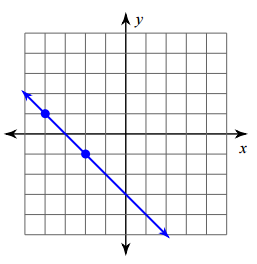
(6,7) and (4,2)
(2, 4) and (6, 12)
(10, 1) and (5, 2)

What is the slope represented in the table?
slope: 21
slope: 2
slope: −21
slope: −2

What is the Slope represented in this table?
slope: −41
slope: −4
slope: 41
slope: 4

Negative


Is y a function of x?
function
not a function

Is y a function of x?
function
not a function

Is y a function of x?
function
not a function
Which graph represents a function?


Which image is NOT the graph of a function?


Answer this question!
67 + 66
100 + 33
142 + (-9)
157 + (-33)

Answer this question!
36 + 9
30 + 15
40 + 5
20 + 25

Answer this question!
7 x 7
17 x 3
3 x 17
9 x 6

Answer this question!
198 + 10
198 + 20
104 + 104
108 + 100

Answer this question!
5 x 32
18 x 9
54 x 3
32 x 5
In which of the following graphs below are both runners moving at the same speed?


Match the description to the graph:
"The car is stopped."


Match the description to the graph:
"The car is coming back."
Match the description to the graph:
"The car is traveling at a constant speed."


Deb walked to the ice cream shop. Sat and ate her ice cream and then went for a run.
Which graph matches this motion?
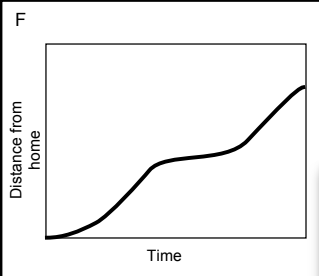
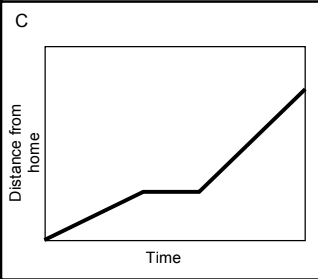
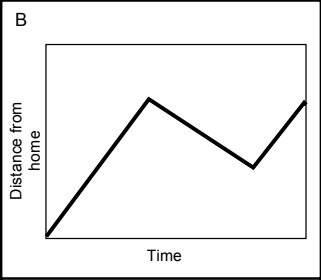
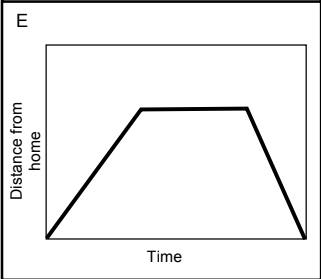

What is the speed of the object at 3 hours?
0 mi/hr
24 mi/hr
2.5 mi/hr
6 mi/hr

What is the displacement of (that is, the distance traveled by) the object at 45 seconds?
7 m
13 m
.16 m
6.4 m
Deb walked to the ice cream shop. Sat and ate her ice cream and then went for a run.
Which graph matches this motion?


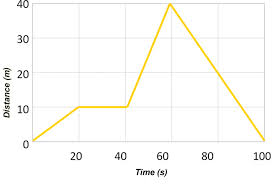

What was occurring from point B to point C?
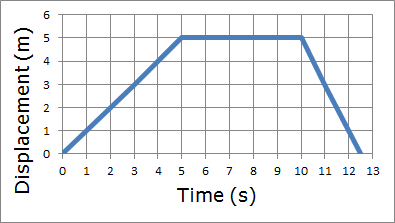
Which of these graphs do not show the object staying still?


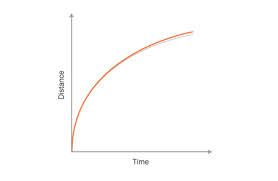

The word "stationary" means...
moving towards
moving away
moving
not moving

Edward drove 80 miles from his home to London.
He stopped and visited his friend Nicola on the way. Here is the distance-time graph for the journey.
How far was Edward from home when he visited Nicola?
30 miles
40 miles
10 miles
45 miles

Edward drove 80 miles from his home to London.
He stopped and visited his friend Nicola on the way.
Here is the distance-time graph for the journey.
How long did Edward stop?
2 hours
1 hour
1.2 hours
1.5 hours

Anne cycles from Bristol to Salisbury.
The diagram shows the distance-time graph of her journey.
What is Anne's speed for the first two hours of her journey?
40 mph
30 mph
20 mph
10 mph

Anne cycles from Bristol to Salisbury.
The diagram shows the distance-time graph of her journey.
How far from Bristol is Anne at 8:00?
15 miles
20 miles
10 miles
40 miles

