
 Worksheets
Transformations
Total questions: 100
Worksheet time: 1hrs 26mins
If point H(–6, 2) is translated 4 units up and 3 units right, what are the coordinates of the translated image?
(-2, 5)
(-3, 6)
(-9, -2)
(-9, 6)
If point H(–6, 2) is translated 4 units up and 3 units right, what are the coordinates of the translated image?
(-2, 5)
(-3, 6)
(-9, -2)
(-9, 6)
Point N(6, –5) is reflected across the
x-axis. What are the coordinates of the image?
(-6, -5)
(-5, 6)
(5, -6)
(6, 5)

Suppose triangle RST shown on the
coordinate grid is reflected across the y-axis. Which ordered pair does not represent a vertex of the reflected triangle?
(5, 1)
(-4, -2)
(2, -4)
(-2, 4)
Triangle LMN has vertices L(–1, 4), M(–2, 4), and N(–1, –1). What are the coordinates of the image of point M after a dilation with a scale factor of 3?
(-6, 12)
(-6, 4)
(-2, 12)
(12, -6)

If the figure is rotated 90 degrees clockwise, what are the coordinates of R?
(-3, 3)
(3, -3)
(-3, -3)
(3, 3)
Triangle RST has vertices R(–1, 1), S(3, 1), and T(3, –4). What are the coordinates of the image of RST after a translation 4 units to the left and 2 units down?
R'(–5, 1), S'(–1, 1), and T'(–1, –4)
R'(–5, –1), S'(3, –1), and T'(–1, –4)
R'(–1, –1), S'(3, –1), and T'(3, –6)
R'(–5, –1), S'(–1, –1), and T'(–1, –6)
Point A(3, 5) was dilated, and the point after dilation was A’(6, 10). What was the scale factor used?
1/2
2
1
3

What scale factor was used for the dilation shown?
1/2
1
2
3
The vertices of triangle GHI are G(1, 2), H(3, 4), and I(4, 2). The triangle will be reflected across the x-axis. What will be the coordinates of the image point H′?
(-3, 4)
(3, -4)
(-3, -4)
(3, 4)
Point W is located at (7, 3) on a coordinate plane. Point W is translated 2 units to the left and 3 units up. What are the coordinates of the image point W′?
(10, 1)
(9, 0)
(5, 6)
(4, 1)

(x-2, y+9)


Describe the transformation:
(x, y) -> (x+3, y)
Translation 3 units to the left
Translation 3 units up
Translation 3 units to the right
Translation 3 units down
Describe the transformation:
(x, y) -> (x, y-2)
Translation 2 units to the left
Translation 2 units up
Translation 2 units to the right
Translation 2 units down
Describe the transformation:
(x, y) -> (x-2, y+7)
Translation 2 units to the left & 7 units up
Translation 2 units to the left & 7 units down
Translation 2 units to the right & 7 units up
Translation 2 units to the right & 7 units down
Describe the transformation:
(x, y) -> (x-1, y+1)
Translation 1 unit to the left & 1 unit down
Translation 1 unit to the left & 1 unit up
Translation 1 unit to the right & 1 unit down
Translation 1 unit to the right & 1 unit up
Describe the transformation:
(x, y) -> (x, y-10)
Translation 10 units to the left
Translation 10 units up
Translation 10 units to the right
Translation 10 units down
Describe the transformation:
(x, y) -> (x, -y)
reflection across the x-axis
reflection across the y-axis
rotation 90 degrees clockwise
rotation 90 degrees counterclockwise
Describe the transformation:
(x, y) -> (-x, y)
reflection across the x-axis
reflection across the y-axis
rotation 90 degrees clockwise
rotation 90 degrees counterclockwise
Describe the transformation:
(x, y) -> (-y, x)
reflection across the x-axis
reflection across the y-axis
rotation 90 degrees clockwise
rotation 90 degrees counterclockwise
Describe the transformation:
(x, y) -> (y, -x)
reflection across the x-axis
reflection across the y-axis
rotation 90 degrees clockwise
rotation 90 degrees counterclockwise
Describe the transformation:
(x, y) -> (3x, y)
Horizontal translations 3 units to the right
Vertical translation 3 units up
Horizontal stretch 3 times as wide
Vertical stretch 3 times as tall
Describe the transformation:
(x, y) -> (x, 2y)
Horizontal translations 2 units to the right
Vertical translation 2 units up
Horizontal stretch 2 times as wide
Vertical stretch 2 times as tall
A mirror image of a figure
Translation
Reflection
Rotation
Dilation
to slide or move a figure
Translation
Reflection
Rotation
Dilation
Turning around a point
Translation
Reflection
Rotation
Dilation
To change the size of a figure
Translation
Reflection
Rotation
Dilation
What does it mean if two figures are congruent?
The figures are the same shape, but different size
The figures are different size and shape
The figures are the same size and shape
The figures are the same size, but different shape

Are the figures congruent?
(What type of transformation is shown?)
Congruent (rotation)
Congruent (reflection)
NOT Congruent (rotation)
NOT Congruent (reflection)

Are the figures congruent?
(What type of transformation is shown?)
Congruent (rotation)
Congruent (reflection)
NOT Congruent (rotation)
NOT Congruent (reflection)

Are the figures congruent?
(What type of transformation is shown?)
NOT Congruent (dilation)
NOT Congruent (translation)
Congruent (dilation)
Congruent (translation)

Are the figures congruent?
(What type of transformation is shown?)
NOT Congruent (dilation)
NOT Congruent (translation)
Congruent (dilation)
Congruent (translation)
If point H(–6, 2) is translated 4 units up and 3 units right, what are the coordinates of the translated image?
(-2, 5)
(-3, 6)
(-9, -2)
(-9, 6)
Point N(6, –5) is reflected across the
x-axis. What are the coordinates of the image?
(-6, -5)
(-5, 6)
(5, -6)
(6, 5)
Suppose triangle RST shown on the
coordinate grid is reflected across the y-axis. Which ordered pair does not represent a vertex of the reflected triangle?
(5, 1)
(-4, -2)
(2, -4)
(-2, 4)
Triangle LMN has vertices L(–1, 4), M(–2, 4), and N(–1, –1). What are the coordinates of the image of point M after a dilation with a scale factor of 3?
(-6, 12)
(-6, 4)
(-2, 12)
(12, -6)
If the figure is rotated 90 degrees clockwise, what are the coordinates of R?
(-3, 3)
(3, -3)
(-3, -3)
(3, 3)
Triangle RST has vertices R(–1, 1), S(3, 1), and T(3, –4). What are the coordinates of the image of RST after a translation 4 units to the left and 2 units down?
R'(–5, 1), S'(–1, 1), and T'(–1, –4)
R'(–5, –1), S'(3, –1), and T'(–1, –4)
R'(–1, –1), S'(3, –1), and T'(3, –6)
R'(–5, –1), S'(–1, –1), and T'(–1, –6)
Point A(3, 5) was dilated, and the point after dilation was A’(6, 10). What was the scale factor used?
1/2
2
1
3
What scale factor was used for the dilation shown?
1/2
1
2
3
The vertices of triangle GHI are G(1, 2), H(3, 4), and I(4, 2). The triangle will be reflected across the x-axis. What will be the coordinates of the image point H′?
(-3, 4)
(3, -4)
(-3, -4)
(3, 4)
Point W is located at (7, 3) on a coordinate plane. Point W is translated 2 units to the left and 3 units up. What are the coordinates of the image point W′?
(10, 1)
(9, 0)
(5, 6)
(4, 1)
(x-2, y+9)
Describe the transformation
f(x)+3
3 Units Up
3 Units Down
3 Units Left
3 Units Right
Describe the transformation
f(x−2)
2 Units Up
2 Units Down
2 Units Left
2 Units Right
Describe the transformation
f(x+5)
5 Units Up
5 Units Down
5 Units Left
5 Units Right
Describe the transformation
f(x)−6
6 Units Up
6 Units Down
6 Units Left
6 Units Right
Describe the transformation
f(x)−6
6 Units Up
6 Units Down
6 Units Left
6 Units Right
Describe the transformations
g(x+4)−6
4 Units Left
6 Units Up
4 Units Left
6 Units Down
4 Units Right
6 Units Up
4 Units Right
6 Units Down
Describe the transformations
−g(x)+2
Reflected across the x-axis
2 Units Up
Reflected across the x-axis
2 Units Down
Reflected across the y-axis
2 Units Up
Reflected across the y-axis
2 Units Down
Describe the transformation
3h(x)
Vertically Stretched by a factor of 3
Vertically Compressed by a factor of 3
Horizontally Stretched by a factor of 3
Horizontally Stretched by a factor of 3
Describe the transformation
h(31x)
Vertically Stretched by a factor of 31
Vertically Compressed by a factor of 31
Horizontally Stretched by a factor of 31
Horizontally Stretched by a factor of 31
Describe the transformations
g(−x)−4
Reflected across the x-axis
4 Units Left
Reflected across the x-axis
4 Units Down
Reflected across the y-axis
4 Units Left
Reflected across the y-axis
4 Units Down
Describe the transformation of y = f(x) for the new function
y = - f(x)
The graph of y = f(x) was flipped vertically across the x axis.
The graph of y = f(x) was flipped horizontally across the y axis.
The graph of y = f(x) was shifted down.
The graph of y = f(x) was shifted right
The graph of y=2x+3 looks like the graph of the parent function y=2x shifted ...
up 3 units
down 3 units
3 units in the negative x direction (left)
3 units in the positive x direction (right)


Bob has $150 in his savings account and saves $40 per month. Which equation represents the amount Bob has in his account after x months?
y = 150 + 40
y = 40x + 150
y = 150x + 40
y = 40 + 150x

The graph shows the cost, in dollars, for printing T-shirts at the T-shirt Shoppe.
Which linear equation can be used to represent the cost, y, for printing x T-shirts?
y=5x+50
y=x + 50
y=10x+50
y=50x+5


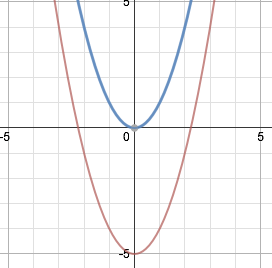
How has the parent graph y= x2 been transformed?
y=(x-4)2+1
y=(x-4)2-1
y=(x+4)2+1
y=(x+4)2-1
Which equation shows a function that has been translated left 4 and 7 up?
y = |x + 4| + 7
y = (x - 4)2 + 7
y = (x + 7)2 - 4
y = |x + 4| - 7


Describe the transformations that map y=x2 to:
Translation left 1 unit, Vertical Stretch, Translation down 1 unit
Vertical Compression, Translation right 1, Translation down 1
Vertical stretch, Translate right 1 unit, Translation down 1 unit
Translation left 1 unit, Horizontal stretch, Translation down 1 unit

moves right 3, Vertical Stretch , and down 4
Horizontal stretch, moves right 3, and down 4
moves right 3, Horizontal compression, and down 4
Vertical stretch, moves left 3, and down 4
What transformations happen to the function f(x) = -3(x - 4)2 ?
left 3, down 4
reflect down , vertical stretch 3, left 4
reflect down, vertical stretch 3, right 4
down 3, right 4
Describe the transformation of y = f(x) for the new function
y = - f(x)
The graph of y = f(x) was flipped vertically across the x axis.
The graph of y = f(x) was flipped horizontally across the y axis.
The graph of y = f(x) was shifted down.
The graph of y = f(x) was shifted right

Choose the correctly transformed function from y=x2
f(x)= -(x+1)2+4
f(x)= (x-1)2-4
f(x)= -(x+1)2-4
f(x)= -(x+4)2-1
Does the equation vertically stretch, compress, or reflect?
*Always compare to the parent function (graph first)*
Stretch by a factor of 2
Compress by a factor of 0.75
Reflect across the x-axis
Both stretch by a factor of 2 and reflect across the x-axis
Does the equation vertically stretch, compress, or reflect?
*Always compare to the parent function (graph first)*
Stretch by a factor of 2
Compress by a factor of 2
Reflect across the y-axis
Both Stretch by a factor of 21 & Reflect across the x-axis
Does the equation vertically stretch, compress, or reflect?
f(x)=−x2
*Always compare to the parent function (graph first)*
Stretch by a factor of 2
Compress by a factor of −2
Reflect across the x-axis
Both Compress by 2 and Reflect across the x-axis
Does the equation vertically stretch, compress, or reflect?
f(x)=−5x2
*Always compare to the parent function (graph first)*
Stretch by a factor of 5
Compress by a factor of 25
Reflect across the x-axis
Both Stretch by a factor of 5 & Reflect across the x-axis
Does the equation vertically stretch, compress, or reflect?
f(x)=41x2
*Always compare to the parent function (graph first)*
Stretch by a factor of 41
Compress by a factor of 41
Reflect across the x-axis
Both Compress by a factor of 2 & Reflect across the x-axis
Does the equation vertically stretch, compress, or reflect?
f(x)=0.5x2
*Always compare to the parent function (graph first)*
Stretch by a factor of 0.5
Compress by a factor of 0.5
Reflect across the x-axis
Both Compress by a factor of 0.5 & Reflect across the x-axis
Does the equation vertically stretch, compress, or reflect?
f(x)=10x2
*Always compare to the parent function (graph first)*
Stretch by a factor of 10
Compress by a factor of 2
Reflect across the x-axis
Both Compress by a factor of 10 & Reflect across the x-axis
Does the equation vertically stretch, compress, or reflect?
f(x)=−7x2
*Always compare to the parent function (graph first)*
Stretch by a factor of 7
Compress by a factor of −7
Reflect across the x-axis
Both Stretch by a factor of 7 & Reflect across the x-axis
Does the equation vertically stretch, compress, or reflect?
f(x)=71x2
*Always compare to the parent function (graph first)*
Stretch
Compress
Reflect
Both Compress & Reflect
What is the parent function of a quadratic?
y=x2
y=x
y=x
y=∣x∣
Identify the steps for identifying the translations of quadratic functions.
Graph the parent function
Solve for y
Solve for x
Graph the given equation

