
 Worksheets
Code.org Express Course -> Lesson 10
Total questions: 19
Worksheet time: 15mins


Use loops to draw this staircase.
Each stair step is 50 pixels long and 50 pixels tall
You will need to turn 90 degrees in each direction


I can do what with this..
Click it because it's pink.
Repeat my steps with LESS puzzle pieces.
Looks kind if weird.
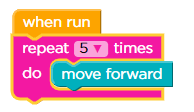
What does this code do?
Moves forward 1 time
Moves forward forever
Moves forward 5 times
Moves left
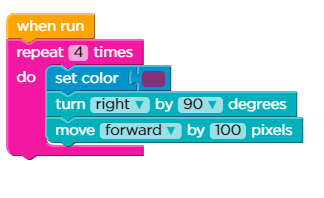
What shape does this code make?
Rectangle
Triangle
Square
Circle
Define PATTERN RECOGNITION.
A sequence of instructions.
Looking for similarities and trends.
Breaking a task into smaller tasks.
Focusing on what is important and ignoring what is unnecessary.
Define DECOMPOSITION
Breaking a task into smaller tasks.
Looking for similarities and trends.
A sequence of instructions.
Focusing on what is important and ignoring what is unnecessary.
Why is Pattern Matching important to Computer Science?
It helps us solve problems that have repeated actions
It helps us write loops
It helps us write algorithms in fewer steps by looping repeated steps.
All of these
George wanted to make a robot that prepared him a bowl of ice cream every day when he got home from work.He noticed that the robot made the same motion over and over again. He decided to loop that behavior in his program. What part of Computational Thinking was she using?
Abstraction
Decomposition
Algorithm
Pattern Matching
What is the purpose of Computational Thinking?
To confuse us
To help us solve only Computer Science problems
To help us with out homework
To help us solve any problem that we are faced with

Which of the following options of code condenses the pattern or patterns found in the original code?


All of these
None of these


23, 33, ___, 53, ___, 73
70,60,50,40
16, 11, 6, 1


Why do we need to look for patterns in problems?
Patterns make it easier for us to solve complex problems
We don't need to look for patterns
Patterns make it more difficult complex problems

