
 Worksheets
Darwins theory
Total questions: 15
Worksheet time: 8mins
Name
Class
Date
1.

Charles Darwin came up with this theory
a)
Natural Selection
b)
Mutation
2.

Darwin wrote that organisms with traits that are best suited to the environment will ________________
a)
increase in number
b)
become extinct
3.

Another word for adapt is ____________.
a)
change
b)
create
4.
Which of the following is NOT an example of natural selection?
a)
People selectively breeding hamsters.
b)
Insect populations developing resistance to certain pesticides.
c)
Bacteria becoming resistant to antibiotics.
d)
Male birds of certain species developing colorful feathers to attract female mates.
5.
Mutations are important because they bring about
a)
death of the organism in which they develop
b)
genetic variation needed for a population to evolve
c)
benefits for the individual, not for the population
d)
Hardey-Weinberg equilibrium within a population
6.
Finches on the Galapagos Islands had different beaks in order to help them do what?
a)
Build nests
b)
Fight off predators
c)
Collect food sources
d)
Compete with rivals
7.
A remnant or trace of an organism from the past is called a _______.
a)
Ancestor
b)
Skeleton
c)
Fossil
d)
Imprints
8.
Inherited trait that helps an organism survive is a(n) __________.
a)
Fossil
b)
Adaptation
c)
Ancestor
d)
Natural selection
9.
Magda is a tall, 11 year old drummer. She has a scar on her right cheek. She is good at swimming. Which of her traits did Magda most likely inherit?
a)
height
b)
the scar
c)
ability to swim
d)
ability to play drums
10.

According to the diagram, which organism is older?
a)
ammonite
b)
coral
c)
gastropod
d)
trilobite
11.
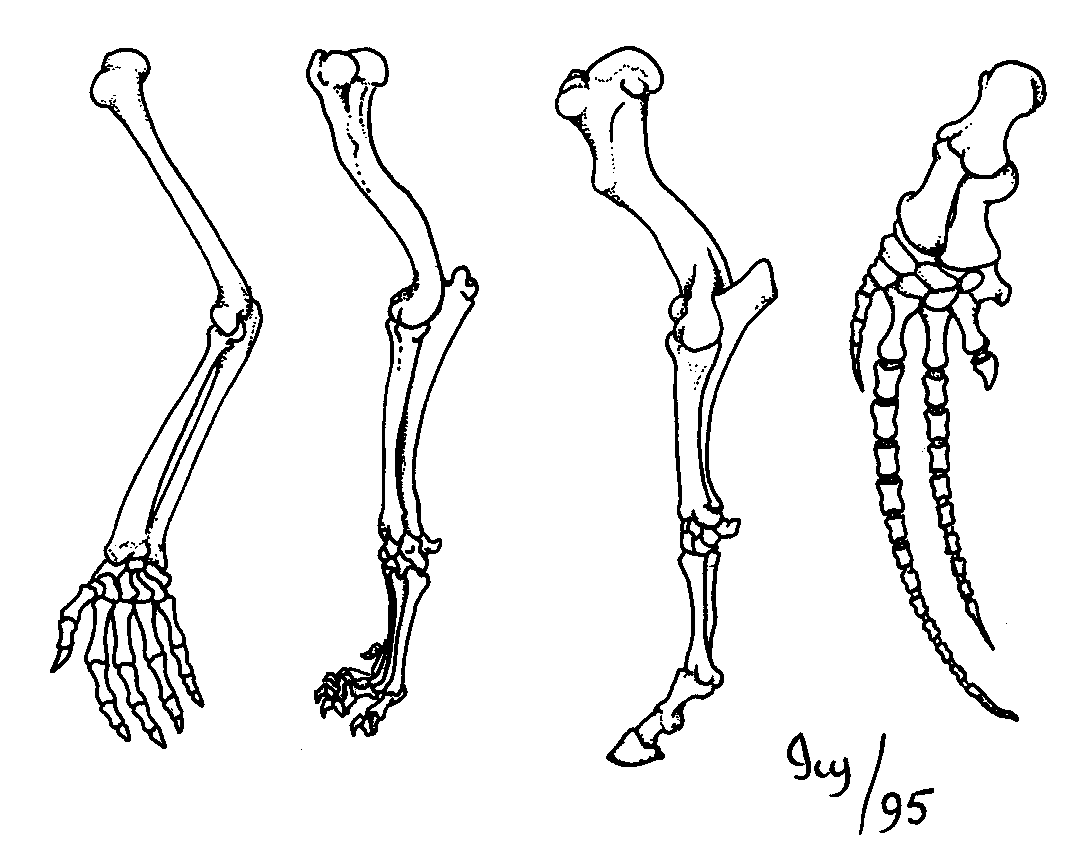
Structures with the same parts have different functions; suggests that organisms share a common ancestry
a)
vestigial structures
b)
homologous structures
c)
adaptive radiation
d)
fossil
12.

The diagram shows fossils in different rock layers. Which of these statements about the age of these fossils is most likely correct?
a)
Fossil A and C are the same age
b)
Fossil B is older than fossil C
c)
Fossils A is older than fossil B
d)
Fossil D is older than fossil C
13.
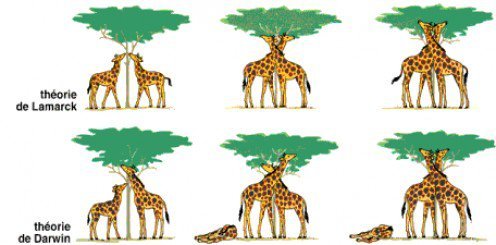
What would happen if the Giraffes never evolve?
a)
they would survive
b)
They would thrive
c)
They would become extinct
d)
They will find another source of food
14.
The ability of an organism to survive and reproduce in its specific environment
a)
diversity.
b)
evolution
c)
adaptation
d)
fitness
15.
Why are advantageous traits more likely to be passed onto offspring?
a)
Because they are more likely to survive and reproduce.
b)
Because they come from dominant alleles.
c)
Because they come from recessive alleles.
d)
Because the trait is an acquired phenotype.
100 %

