
 Worksheets
Unit 3: Newton's Laws of Motion Exam Review
Total questions: 206
Worksheet time: 5hrs 28mins
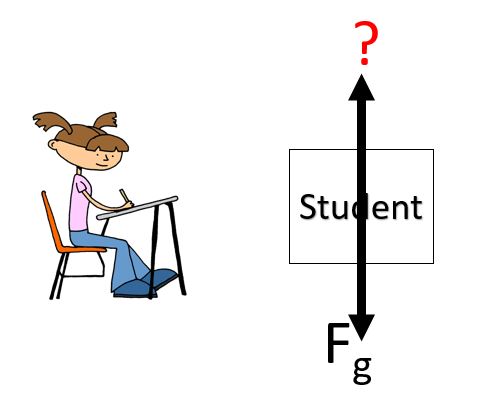
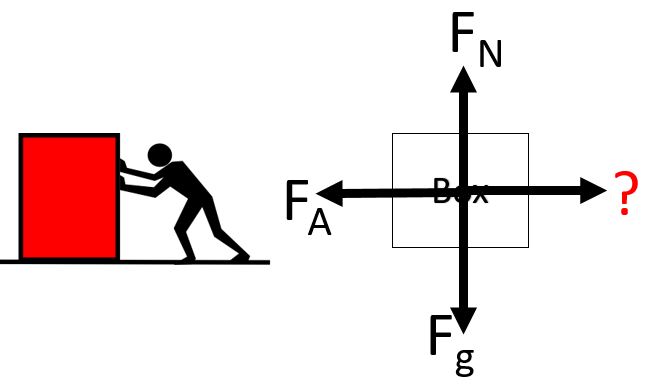
Whenever an object is moving, there is always this force opposing the motion:
inertia
momentum
friction
applied force
The force that keeps objects on top of surfaces instead of letting them sink into the surface is known as:
normal
abnormal
static
inertia
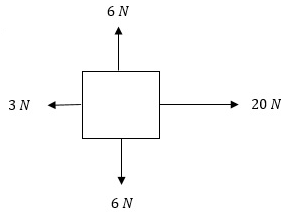
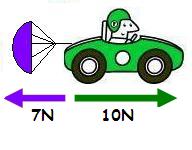
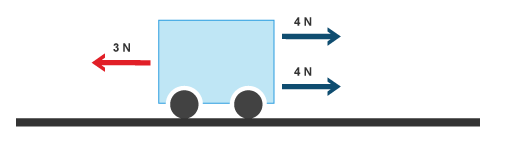
What is the NET FORCE of this diagram?
17 N, right
17 N, left
23 N, right
12 N, up

What forces are on a leopard laying on a log?
Fg & Fapp
Fb & Fg
Fg & FN
Ff & FN
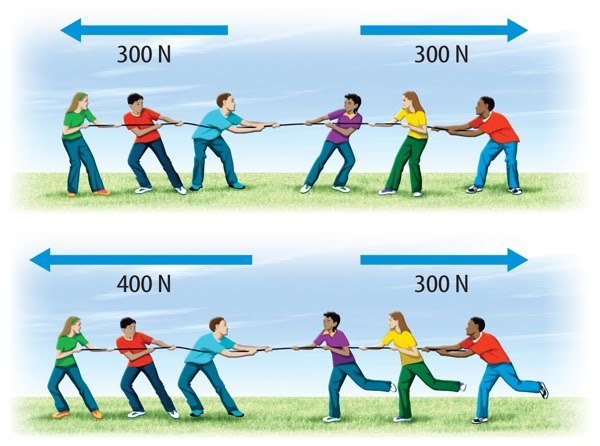
A rightward force is applied to a dresser to accelerate it to the right across the bedroom floor.


A hockey puck glides to the right across the ice at a constant speed.


Which freebody diagram best represents a bookbag resting on the classroom floor?


Which freebody diagram best represents a desk being pushed across the classroom floor?


What is the net force?
3 N Right
3 N Left
17 N Right
17 N Left


Newton's Law of Inertia (first law) describes the motion of-
Objects that accelerate

Law of Inertia
Law of Acceleration
Law of Action-Reaction
Law of Gravitation

Law of Inertia
Law of Acceleration
Law of Action - Reaction
Law of Gravitation

Law of Inertia
Law of Acceleration
Law of Action - Reaction
Law of Gravitation

Law of Inertia
Law of Acceleration
Law of Action - Reaction
Law of Gravitation
Newton's Law of Inertia (first law) describes the motion of-
Objects that accelerate
Law of Inertia
Law of Acceleration
Law of Action-Reaction
Law of Gravitation
Law of Inertia
Law of Acceleration
Law of Action - Reaction
Law of Gravitation
Law of Inertia
Law of Acceleration
Law of Action - Reaction
Law of Gravitation
Law of Inertia
Law of Acceleration
Law of Action - Reaction
Law of Gravitation
An object at rest will remain at rest, and an object in motion will remain in motion, unless acted upon by an unbalanced force.
Law of Inertia
Law of Acceleration
Law of Action - Reaction
Force is directly proportional to acceleration but inversely proportional to an object's mass.
Law of Inertia
Law of Acceleration
Law of Action - Reaction
Law of Inertia
Law of Acceleration
Law of Action - Reaction

An automobile you are riding in suddenly stops, but you continue to go forward.
Law of Inertia
Law of Acceleration
Law of Action - reaction

You push against a wall and the wall is pushing back on you.
Law of Inertia
Law of Acceleration
Law of Action Reaction

As the fuel in a rocket ignites, the force of gas expansion and explosion pushes out the back of the rocket and pushes the rocket forward.
Law of Inertia
Law of Acceleration
Law of Action - Reaction
What is Newtons 1st law of motion?
Force = mass x acceleration
An object at rest stays at rest unless acted on an unbalanced force.
For every action there is an equal and opposite reaction
Weight=mass x gravity
Force =mass x acceleration
For every action there is a equal and opposite reaction
Speed = timedisplacement
Force = mass x acceleration
Which force causes an object to speed up or slow down (accelerate or decelerate)?
What is Newton's First Law known as? The Law of ________
Newton's Second Law is also known as the Law of _______
Inertia
Acceleration
Action - Reaction
Gravitation
Newton's Third Law is also known as the Law of _______
Inertia
Acceleration
Action - Reaction
Gravitation
Which of the following is the correct position - time graph for an object moving with a constant velocity?


Force =mass x acceleration
For every action there is a equal and opposite reaction
Speed = timedisplacement
Force = mass x acceleration
Which force causes an object to speed up or slow down (accelerate or decelerate)?
Which of the following is the correct position - time graph for an object moving with a constant velocity?
An object resting on a surface experiences +980 N of Normal force. What is the mass of the object?
W=mg
-98 kg
9.8 kg
100 kg
-100 kg


An apple weighs 1 N. The net force on the apple when it is in free fall is
0 N.
0.1 N.
1 N.
10 N

Calculate the net force acting upon the object.
10N, north
20N, south
10N, south
22.4N, north

What is the net force of the block?
8N, right
2N, right
8N, left
2N, left


Determine the net force and direction of motion:
16 N Right
16 N Left
0 N not moving
0 N left

Determine the net force and direction:
11 N Left
11 N Right
0 N Left
5 N Left

Determine the net force and direction
20 N up
0 N no movement
20 N down
40 N down

Determine the net force and direction
15 N up
15 N down
0 N no movement
30 N up

Determine the missing force at C:
700 N
200 N
0 N
1100 N

Determine the force at G:
30 N
20 N
50 N
0 N

What is the force at D and E?
D: 300 N, E: 20 N
E: 300 N, D: 80 N
E: 300 N, D: 20 N
E: 300 N, D: 60 N

A: 200 N; B: 50 N
A: 250 N; B: 250 N
A: 500 N; B: 200 N
A: 50 N; B: 200 N

What can you tell about the forces on F and H?
They must be unbalanced.
They are negative.
They must be the same.
They are equal to the net force.


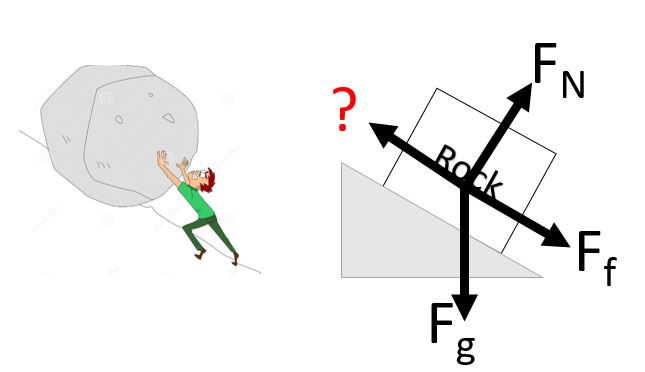
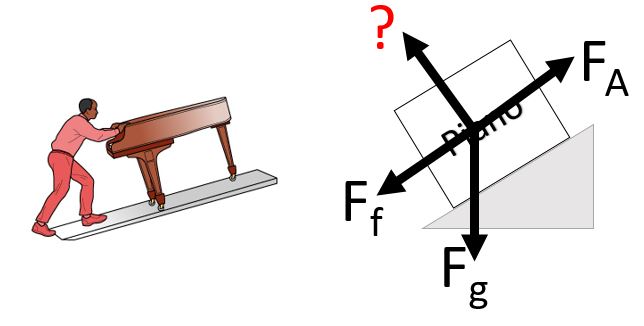
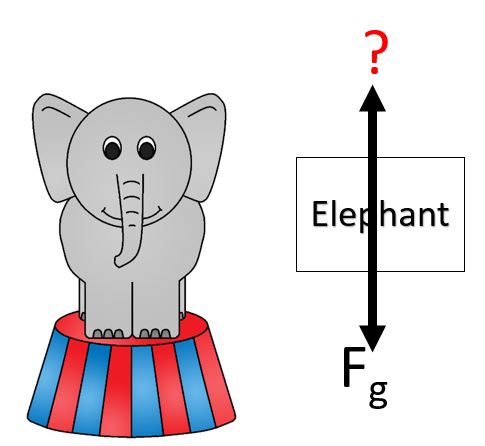
Whenever an object is moving, there is always this force opposing the motion:
inertia
momentum
friction
applied force
If an object is moving to the right, this force is pushing or pulling to the left:
friction
applied
normal
tension
The force that keeps objects on top of surfaces instead of letting them sink into the surface is known as:
normal
abnormal
static
inertia
What is the NET FORCE of this diagram?
17 N, right
17 N, left
23 N, right
12 N, up
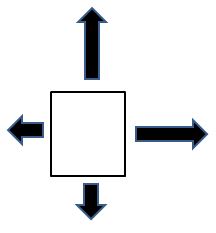
This object would be moving (pick all that are correct):
up
down
left
right
The down-arrow in this diagram is most-likely:
gravity
normal
a push or pull
friction
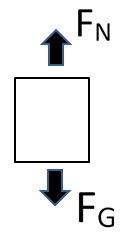
Which of the following is true about this free-body diagram?
the forces are are balanced
the object is free-falling
the object is moving upward
the forces are unbalanced
What forces are on a leopard laying on a log?
Fg & Fapp
Fb & Fg
Fg & FN
Ff & FN

The Coffee cup in the picture is resting on a table. What force(s) are missing from the free body diagram?
No forces are missing
The normal force from the table pushing the cup up.
The normal force form the table pushing the cup down.
The friction force from the table pushing the cup left and right.

The coffee cup in the picture is at rest on the table. What is true about the Normal force?
The normal force is exactly 15
The normal force is less than 15
The normal force is more than 15
The normal force is -10

The hockey puck is moving at a constant velocity across the ice. What forces does the puck experience at this moment?
None
Gravity
Gravity and Normal
Gravity, Normal, and Friction
Gravity, Normal, Friction, and Applied
The hockey puck is moving at a velocity of 20 m/s. If the forces on the puck are in equilibrium, what will the puck's velocity be 2 seconds later?
0 m/s
1 m/s
2 m/s
10 m/s
20 m/s

Which equation would accurately describe the forces on this cup of coffee?
Fn − Fg = 0
Fn×Fg = 0
Fn−10Fg
Fn−Fg = −10

The forces on this chandelier are...
Gravity
Gravity and Normal
Gravity and Tension
Gravity, Tension, Friction, and Applied

A chandelier is hanging from the ceiling. If the force of gravity on the chandelier is 120 N, the force of tension must be ...
0 N
12 N
60 N
120 N

A squirrel sits on the ground and eats a donut. We know the forces on him must be balanced because...
Forces are always balanced
the squirrel is not accelerating
squirrels are projectiles
he's eating a donut

A squirrel sits on the ground and eats a donut. If the ground pushes up on the squirrel with a force of 11 N, The squirrel and donut together weigh ...
less than 11 N
Exactly 11 N
More than 11 N

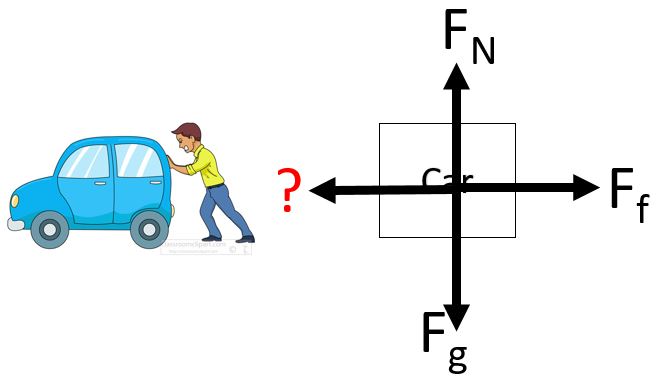
The car in the picture is moving at a constant velocity. What forces does the car experience?
Gravity
Gravity and Normal
Gravity, Normal, and Friction
Gravity, Normal, Friction, and Applied

The Car in the picture is moving to the right at a constant velocity. Any friction present would be pushing the car to the ...
Up
Right
Down
Left
Two books rest on the same table. Book A weighs 20 N. Book B has a mass of 3 kg. Which one has a greater force of gravity on it?
The same
Book A
Book B

A man pushes a box across the floor at a constant velocity. There is a force on the box pulling it toward the center of the earth. This is called the
force of gravity
normal force
friction force
applied force
A man pushes a box across the floor at a constant velocity. There is a force on the box from the floor pushing the box up. This is the ...
force of gravity
normal force
force of friction
applied force
A man pushes a box across the floor at a constant velocity. There is a force on the box resisting its motion. This is the ...
force of gravity
normal force
force of friction
applied force
A man pushes a box across the floor at a constant velocity. There is a force from the man pushing on the box. This is the ...
force of gravity
normal force
force of friction
applied force
A man pushes a box across the floor at a constant velocity. There is a force on the box pulling it toward the center of the earth. This is called the
force of gravity
normal force
force of friction
applied force
A man pushes a box across the floor at a constant velocity. Which formula describes the horizontal forces on the box?
FP − Ff = 0
Fp+Fg − Ff = 0
FP −10Fg = 0
Fp ×Ff=0
A man pushes a box across the floor at a constant velocity. Which formula describes the vertical forces on the box?
FP − Fg = 0
Fp+Fg − Ff = 0
Fn −10Fg = 0
Fn−mg = 0
A man pushes a box across the floor at a constant velocity. If another box were put on top of this box, what would happen to the force of friction?
It would increase
It would decrease
It would remain unchanged
What is the NET FORCE of this diagram?
17 N, right
17 N, left
23 N, right
12 N, up
An object resting on a surface experiences +980 N of Normal force. What is the mass of the object?
W=mg
-98 kg
9.8 kg
100 kg
-100 kg
An apple weighs 1 N. The net force on the apple when it is in free fall is
0 N.
0.1 N.
1 N.
10 N
Calculate the net force acting upon the object.
10N, north
20N, south
10N, south
22.4N, north
What is the net force of the block?
8N, right
2N, right
8N, left
2N, left
Determine the net force and direction of motion:
16 N Right
16 N Left
0 N not moving
0 N left
Determine the net force and direction:
11 N Left
11 N Right
0 N Left
5 N Left
Determine the net force and direction
20 N up
0 N no movement
20 N down
40 N down
Determine the net force and direction
15 N up
15 N down
0 N no movement
30 N up
Determine the missing force at C:
700 N
200 N
0 N
1100 N
Determine the force at G:
30 N
20 N
50 N
0 N
What is the force at D and E?
D: 300 N, E: 20 N
E: 300 N, D: 80 N
E: 300 N, D: 20 N
E: 300 N, D: 60 N
A: 200 N; B: 50 N
A: 250 N; B: 250 N
A: 500 N; B: 200 N
A: 50 N; B: 200 N
What can you tell about the forces on F and H?
They must be unbalanced.
They are negative.
They must be the same.
They are equal to the net force.
Whenever an object is moving, there is always this force opposing the motion:
inertia
momentum
friction
applied force
This object would be moving (pick all that are correct):
up
down
left
right
The down-arrow in this diagram is most-likely:
gravity
normal
a push or pull
friction
Which diagram best shows person pushing a couch (accelerating) across the floor?


As the angle of the incline increases, what happens to the normal force?
The normal force increases
The normal force decreases
The normal force is not affected by the incline
The normal force is only dependent on the force due to gravity


Camille launches has a catapult that changes the velocity of a ball (m= 2 kg) from 0 to 10 m/s in one sec. What is the average force that is exerted on the ball during launch?
20 N
5 N
8 N
0.2 N

Which of the following statements is true about the image above?
The accelerations of the blocks will vary according to their mass
The net force acting on each block is the same
The blocks will experience the same acceleration
The 3m box will eat the 2m and the m boxes

Which of the following is not true about the system?
T3 is equal to the scalar sum of the magnitudes of T2 and T1
T3 is equal in magnitude to Fg
The x- components of the T1 and T2 and equivalent but in opposite directions
The system is in equilibrium.

If there is no friction, then the acceleration would be equal to
mg
sin(θ)mg
g
sin(θ)g
A 80 kg skydiver is free falling at a constant velocity of 19 m/s. What is the net (total) force acting on her?
1,520 N
0 N
800 N
Not enough information to answer

A man standing on a scale in an elevator notices that the scale reads 40 newtons greater than his normal weight. Which type of movement of the elevator could cause this greater-than-normal reading?
accelerating upward
accelerating downward
moving upward at a constant speed
moving downward at a constant speed
A man weighing 800 Newtons is standing in an elevator. If the elevator rises with an acceleration of 0.5 meters per second2, the force exerted by the elevator on the man will be
400 N
800 N
1200 N
1000 N

An apple weighs 1 N. The net force on the apple when it is in free fall is
0 N.
0.1 N.
1 N.
10 N
A 70 kg acrobat hangs from a bar, motionless, that is attached to the ceiling by two ropes. Find the tension in each rope.
70 N
700 N
350 kg
350 N
The hockey puck is moving at a constant velocity across the ice. What forces does the puck experience at this moment?
None
Gravity
Gravity and Normal
Gravity, Normal, and Friction
Gravity, Normal, Friction, and Applied
What is the NET FORCE of this diagram?
17 N, right
17 N, left
23 N, right
12 N, up
Determine the net force and direction of motion:
16 N Right
16 N Left
0 N not moving
0 N left

If two forces are opposite each other on a free body diagram you should...
Multiply them together
Divide them into each other
Subtract them from each other
Add them together

Which of the following is possible for an object with balanced forces acting on it? (Choose all that apply)
at rest
moving at constant speed
changing direction
slowing down
Which of the following is possible for an object with unbalanced forces acting on it? (choose all that apply)
Moving to the right with a constant speed of 3 m/s
Moving to the left with rightward acceleration
changing direction
at rest
Whenever an object is moving, there is always this force opposing the motion:
inertia
momentum
friction
applied force
Which diagram best shows person pushing a couch (accelerating) across the floor?
Which of these include only contact forces?
Fapp Fg Fnorm
Fapp Ftens Fnorm
Fb Fapp Fg
Fair Fnorm Fg
The force that keeps objects on top of surfaces instead of letting them sink into the surface is known as:
normal
abnormal
static
inertia
The hockey puck is moving at a constant velocity across the ice. What forces does the puck experience at this moment?
None
Gravity
Gravity and Normal
Gravity, Normal, and Friction
Gravity, Normal, Friction, and Applied
Which is the best description of tension force in a system with balanced forces?
The force that opposes motion
The force that opposes weight
The force in a string that is equal to weight
The force that opposes friction
The same as a frictional force.
Ted is trying to move a fridge through his house, he gets stuck on a carpet and even though he is pushing the fridge, it is not moving. What force is acting against him?
applied
static friction
kinetic friction
normal
A downward-moving skydiver who has just opened the parachute is slowing down.


What does the F stand for on a free-body diagram?
Free
Fan
Net
Force
Which of the following is true about this free-body diagram?
the forces are are balanced
the object is free-falling
the object is moving upward
the forces are unbalanced
A hockey puck glides to the right across the ice at a constant speed.
Which freebody diagram best represents a bookbag resting on the classroom floor?
The down-arrow in this diagram is most-likely:
gravity
normal
a push or pull
friction
If this object were moving right, the left-arrow in this diagram is most-likely:
gravity
normal
a push or pull
friction
Whenever an object is moving, there is always this force opposing the motion:
inertia
momentum
friction
applied force
A man pushes a box across the floor at a constant velocity. There is a force on the box pulling it toward the center of the earth. This is called the
force of gravity
normal force
friction force
applied force
The force that keeps objects on top of surfaces instead of letting them sink into the surface is known as:
normal
abnormal
static
inertia
The force exerted by ropes and chains is called
tension
normal
elastic
mechanical
The Coffee cup in the picture is resting on a table. What force(s) are missing from the free body diagram?
No forces are missing
The normal force from the table pushing the cup up.
The normal force form the table pushing the cup down.
The friction force from the table pushing the cup left and right.
The hockey puck is moving at a constant velocity across the ice. What forces does the puck experience at this moment?
None
Gravity
Gravity and Normal
Gravity, Normal, and Friction
Gravity, Normal, Friction, and Applied
The car in the picture is moving at a constant velocity. What forces does the car experience?
Gravity
Gravity and Normal
Gravity, Normal, and Friction
Gravity, Normal, Friction, and Applied

What force opposes gravity when an object is on a surface?
Applied Force
Normal Force
Frictional Force
Air Resistance
How many forces are on a leopard laying stationary on a log?
1
2
3
4