Wayground logo

Free Printable Worksheets

Font size

S
M
L
XL
Worksheets

Test Review: Functions

Total questions: 77

Worksheet time: 6hrs 25mins
Name
Class
Date
1.
What is the definition of function?
a)
Has inputs and outputs
b)
Every input has only ONE output
c)
Inputs have different outputs every time
d)
x-values and y-values
2.
a)
Function
b)
Not a Function
3.
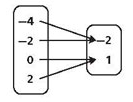
Is this mapping a function or not a function? 
a)
Function
b)
Not a Function
4.
All of the y values or outputs are called what?
a)
Domain
b)
Range
c)
Relation
d)
Function
5.
All of the x values or inputs are called what?
a)
Domain
b)
Range
c)
Relation
d)
Function
6.
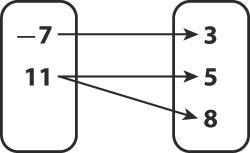
Is the relation a function? Why.
a)
Yes, because the x-value 11 has two y-values pair with it.
b)
Yes, because each x-value has only one y-value paired with it.
c)
No, because the x-value 11 has two y-values pair with it.
d)
No, because each x-value has only one y-value paired with it.
7.
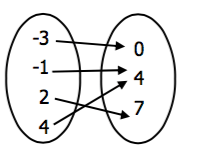
Is this mapping a function or not a function? 
a)
Function
b)
Not a Function 
8.
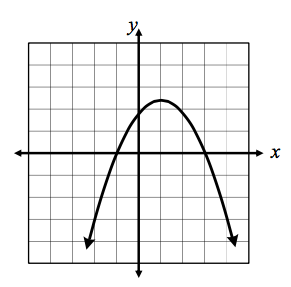
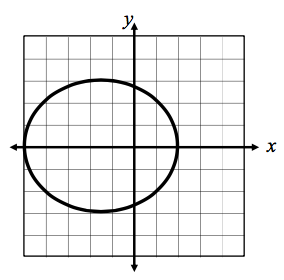
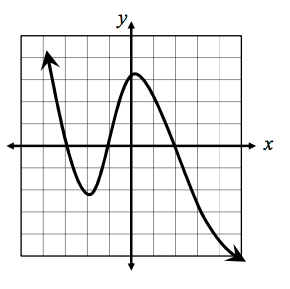
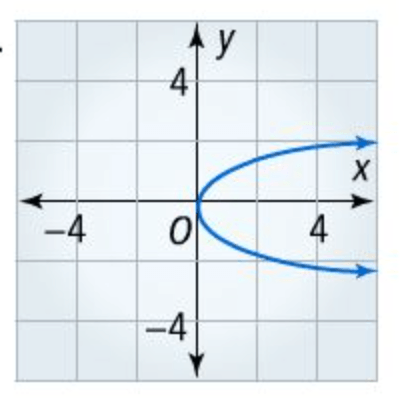
Is this graph a function or not a function? 
a)
Function
b)
Not a Function
9.
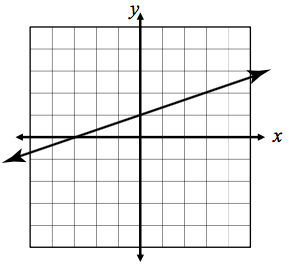
Is this graph a function or not a function? 
a)
Function
b)
Not a Function
10.
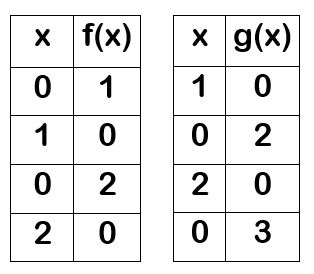
Is this table a function or not a function? 
a)
Function
b)
Not a Function
11.
Is this graph a function or not a function? 
a)
Function
b)
Not a Function
12.
Which set of values is a function?
a)
(9,5) (10,5) (9,-5) (10,-5)
b)
(3,4) (4,-3) (7,4) (3, 8)
c)
(6,-5) (7, -3) (8, -1) (9, 1)
d)
(2, -2) (5, 9) (5, -7) (1, 4)
13.
Is this graph a function or not a function? 
a)
Function 
b)
Not a Function 
14.
For the function {(0,1), (1,-3), (2,-4), (-4,1)}, write the domain and range.
a)
D: {1, -3, -4,}
R: {0, 1, 2, -4}
b)
D:{0, 1, 2, -4}
R:{1, -3, -4}
c)
D:{0, 1, 2, 3, 4}
R:{1, -3, -4}
15.
Which ordered pair could you add to the following list of points to create a function?  (3, 5) (4, 9) (2, 5) 
a)
(3, 7)
b)
(4, 1) 
c)
(1, 9)
d)
(2, 6)
16.
Does the table represent a function?
a)
Yes, there  is a repeated x-value. 
b)
No, there aren't any repeated y-values. 
c)
Yes, there are repeated y-values. 
d)
No, there is a repeated x-value. 
17.
Is this graph a function or not a function? 
a)
Function 
b)
Not a Function
18.
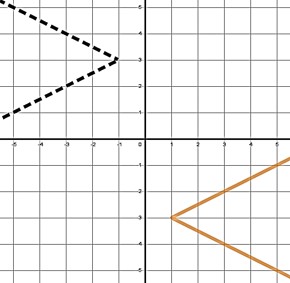
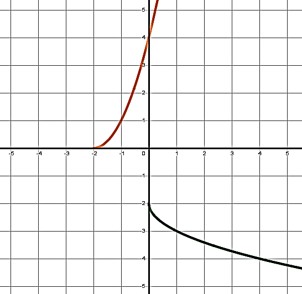
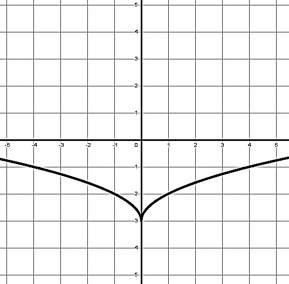
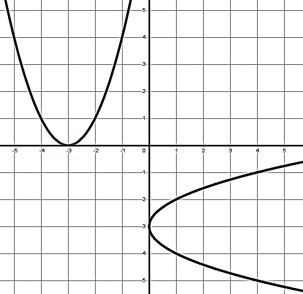
Which graph does NOT pass the vertical line test?
a)
Graph 1
b)
Graph 2
c)
Graph 3
d)
Graph 4
19.
a)

8

b)

-24

c)

24

d)

-22

20.
a)

27

b)

21

c)

24

d)

72

21.
Give the domain and range. Tell if it is a function.
a)
D: {-4, -2, 0, 2}
R: {-2, -2, 1, 1}
Function
b)
D: {-4, -2, 0, 2}
R: {-2, 1}
Function
c)
D: {-4, -2, 0, 2}
R: {-2, -2, 1, 1}
Not a Function
d)
D: {-4, -2, 0, 2}
R: {-2, 1}
Not a Function
22.
f(x)=2x+1
If f(x)=4, what is the value of x?
a)
3/2
b)
2
c)
1/2
d)
4
23.
Complete the function table for y = -2x + 1.
a)
-2(2) + 1; -2
b)
-2(2) + 1; -3
c)
-2(2) + 1; -1
d)
-2(2) + 1; 0
24.
Is the relation a function?
a)
yes, it is a function
b)
no, it is not a function
c)
not enough information to determine
25.
Arcadia Inc. manufactures videogames. This is a graph showing the profit, in thousands of dollars, made by the company over the first six months of the year. Which statement about the company's profits is incorrect?
a)
The profits increased from January to February.
b)
The largest profit for the six-month period was $275,000.
c)
The profit decreased from April to June.
d)
The smallest profit for the six-month period was $150,000.
26.
A ball is launched straight up. The function v(t)=96-32t gives the ball's speed, v, in feet per second, in terms of time, t, in seconds as it reaches its maximum height before falling back to the ground. Which graph shown models the function?
a)
Graph A
b)
Graph B
c)
Graph C
d)
Graph D
27.
What is the range of this function?
a)
(150, 275)
b)
[150, 275]
c)
[220, 265]
d)
(220, 265)
28.

What is the name of the test that we do on a graph to see if it is a function?

a)

vertical line test

b)

horizontal line test

c)

there isn't a name for it

d)

slope line test

29.
f(x) = 3x2 + 7x and g(x) = 2x2 - x - 1, find (f - g)(x).
a)
x2 + 8x + 1
b)
x2 + 6x - 1
c)
5x2 + 8x - 1
d)
x2 + 8x -1
30.

Given  f(x)=3x2−2x+1f\left(x\right)=3x^2-2x+1  and  g(x)=x−4g\left(x\right)=x-4  , find  (f×g)(x)\left(f\times g\right)\left(x\right)  

a)

3x3−10x2−7x−43x^3-10x^2-7x-4  

b)

3x3−14x2+9x−43x^3-14x^2+9x-4  

c)

3x2−x−33x^2-x-3  

d)

3x3+14x2−9x−43x^3+14x^2-9x-4  

31.

Find f(-1)

a)

-3

b)

15

c)

19

d)

17

32.
a)

A

b)

B

c)

C

d)

D

33.

Given the graph of h(x), evaluate h(0).

a)

-2

b)

2

c)

4

d)

0

34.

What is the function value when x = 2?

a)

-4

b)

8

c)

0

d)

5

35.
For what value of x does f(x) = -2?
a)
0
b)
-5
c)
3
d)
-3
36.

Given f(x)=6x2-4, find f(-1).

a)

-2

b)

13

c)

2

d)

0

37.

Evaluate f(10) given f(x)=-2x+13.

a)

-7

b)

1

c)

-8

d)

7

38.

Solve for x given f(x) = -4x - 10 and f(x) = 10.

a)

x = -5

b)

x = 5

c)

x = -50

d)

x = 30

39.

Solve for x given w(x) = 3x - 7 and w(x) = 14.

a)

7

b)

35

c)

2.33333

d)

-49

40.
What is x if
f(x) = -2?
a)
4
b)
0
c)
3
d)
8
41.

Given f(x)=4x+5, find f(4).

a)

21

b)

-11

c)

-31

d)

25

42.

Given f(x)=x+3, find x if f(x) = -5.

a)

-2

b)

-1

c)

-8

d)

7

43.

Evaluate the function for the given value:

a)

-5

b)

63

c)

450

d)

5

44.

Evaluate f(x) = 7x when x = -5.

a)

-35

b)

35

c)

2

d)

75

45.

Find x given f(x) = 4x - 1 and f(x) = 19.

a)

39

b)

41

c)

5

d)

38

46.

Given the diagram of f(x), evaluate f(4).

a)

-3

b)

0

c)

4

d)

7

47.

Given the table of t(x), evaluate t(33).

a)

33

b)

11

c)

10

d)

8

48.

Given the graph of g(x), evaluate g(1).

a)

0

b)

-3

c)

3

d)

2

49.

Given the two functions, evaluate g(10).

a)

x = -30

b)

x = -29

c)

x = 8

d)

x = 31

50.

The following are coordinates from the function f(x):

(3, 5) (2, 4) (9, 0) and (-4, 2).

Evaluate f(2).

a)

3

b)

2

c)

4

d)

-4

51.

The following are coordinates from the function g(x):

(9, -2) (4, 3) ( 8, 10) ( -4, 8).

Find x if g(x) = 8.

a)

-4

b)

4

c)

10

d)

8

52.

Find the inverse function

a)
b)
c)
d)
53.

State if the given functions are inverses.

a)

yes

b)

no

54.

State if the given functions are inverses.

a)

yes

b)

no

55.

State if the given functions are inverses.

a)

yes

b)

no

56.
The inverse of the function f(x) is written as ...
a)
f -1(x)
b)
f 2(x)
c)
f '(x)
d)
f +(x)
57.

Which of the following is NOT TRUE about inverse functions?

a)

Inverse functions are reflections of each other over the line y = x.

b)

You find the inverse by switching x and y in the equation.

c)

The domain of a function always becomes the domain of its inverse.

d)

The domain of a function always becomes the range of its inverse.
58.
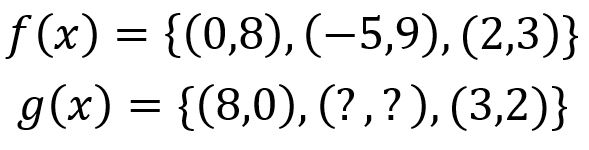
What are the missing values if g(x)=f-1(x)?
a)
(9,-5)
b)
(-9,-5)
c)
(5,9)
d)
(-9,5)
59.

What is the best description?

a)

They are both functions, but not inverse functions.

b)

Their coordinates are inverted, but they are not both functions.

c)

Their coordinates are NOT inverted, and they are not both functions.
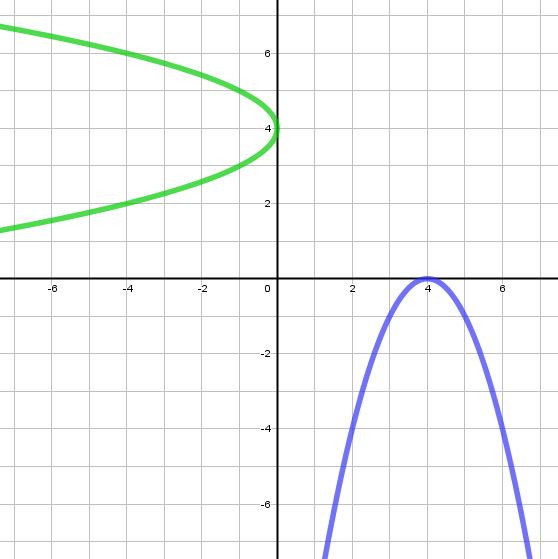
d)

They are inverse functions.

60.

What is the best description?

a)

They are both functions, but not inverse functions.

b)

They are inverse functions.

c)

Their coordinates are inverted, but one of the graphs is not a function.

d)

Their coordinates are NOT inverted, and they are not both functions.

61.

What is the best description?

a)

They are both functions, but not inverse functions.

b)

They are inverse functions.

c)

Their coordinates are inverted, but one of the graphs is not a function.

d)

Their coordinates are NOT inverted, and they are not both functions.

62.

f(x) = -4x - 12

What is f-1(x)?

a)

f-1(x) = 4x - 3

b)

f-1(x) = -1/4x - 3

c)

f-1(x) = 1/4x + 3

d)

f-1(x) = -4x - 3

63.

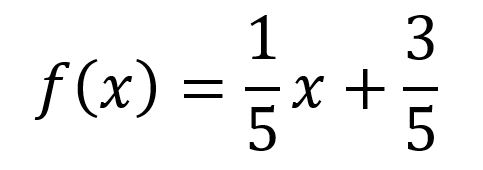
Which is f -1(x)?

a)

f -1(x) = 5x + 3

b)

f -1(x) = 5x - 3

c)

f -1(x) = 5x - 15

d)

f -1(x) = 1/5(x) + 3/5

64.

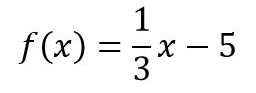
Which is f -1(x)?

a)

f -1(x) = 3x + 5

b)

f -1(x) = 3x - 5

c)

f -1(x) = 3x - 15

d)

f -1(x) = 3x + 15

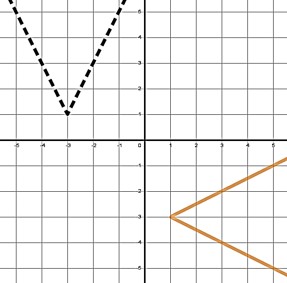
65.

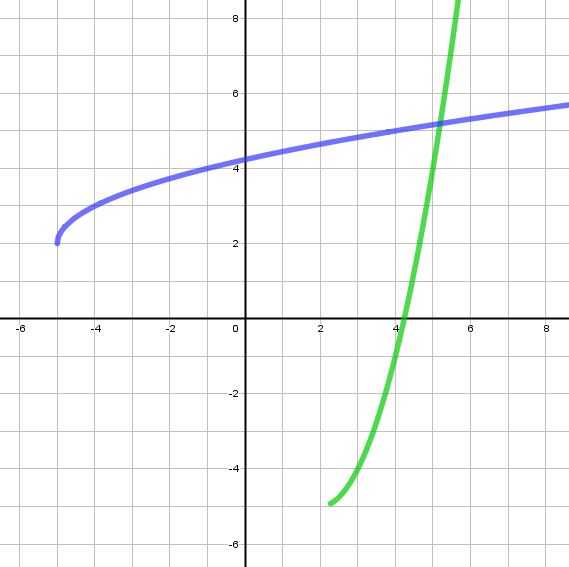
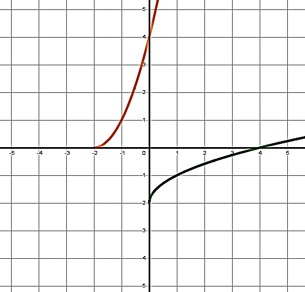
Which graph represents the functions f(x) and f-1(x)?
a)
b)
c)
d)
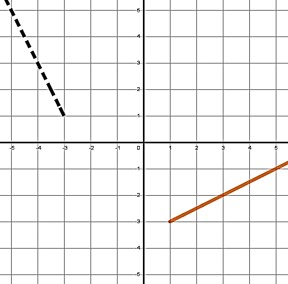
66.

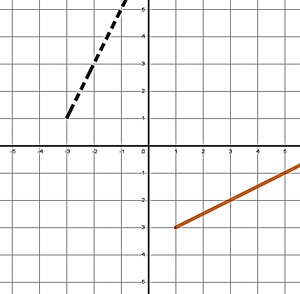
Which graph represents the functions f(x) and f-1(x)?
a)
b)
c)
d)
67.
f(x) = 3x + 10
g(x) = x - 2
Find g(f(x))
a)
3x + 8
b)
3x - 2
c)
3x + 4
d)
None of these.
68.

When f(x) = 4x+8 and g(x) = x+3, find f(x) * g(x).

a)
4x2+24
b)
4x2+20x+24
c)
4x2+12x+24
d)
4x2+4x+24
69.
When f(x) = 2x and g(x) = x2+3 , find f(g(x)).
a)
x2+2x+3
b)
4x2+3
c)
2x2+3
d)
2x2+6
70.
g(x)=3x+4
h(x)=3x-1
Find g(h(x))
a)
-9x+11
b)
4x2+4x
c)
9x+1
d)
9x+11
71.
When f(x) = 9-3x and g(x) = 5x-7 , find f(x)+g(x). 
a)
14x-10
b)
-8x+2
c)
2x+2
d)
2x-2
72.
When f(x) = x2+9 and g(x) = x-9, find f(x)-g(x). 
a)
x2+x+9
b)
x2-x+9
c)
x2-x
d)
x2-x+18
73.
When f(x) = 2x and g(x) = x2+3 , find f(g(x)).
a)
x2+2x+3
b)
4x2+3
c)
2x2+3
d)
2x2+6
74.
f(x) = x2+9
g(x) = x-9
Find f(x)-g(x). 
a)
x2+x+9
b)
x2-x+9
c)
x2-x
d)
x2-x+18
75.
f(n)=x2+1
g(n)=2x-5
Find f(n)-g(n)
a)
x2-2x+6
b)
-x2+2x+4
c)
-x2-2x-6
d)
x2-2x-4
76.
g(x)=3x+4
h(x)=3x-1
Find g(h(x))
a)
-9x+11
b)
4x2+4x
c)
9x+1
d)
9x+11
77.
f(x) = 3x + 10
g(x) = x - 2
Find g(f(x))
a)
3x + 8
b)
3x - 2
c)
3x + 4
d)
None of these.