
 Worksheets
Interim Assessment 1 Review 5th Grade
Total questions: 24
Worksheet time: 16mins

A student places objects in a bucket of water to determine if they will float.
Which set of items is less dense than water?
Plastic paper clip, penny, and cork
Toothpick, metal spoon, and plastic paper clip
Metal spoon, vegetable oil, and penny
Toothpick, cork, and vegetable oil
Which of the following is not a
good conductor of electricity?
copper
aluminum
wood
gold
Which of the following is a good
conductor of electricity?
wood
copper
rubber
plastic

A student investigated the physical properties of some substances. The student recorded his findings in a table. The student needs to complete the column headings for each group.
Which column headings should the student use for his table?


Which mixture would be easiest to separate with a sieve based on the size of the particles?
vinegar and water
sand and gravel
oil and water
sugar and water

What is the same about the three groups of materials X, Y, and Z?
They are all solids.
They are all mixtures.
They are all solutions.
They each have only one part.
What happens when sugar is put into water and stirred?
The mass of the sugar decreases.
The sugar disappears and no longer exists.
The sugar is evenly distributed in the water
The crystals of sugar have entered the atmosphere.
A student stirs a mixture of sand, iron filings, and water and observes that eventually the sand and iron filings sink to the bottom of the container. How can the student separate the mixture?
Slowly pour the mixture into another container, making sure the sand does not flow out with the water. Pick the iron out with tweezers.
Pour the mixture into a pot and heat one minute. Spoon the sand from the water. Use a magnet to remove the iron.
Pour the mixture through a coffee filter, leaving only the sand and iron in the filter. Separate the sand and iron with a magnet.
Use a spoon and scoop out as much sand as possible. Drag a magnet through the water to remove the iron.

The student has four materials to choose from. Which of theses materials is least useful as an insulator?
Cardboard
Aluminum
Rubber
Plastic

Which two physical properties of beads can be used to separated the mixture?
Solubility and mass
Density and Solubility
Magnetism and density
Solubility and magnetism

Bsed on your knowledge of density, which choice is correct?
3 objects sink and 2 float
2 objects sink and 3 float
4 objects sink and 1 float
1 objects sink and 4 float
Which of the following items would NOT be attracted or repelled by a magnet?
Steel paper clip
Iron nail
Copper penny
Another magnet
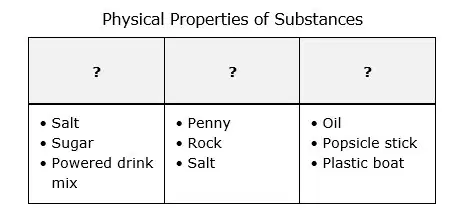
A student investigated the physical properties of some substances. The student recorded her findings in a table. The student needs to complete the column headings for each group.
Which column headings should the student use for her table?




Which of these mixtures would you separate using a filter? (2 answers)
Sand and water
Pebbles and glass marbles
Ground pepper and milk
Iron filings and sand
Grapes and cherries
Which of these mixtures would you separate using hand sorting? (2 answers)
Sand and water
Pebbles and glass marbles
Ground pepper and milk
Iron filings and sand
Grapes and cherries
How can salt be removed or separated from a salt water mixture?
Use a strainer to separate the two
boil the mixture, the heat will cause the salt and water to separate
pour more salt until it absorbs the water
Freeze the mixture
Mr. Jones is looking for seashells hidden in the sand on the beach. How could he quickly separate any seashells from the sand?
He could wait for the Sun to heat the sand.
He could pour the sand through a sieve (strainer).
He could use water to absorb the sand.
He could dissolve the sand in soda.
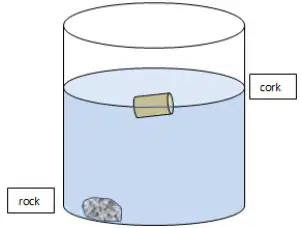
Cork is a material harvested from the bark of the Cork Oak tree. It has many uses, including bulletin boards, flooring, and the inside material in a baseball.
A student placed a piece of cork, and a similarly sized rock in a container of water. Why would the cork behave as shown in the picture above?
A cork and a rock are different states of matter.
A cork and a rock are different sizes.
A cork and a rock have different densities.
A cork and a rock have different shapes.
Which mixture could be separated using a magnet?
Pepper and sugar
Pebbles and marbles
Sand grains and seashells
Iron filings and pepper
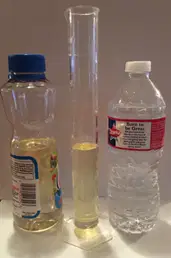
A teacher pours 55mL of cooking oil into a graduated cylinder. He then pours in 35 mL of water and lets the mixture sit for 30 minutes.
What will most likely happen to the liquids in the graduated cylinder?
The oil will remain on the bottom because there is more of it.
The oil will rise to the top because it is less dense than water.
The oil will remain on the bottom because it was poured in first.
The oil will mix with the water and form a solution.
A common treatment for a sore throat is to place salt in warm water and gargle the solution to relieve the pain. Which property of the salt will remain the same when it forms the solution with water?
The size of the salt crystals
The taste of the salt
The shape of the salt crystals
The texture of the salt

