
 Worksheets
USA 2 Practice Problems
Total questions: 20
Worksheet time: 3600secs

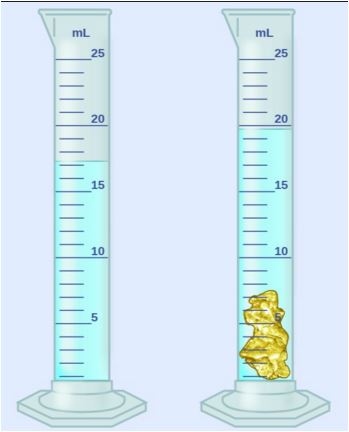
The amount of water displaced is the same as the volume of the object. What is the VOLUME of the object?
An object is is placed into 45 mL of water. The water rises to 48 mL. What is the volume of the object?
3 mL
93mL
8 mL
83 mL


The density of a material is 2 g/cm3. The volume is 24 cm3 . What is the mass?

There are 4 objects listed with their densities. Which of the following will float on water? (SELECT 2)
Object A:
0.7 g/cm3
Object B:
1.2 g/cm3
Object C:
0.25 g/cm3
Object D:
11.4 g/cm3
If an object has a density of 6 g/mL and you put it into water, will it sink or float?
A boat weighs 220,000 lbs. If it has a density of 0.5g/L, will it SINK or FLOAT?
Sink because it weighs over 100 tons!
Float because its density is less than water.
Sink because its density is more than water.
An object has a mass of 200g and a volume of 100. Canola oil has a density of around 0.915g/cm^3. Will the object sink or float in canola oil?
Sink
Float
An object's mass is 2kg, and its volume is 5L. If honey has a density of 1.4 kg/L, will the object sink or float?
Sink
Float

Based off of this table, which statement is true?
Aspirin is more soluble than Sugar
Sugar is less soluble than Salt
Carbon Dioxide is less soluble than Salt
Sugar is the most soluble substance on the planet

Based on this table, what can be concluded?
KNO3 is more soluble at higher temperatures than lower temperatures
KNO3 is most soluble at lower temperatures
KNO3 is insoluble at low temperatures
KNO3 is less soluble at higher temperatures than lower temperatures

Use the Data Table to answer the question:
If the following liquids were stacked together in a jar, where in the jar would a substance with a mass of 14g and a volume of 20mL float?
In the middle
Near the top
At the bottom
On top of everything else


Which best describes the behavior of particles in a liquid?
Particles are packed closely together, not moving
Particles are packed closely together, vibrating in a fixed position
Particles are close together, but can move across each other freely
Particles are not held closely together, they spread out to take the shape of the container they are in

