
 Worksheets
NATURAL SELECTION AND EVOLUTION
Total questions: 26
Worksheet time: 7hrs 30mins
Why are advantageous traits more likely to be passed onto offspring?
Because they are more likely to survive and reproduce.
Because they come from dominant alleles.
Because they come from recessive alleles.
Because the organism knew it needed that trait, survives, and passes it on.
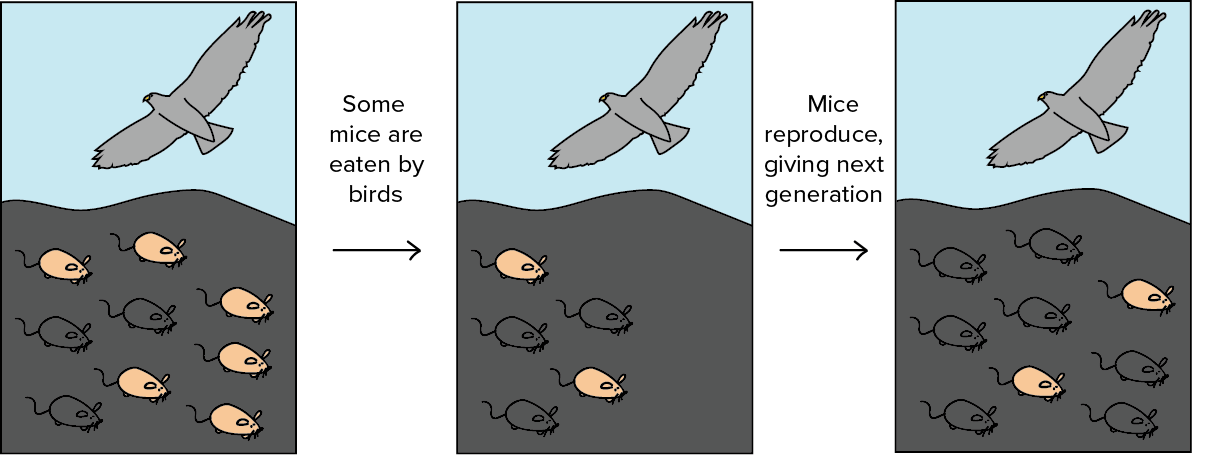
Where do adaptations come from?
The individual organism decides to adapt
Mutations that give an organism an advantage in its environment
Genetic recombination during meiosis
Both mutations and genetic recombination are sources of adaptation
Which best describes the role of mutations in natural selection?
Mutations help an organism to better survive in their environment
An organism may acquire a helpful mutation by interacting with the environment
A mutation may result in a beneficial trait that makes an organism more likely to survive and reproduce
Organisms with certain traits are more likely to win competitions for mutations

All rabbits of the same species living in a particular area would be an example of a(n)
population
species
community
ecosystem
The more genetic variation a population has,
the more likely it is for some individuals to
evolve
migrate
survive
mutate
What type of evolution is described in the following scenario: Porcupines in the United States have quills (spines) that are attached to their skins. When they feel threatened, they can tense up their bodies, causing the quills to “shoot out.” These spiny quills can pierce the skin of attacking animals, causing injury and pain. Although not closely related to the porcupine, hedgehogs that live throughout parts of Europe also have protective spines that they use to defend themselves from attacking animals.
Coevolution
Divergent Evolution
Convergent Evolution
What type of evolution is described in the following scenario: King Snakes are a family of snakes that usually eat other snakes in the wild. Even though many of the snakes they eat are very poisonous, King Snakes have adapted the ability to not be affected by their poisons. In response, some of these poisonous snakes, like rattlesnakes, have adapted other defensive behaviors (other than biting) to try and “scare off” the King Snakes.
Coevolution
Divergent Evolution
Convergent Evolution
What type of evolution is described in the following scenario: Chameleons, a type of lizard (reptile), have two eyes they can move in completely different directions, so they can see all the way around themselves. Sand lances are a type of fish that can also move their eyes like the chameleon, even though they are not related to one another.
Coevolution
Divergent Evolution
Convergent Evolution
What type of evolution is described in the following scenario: A kit fox lives in the desert and has large ears with greater surface area that keep the fox from getting overheated. The red fox lives in the forest and has a red coat that keeps it camouflaged.
Coevolution
Divergent Evolution
Convergent Evolution
What type of evolution is described in the following scenario: The Galloti atlantica and Galloti galloti lizards evolved through natural selection from a common ancestor into a wide variety of different looking lizards.
Coevolution
Divergent Evolution
Convergent Evolution

Other insects cannot, but, a bumble bee has just enough weight to open up the snapdragon flower to pollinate it. This is an example of...
convergent evolution
co-evolution
divergent evolution
speciation

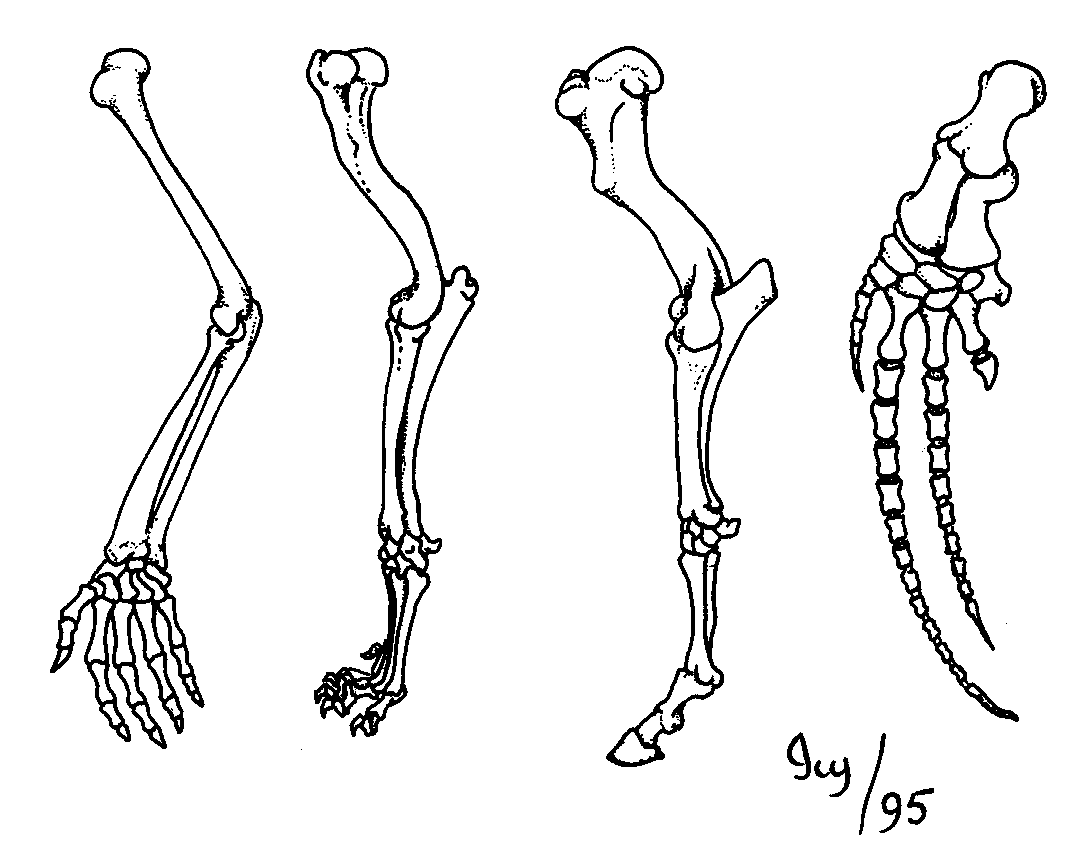


The pelvic bone of whales is not needed for movement within the water. This is an example of a(n) ______________ structure.
vestigial
analogous
homologous

Which of the following is NOT an example of natural selection?
People selectively breeding hamsters.
Bacteria becoming resistant to antibiotics.
Insect populations developing resistance to certain pesticides.
Male birds of certain species developing colorful feathers to attract female mates.

Images of the embryo and adult stages of three different organisms are shown.
Q. Which of the following is the best conclusion that can be drawn from this evidence?
Having similar embryos indicates that these organisms eat the same types of food.
Having similar embryos indicates that these organisms live in a similar environment.
Having similar embryos indicates that these organisms share a recent common ancestor.
Having similar embryos indicates that a certain protein controls how many legs the adult organisms will have.
Two organisms that are closely related would have
very similar DNA sequence
exactly the same DNA sequences
no proteins in common
completely different DNA sequences

