wayground logo

Free Printable Worksheets

Font size

S
M
L
XL
Worksheets

PRELIM 4 MIMW

Total questions: 47

Worksheet time: 55mins

Name
Class
Date
1.
Which of the following would be a Fibonacci sequence?
a)
1, 2, 3, 4, 5, 6
b)
2, 4, 6, 10, 16, 26
c)
3, 6, 9, 12, 15, 18
d)
4, 2, 1, 1/2, 1/4, 1/8
2.
What did young Fibonacci do with his father?
a)
play baseball
b)
paint
c)
travel
d)
partial fraction decomposition
3.
Fibonacci was instumental in introducing Europe to the Hindu-Arabic numeral system (the one we use today).  What system was being used prior to this?
a)
Babylonian
b)
Binary
c)
Roman
d)
Egyptian
4.
What animal helped Fibonacci recognize his sequence?
a)
elephant
b)
rabbit
c)
camel
d)
dog
5.
Fibonacci wrote a book called Liber Abbaci which translates as ______________.
a)
The Book of Freedom
b)
The Book of Calculations
c)
Free Willy
d)
The Book of Really Hard Problems
6.
What was Fibonacci's real name?
a)
Leonardo Pisano
b)
Leo Pisa
c)
The Big Fibber
d)
Leonardo Fibo
7.
What is the Fibonacci number pattern?
a)
Counting up starting from 1 by 1.
b)
Adding the two numbers before it to get the next number.
c)
Multiplying the two numbers before it to get the next number.
d)
Subtracting the two numbers before it to get the next number.
8.

What were some of Fibonacci's mathematical contributions?

a)

The Fibonacci Sequence

b)

Arabic Numerals

c)

The Golden Ratio

d)

All of the above

9.

True or false: The Golden Ratio is rational.

a)

True

b)

False

10.

What is the approximate number for the Golden Ratio?

a)

1.1

b)

0.000465

c)

1.61913398875…

d)

1.61803398875…

11.

Select two that fills in one of the blanks


3, 5, __, 13, 21, __, 55, 89,...

a)

34

b)

9

c)

8

d)

28

12.
A transformation that “turns” a figure about a fixed point at a given angle and a given direction.
a)
reflection
b)
translation
c)
rotation
d)
dilation
13.
Triangle C is rotated 180° clockwise with the origin as the center of rotation to create a new figure. Which triangle shows the new location?
a)
A
b)
B
c)
C
d)
D
14.
How many degrees was the figure rotated?
a)
90 degrees counterclockwise 
b)
180 degrees
c)
90 degrees clockwise
15.
Find the common difference: -34, -29, -24, -19, ...
a)
d = -5
b)
d = 5
c)
d = -6
d)
d = 6
16.
Find the common difference: 1, 201, 401, 601, ...
a)
d = 100
b)
d = 101
c)
d = 200
d)
d = 201
17.

The first three terms of an arithmetic sequence are as follows


13, 19, 25


What are the next two terms of the sequence?

a)

31 and 37

b)

31 and 36

c)

30 and 37

d)

30 and 36

18.

Which sequence is NOT an arithmetic sequence?

a)

12, 18, 24, 30,...

b)

10, 3, -4, -11,...

c)

2, 4, 8, 16,...

d)

16, 20, 24, 28,...

19.

Define arithmetic sequences.

a)

A sequence whose terms change by adding the same number each time.

b)

A sequence whose terms change by multiplying the same number each time.

c)

A sequence whose terms change by dividing the same number each time.

d)

A list of numbers that often (but not always) form a pattern.

20.

Sometimes sequences are described in subscript notation.

Given a1=5a_1=-5  and an=an1+3a_n=a_{n-1}+3  , what are the first 4 terms in the sequence?

a)

-5, -2, 1, 4

b)

-5, -8, -11, -14

c)

3, -2, -7, -12

d)

3, -15, 75, -375

21.
Identify a1 and d for the sequence
-5, -2, 1, 4, ...
a)
a1 = 3 and d = -5
b)
a= -8 and d = 3
c)
a1 = -5 and d = 3
d)
a1 = -5 and d = -3
22.

Write the EXPLICIT rule for the arithmetic sequence

-10, -3, 4, 11,...

a)

an = 10n + 17

b)

an = 7n - 17

c)

an = -7n + 17

d)

an = 7n + 3

23.
Write the explicit rule for the arithmetic sequence
12, 10, 8, 6, ...
a)
an = 12n - 14
b)
a= 2n - 14
c)
a= -2n + 14
d)
a= -12n + 14
24.

Write the recursive rule for the arithmetic sequence

82, 76, 70, 64, ...

a)

a1= 82; an = an-1 - 6

b)

a1= 64; an = an-1 - 6

c)

a1= 82; an = an-1 + 6

d)

a1= 64; an = an-1 + 6

25.

Name the Sequence:

300, 150, 75, 37.5.....

a)

A. Arithmetic

b)

B. Geometric

c)

C. Recursive

d)

D. Explicit

26.

The Recursive Formula for the Arithmetic Sequence is:

a)

A.   an = a1 + d (n1)A.\ \ \ a_n\ =\ a_1\ +\ d\ \left(n-1\right)  

b)

B.  an = a(n1) + dB.\ \ a_{n\ }=\ a_{\left(n-1\right)}\ +\ d  

c)

an = a1  r (n1)a_{n\ }=\ a_{1\ }\cdot\ r\ ^{\left(n-1\right)}  

d)

an = a(n1)  ra_n\ =\ a_{\left(n-1\right)}\ \cdot\ r  

27.

The Explicit Formula for the Arithmetic Sequence is:

a)

A.   an = a1 + d (n1)A.\ \ \ a_n\ =\ a_1\ +\ d\ \left(n-1\right)  

b)

B.  an = a(n1) + dB.\ \ a_{n\ }=\ a_{\left(n-1\right)}\ +\ d  

c)

an = a1  r (n1)a_{n\ }=\ a_{1\ }\cdot\ r\ ^{\left(n-1\right)}  

d)

an = a(n1)  ra_n\ =\ a_{\left(n-1\right)}\ \cdot\ r  

28.

What does a1 represent?

a)

Any term

b)

First term

c)

Last term

29.

What does n represent?

a)

Number

b)

Nothing

c)

Term you are trying to find

30.
Determine whether the sequence is arithmetic, geometric, or neither.
a)
arithmetic
b)
geometric
c)
neither
31.
Determine whether the sequence is arithmetic, geometric, or neither.
a)
arithmetic
b)
geometric
c)
neither
32.
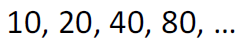
Find the common ratio for the geometric sequence.
a)
10
b)
1/2
c)
2
d)
4
33.
Find the common ratio for the geometric sequence.
a)
1
b)
-1
c)
7
d)
-7
34.
This image shows how a certain bacteria grows in a petri dish. What is the common ratio of this sequence?
a)
4
b)
3
c)
2
d)
6
35.

Given the sequence:

125, 25, 5, ....

Write the rule an using the geometric sequence formula:

a)

an = (125)(1/5)(n-1)

b)

an = 625(1/5)(n-1)

c)

an = 625(5)(n-1)

d)

an = 125 + 5n

36.

What are the next 3 terms in the following geometric sequence:

512, 256, 128, ___, ___, ___, ...

a)

1024, 2048, 4096

b)

32, 8, 2

c)

64, 32, 16

d)

92, 66, 38

37.
Find the first four terms of the sequence given the rule:
an = 4(5)n-1
a)
20, 100, 500, 2500
b)
5, 20, 80, 320
c)
4, 20, 100, 500
d)
4, 9, 14, 19
38.
Find a12 in the sequence -1, -3, -9, -27, ...
a)
-177,147
b)
-19,683
c)
-59,049
d)
118,098
39.

What is the 9th term in a geometric sequence with a common ratio of 2 and a first term of 3?

a)

384

b)

768

c)

1,536

d)

27

40.

Which Figure Number will have 81 Tiles?

a)

20

b)

15

c)

25

d)

10

41.

What is the equation?

a)

y=4x+1

b)

y=1x+4

42.

Which of the following best describes this sequence?

{135, 45, 15, 5, ...}\left\{135,\ 45,\ 15,\ 5,\ ...\right\}  

a)

An arithmetic sequence with a common ratio of  13\frac{1}{3}  

b)

A geometric sequence with a common difference of 3.

c)

An arithmetic sequence with a common difference of 3.

d)

A geometric sequence with a common ratio of  13\frac{1}{3}  

43.

It is a series or sequence that generally repeats itself.

a)

Algebra

b)

Numbers

c)

Patten

d)

Words

44.

How many total number of boxes will there be in the 4th layer?

a)

11

b)

12

c)

15

d)

16

45.
What is the basic formula for The Golden Ratio?
a)
(a+b)/a
b)
(a+b)/b
c)
(a-b)/a
d)
(a-b)/b
46.

The ancient Egyptians used the golden ratio in their pyramids. At that time, the golden ratio was known to them by another name, which is?

a)

The universal ratio

b)

The sacred ratio

c)

The magic ratio

d)

The perfect ratio

47.

What is the 47th term in a Fibonacci Sequence? Use Binet's Formula

(a)