
 Worksheets
Earth Layers and Plate Tectonics
Total questions: 20
Worksheet time: 42mins
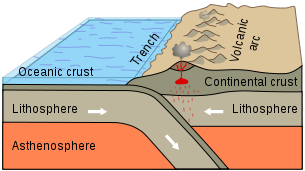
In some areas of the world, like California and Japan, earthquakes are a common occurrence. How can this best be explained?
The strong ocean currents are undermining both areas causing earthquakes.
Both areas are located near the edge of the Pacific Ocean, the unstable sand causes earthquakes.
Both areas are subjected to strong ocean wind and waves that causes earthquakes.
Both areas are on the boundary of active plates, the motion of the plates causes earthquakes.
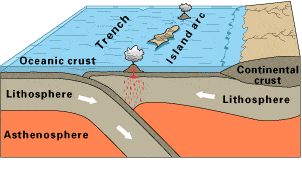
Observe this diagram of a plate boundary. One statement BEST describes what is happening. It is that
the oceanic crust is melting.
the denser ceanic crust is subducting under the less dense oceanic crust
volcanic islands are forming.
the tectonic plates are moving away from each other.
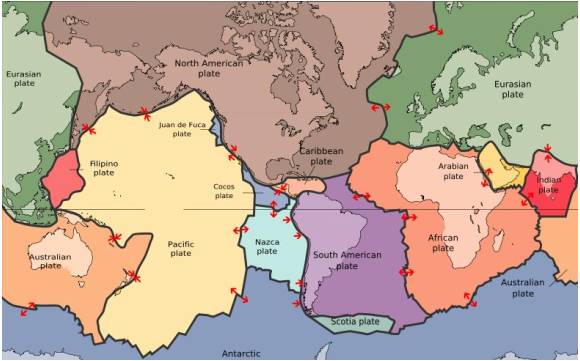
The map in the picture shows tectonic plate boundaries. This map would be useful in predicting the location of future
droughts
hurricanes
earthquakes
tornadoes
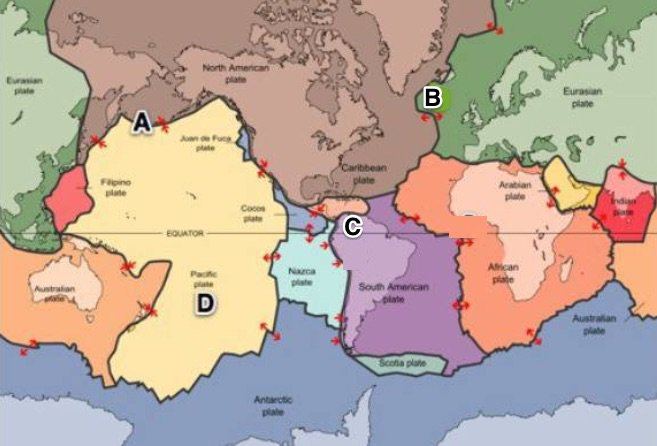
Where would sea floor spreading most likely occur?
At convergent boundaries (oceanic vs. oceanic)
At convergent boundaries (oceanic vs. continental)
At divergent plate boundaries (oceanic vs. oceanic)
At transform plate boundaries

What is the correct order (starting from the surface) of Earth’s layers?
crust, outer core, inner core, mantle
mantle, outer core, inner core, crust
crust, mantle, outer core, inner core
outer core, inner core, crust, mantle

Convection Currents occur in the
Inner Core
Mantle
Crust
Outer Core
Plates slide past each other at _________________ boundaries.
divergent
convergent
transform
universal
The fact that similar fossils are found on both sides of the ocean is evidence of
magnetic reversal
sonar
continental drift
plate boundaries

Observe this diagram of a plate boundary. One statement BEST describes what is happening. It is that
the tectonic plates are moving towards each other
the continental crust is melting
the more dense oceanic crust is subducting
an ocean ridge is forming
The outer core is
Layer of liquid metal.
Outermost layer of the Earth.
Made up of the lithosphere and asthenosphere.
Innermost layer of solid metal.
The inner core is
Layer of liquid metal.
Outermost layer of the Earth.
Made up of the lithosphere and asthenosphere.
Innermost layer of solid metal.

Which crust subducts because it is denser than other crust?
pizza crust
oceanic crust
continental crust
new crust
How are tsunamis generated?
generated from earthquakes
generated from tornadoes
generated from hurricanes
generated by volcanoes

Galileo Galilei
Sir issac
Newton

