wayground logo

Free Printable Worksheets

NEW

Font size

S
M
L
XL
Worksheets

Charging methods

Total questions: 30

Worksheet time: 28mins
Name
Class
Date
1.
When you charge a balloon by rubbing it on your hair this is an example of what method of charging?
a)
Friction
b)
Conduction
c)
Grounding
d)
Induction
2.
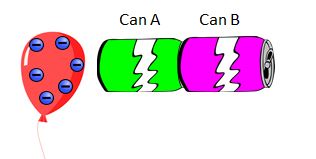
The negatively charged balloon is brought near the two cans. What happens?
a)
The negative charges in Can B move towards the balloon
b)
The negative charges in Can A move away from the balloon
c)
The positive charges in Can B move towards the balloon
d)
The positive charges in Can A move away from the balloon
3.
Which of these is the best definition of polarization?
a)
The object gains a positive or negative charge from another object.
b)
The charges in a neutral object separate due to a nearby charged object.
c)
Charges on a neutral object jump off onto a charged object due to attraction of opposite charges.
d)
Two objects attract each other because they are both charged.
4.

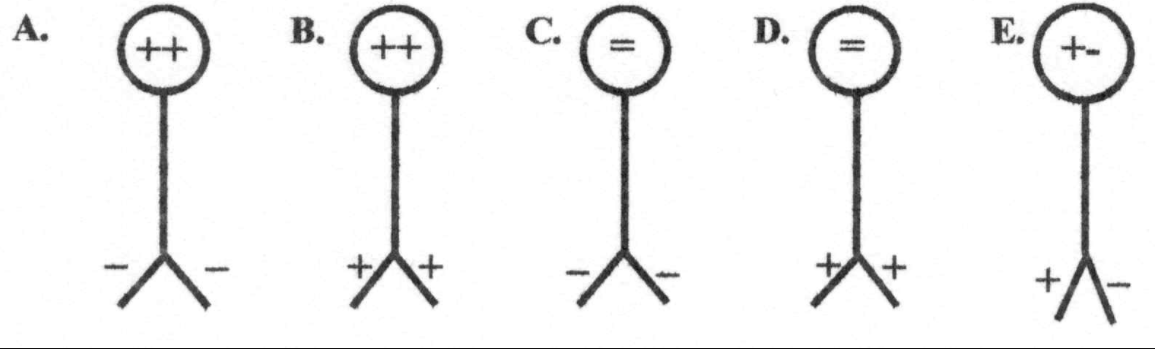
A negatively charged rod is touched to the top of an electroscope. Which shows the resulting charge?

a)

A

b)

B

c)

C

d)

D

e)

E

5.

During induction, grounding is necessary in order for the neutral object to become charged.

a)

true

b)

false

6.

Ms Pippin rubbed two balloons with a piece of wool. What will happen when the balloons are brought near each other?

a)

The balloons will repel each other.

b)

The balloons will attract each other.

c)

The balloons will become positively (+) charged.

d)

The balloons will pop.

7.

What charge will the metal plate have?

a)

positive; protons attract protons

b)

positive; protons attract electrons

c)

negative; protons attract electrons

d)

negative; protons attract protons

8.
Removing a static charge by providing a path to the ground is called __.
a)
electric transfer
b)
grounding
c)
switching
d)
seperation
9.

A positively charged rod is touched to the top of an electroscope. Which shows the resulting charge?

a)

A

b)

B

c)

C

d)

D

e)

E

10.

A positively charged rod is brought close to, but not touching a neutral electroscope. Which shows the resulting charge?

a)

A

b)

B

c)

C

d)

D

e)

E

11.

A positively charged rod is used to charge a neutral electroscope through induction. Which shows the resulting charge?

a)

A

b)

B

c)

C

d)

D

e)

E

12.

A negatively charged rod is brought close to, but not touching a neutral electroscope. Then the charged rod is moved far away from the electroscope. Which shows the resulting charge?

a)

A

b)

B

c)

C

d)

D

e)

E

13.
What do you call the process of charging a conductor by bringing it near another charged object?
a)
induction
b)
polarization
c)
neutralization
d)
conduction
14.
If a negatively charged rod touches a conductor, the conductor will be charged by what method? 
a)
Friction
b)
Conduction
c)
Induction
d)
Convection
15.
A charged balloon is brought near an electroscope but DOES NOT touch the electroscope.  This is an example of charging by
a)
Conduction
b)
Convection
c)
Friction
d)
Induction
16.
When you charge a balloon by rubbing it on your hair this is an example of what method of charging?
a)
Friction
b)
Conduction
c)
Grounding
d)
Induction
17.

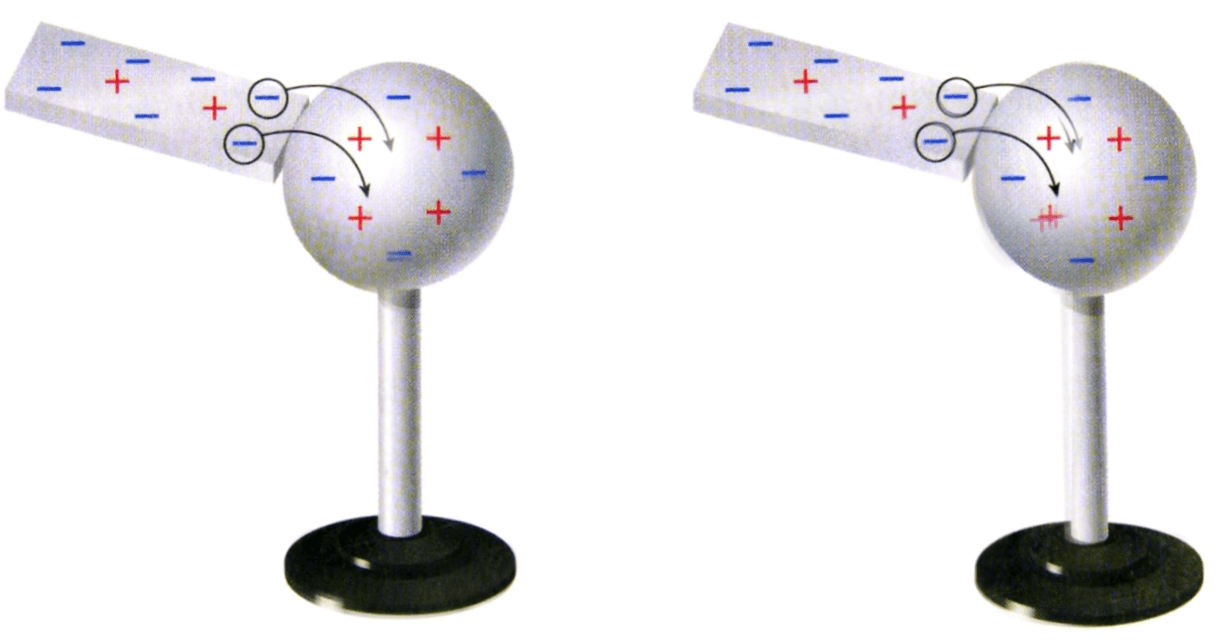
The process of transferring charge between objects by touching
a)
charging by induction
b)
static discharge
c)
charging by contact
d)
proton
18.
Charging by contact results in both objects having the same charge.
a)
True
b)
False
19.
Charging by Friction results in two objects with the same charge.
a)
True
b)
False
20.
When you charge a balloon by rubbing it on your hair this is an example of what method of charging?
a)
Friction
b)
Conduction
c)
Grounding
d)
Induction
21.
Neutral atoms contain equal numbers of positive __ and negative __.
a)
Electrons and Protons
b)
Protons and Electrons
c)
Neutrons and Electrons 
d)
Protons and Neutrons
22.
Materials through which electrons move easily__.
a)
insulator
b)
conductor
23.
If a negatively charged rod touches a conductor, the conductor will be charged by what method? 
a)
Friction
b)
Conduction
c)
Induction
d)
Convection
24.
Two like charges
a)
 neutralize each other.
b)
repel each other. 
c)
must be neutrons. 
d)
attract each other.
25.

1. It is a positively charged particles of an atom.

a)

a. proton

b)

b. neutron

c)

c. electron

26.

2. a subatomic particle of about the same mass as a proton but without an electric charge,(or a no charged particle)

a)

a. proton

b)

b. neutron

c)

c. electron

27.

4. the negatively charged particle of an atom is____

a)

a. proton

b)

b. neutron

c)

c. electron

28.

6. materials that conduct electricity is___

a)

a. plastic

b)

b. conductor

c)

c. insulator

29.

7. an object become electrically charged if____

a)

a. it gain electron

b)

b. it lose electron

c)

c. it gain proton

30.

9. three subatomic particles of an atom are____

a)

a. proton,neutron,electron

b)

b. proton, nucleus, neutron

c)

c. proton, electron, atom