Wayground logo

Free Printable Worksheets

Font size

S
M
L
XL
Worksheets

HOTS TRANSFORMATIONS

Total questions: 261

Worksheet time: 8hrs 26mins

Name
Class
Date
1.

Translate the blue shape to the pink shape...

a)

5 Right

2 Down

b)

5 Left

2 Up

c)

3 Right

1 Down

d)

3 Left

1 Up

2.
Determine where X' would be if you translated X 3 units to the left and 9 units down.
a)
(-4, 4)
b)
(-10, 2)
c)
(-4, -5)
d)
(-1, 5)
3.
Determine where T' would be if you translated T 3 units to the right and 6 units up.
a)
(5, 1)
b)
(2, -5)
c)
(-1, 1)
d)
(8, -2)
4.
Where would A' be if you translated A 3 units to the right and 4 units down?
a)
(-4, 4)
b)
(-1, 0)
c)
(0, -1)
5.
Where would point J' be if you translated point J 5 units to the left and 2 units up?
a)
(5, 3)
b)
(3, -5)
c)
(-5, 3)
d)
(-3, 5)
6.

Translate the blue shape to the pink shape...

a)

5 Right

2 Down

b)

5 Left

2 Up

c)

3 Right

1 Down

d)

3 Left

1 Up

7.
Determine where X' would be if you translated X 3 units to the left and 9 units down.
a)
(-4, 4)
b)
(-10, 2)
c)
(-4, -5)
d)
(-1, 5)
8.
Determine where T' would be if you translated T 3 units to the right and 6 units up.
a)
(5, 1)
b)
(2, -5)
c)
(-1, 1)
d)
(8, -2)
9.
Where would A' be if you translated A 3 units to the right and 4 units down?
a)
(-4, 4)
b)
(-1, 0)
c)
(0, -1)
10.
Where would point J' be if you translated point J 5 units to the left and 2 units up?
a)
(5, 3)
b)
(3, -5)
c)
(-5, 3)
d)
(-3, 5)
11.

Level 1 True or false: When a point is reflected across a line of symmetry, it remains the same distance from the line.

a)

true

b)

false

12.

Level 3 Find K' if the figure is reflected across the x-axis

a)

(4, 1)

b)

(-1, -4)

c)

(1, -4)

d)

(1, 4)

13.
Reflect Point C over the y-axis:
a)
(-3, 2)
b)
(3,2)
c)
(-2,3)
d)
(3,0)
14.
Triangle GHI is reflected across the x-axis.  What are the coordinates of I'?
a)
(-2, 6)
b)
(2, 6)
c)
(-6, -2)
d)
(6, 2)
15.
Is the picture being reflected in the y-axis or x-axis?
a)
y-axis
b)
x-axis
16.
If you were to rotate ABCD 90° counterclockwise about the origin, what would the coordinate of A' be?
a)
(-5, 5)
b)
(-3, 5)
c)
(-5, 3)
d)
(-3, 3)
17.
If you were to rotate ABCD 180°  about the origin, what would the coordinate of A' be?
a)
(-5, 5)
b)
(-3, -5)
c)
(-5, 3)
d)
(-3, 3)
18.
How many degrees was the figure rotated?
a)
90 degrees counterclockwise 
b)
180 degrees
c)
90 degrees clockwise
19.

Rotation Rules (clockwise):

90o rotation: (x, y)→(y, -x)

What are the coordinates for A' after a 90⁰ rotation clockwise?

a)

(1, 3)

b)

(3, 1)

c)

(3, -1)

d)

(1, -3)

20.

Rotation Rules (clockwise):

180o rotation: (x, y)→(-x, -y)

What are the coordinates of C' after a rotation of 180° clockwise?

a)

(-3, -1)

b)

(3,1)

c)

(1,3)

d)

(-1, -3)

21.
Dilate the figure by a scale factor of 3 with the origin as the center of dilation. What are the coordinates of the image?
A(3,3) B(6,6) C(9,3)
a)
A'(9,9) B'(18,18) C'(27,9)
b)
A'(6,6) B'(9,9) C'(12,6)
c)
A'(0,0) B'(3,3) C'(6,0)
d)
A'(1,1) B'(2,2) C'(3,1)
22.
Choose the correct scale factor:
a)
2
b)
3
c)
1/3
d)
1/2
23.
The point (8, 12) was dilated to become point (2, 3). What was the scale factor?
a)
½
b)
¼
c)
4
d)
2
24.
How do you write the algebraic notation when the scale factor is 3?
a)
(x, y) goes to (1/3x, 1/3y)
b)
(x, y) goes to (-3x, -3y)
c)
(x, y) goes to (x + 3, y + 3)
d)
(x, y) goes to (3x, 3y)
25.
Enlargement or reduction?  Find the scale factor!
a)
It's a reduction; the scale factor is 2.
b)
It's an enlargement; the scale factor is 2.
c)
It's an enlargement; the scale factor is 1/2.
d)
It's a reduction; the scale factor is 1/2.
26.
Determine where X' would be if you translated X 3 units to the left and 9 units down.
a)
(-4, 4)
b)
(-10, 2)
c)
(-4, -5)
d)
(-1, 5)
27.
Determine how to translate triangle A'B'C' to triangle ABC.
a)
(x+2, y-5)
b)
(x+2, y-9)
c)
(x-2, y-9)
28.
Determine where T' would be if you translated T 3 units to the right and 6 units up.
a)
(5, 1)
b)
(2, -5)
c)
(-1, 1)
d)
(8, -2)
29.
What rule describes the translation?
a)
(x - 6, y + 2)
b)
(x - 2, y + 6)
c)
(x + 2, y - 6)
d)
(x + 6, y - 2)
30.
Point M (-3, 5) is translated using this rule. 
(x, y) ----> (x - 1, y) 
What are the coordinates of M'?
a)
(-4, 5)
b)
(-2, 5)
c)
(-4, 4)
d)
None of these
31.

What are the coordinate points for point B?

a)

(-4, 6)

b)

(6, -4)

c)

(-4, 5)

32.

What are the coordinate points for point D?

a)

(3, 3)

b)

(-3, 3)

c)

(-3, -3)

33.
What is the Algebraic Notation for this Reflection?
a)
(x, y) → (y, x)
b)
(x, y) → (-x, y)
c)
(x, y) → (-y, -x)
d)
(x, y) → (x, -y)
34.
What is the Algebraic Notation for this Reflection?
a)
(x, y) → (y, x)
b)
(x, y) → (-x, y)
c)
(x, y) → (-y, -x)
d)
(x, y) → (x, -y)
35.
Rotate the point (-3,-4) around the origin 180 degrees. State the image of the point.
a)
(-4,-3)
b)
(-4,3)
c)
(4,-3)
d)
(3,4)
36.
If you were to rotate ABCD 90° counterclockwise about the origin, what would the coordinate of A' be?
a)
(-5, 5)
b)
(-3, 5)
c)
(-5, 3)
d)
(-3, 3)
37.
Which notation describes the translation that moves FIGURE 2 to FIGURE 3 on the coordinate plane?
a)
(x,y)→(x + 4,y + 1)
b)
(x,y)→(x + 3,y – 1)
c)
(x,y)→(x – 4,y + 1)
d)
(x,y)→(x – 4,y – 2)
38.
When a coordinate goes to (-x, -y) it is a 
a)
180 degree rotation
b)
a 90 degree clockwise rotation
c)
a 90 degree counterclockwise rotation
d)
A 360 degree rotation
39.
Triangle A is rotated 270° counterclockwise with the origin as the center of rotation to create a new figure. Which rule describes rotating 270° counterclockwise?
a)
(x,y)→(y, -x) 
b)
(x,y)→(x,y)
c)
(x,y)→(-y,x)
d)
(x,y)→(-x,-y)
40.
Triangle B is rotated 90° counterclockwise with the origin as the center of rotation to create a new figure. Which rule describes this transformation?
a)
(x,y)→(y, -x) 
b)
(x,y)→(x,y)
c)
(x,y)→(-x,-y)
d)
(x,y)→(-y,x)
41.
Translations, rotations, and reflections are three different types of what?
a)
Transformations
b)
Geometry
c)
Vectors
d)
Shapes
42.

When you translate, (x-4 ,y) will move _____.

a)

4 units right

b)

4 units left

c)

4 units up

d)

4 units down

43.
Identify the transformation from ABC to A'B'C'.
a)
90o clockwise rotation
b)
90o counter clockwise rotation
c)
Reflection across the y-axis
d)
Reflection across the x-axis
44.

What is this picture an example of?

a)

Reflection

b)

Translation

c)

Rotation

d)

Dilation

45.

What is the ordered pair for C' if reflected over the y-axis?

a)

(-3, 2)

b)

(3, 2)

c)

(-2, 3)

d)

(3, 0)

46.
Determine how to translate triangle ABC to triangle A'B'C'. 
a)
right 2, down 5
b)
right 2, down 9
c)
left 2, up 9
d)
left 2, down 9
47.
Which answer shows a reflection across the y-axis?
a)
a
b)
b
c)
c
d)
d
48.
Point (-5,2) is reflected over the y axis.  Where is the new point located?
a)
(5,2)
b)
(-5,-2)
c)
(-5,2)
d)
(5,-2)
49.
A slide is also called a _________.
a)
Translation
b)
Reflection
c)
Rotation
d)
Transformation
50.
A turn is also called a ___________.
a)
Translation
b)
Reflection
c)
Rotation
d)
Transformation
51.
 Describe the Transformation
a)
Translation
b)
Rotation
c)
Reflection
52.
Write a rule for the translation.
a)
 (x -1, y  + 2)
b)
 (x -2, y  + 1)
c)
 (x +2, y  - 1)
d)
(x +1, y  -  2)
53.

Zach and Naomi are studying geometric transformations. Zach is able to move the triangle AA to  A′A'  using the following sequence of basic transformations:

        1. Reflection across the x-axis.
        2. Reflection across the y-axis.
        3. Translation two units to the right.
Naomi claims that the same three transformations, done in any order will always produce the same result. Zach disagrees. Who is correct?

a)

Zach

b)

Naomi

c)

Both are correct

d)

Both are incorrect

54.
Which of the following describes the sequence of transformations shown?
a)
Reflect across the x-axis and then rotate -90 degrees around the origin
b)
Rotate -90 degrees around the origin and then translate down.
c)
Reflect across the x-axis and then reflect across the y-axis.
d)
Translate up and then rotate 90 degrees about the origin.
55.
What is the algebraic notation of a figure is Translated 9 units right and 3 units down?
a)
(x, y) --> (x - 9, y + 3)
b)
(x, y) --> (x + 9, y - 3)
c)
(x, y) --> (x + 3, y - 9)
d)
(x, y) --> (9x, 3y)
56.

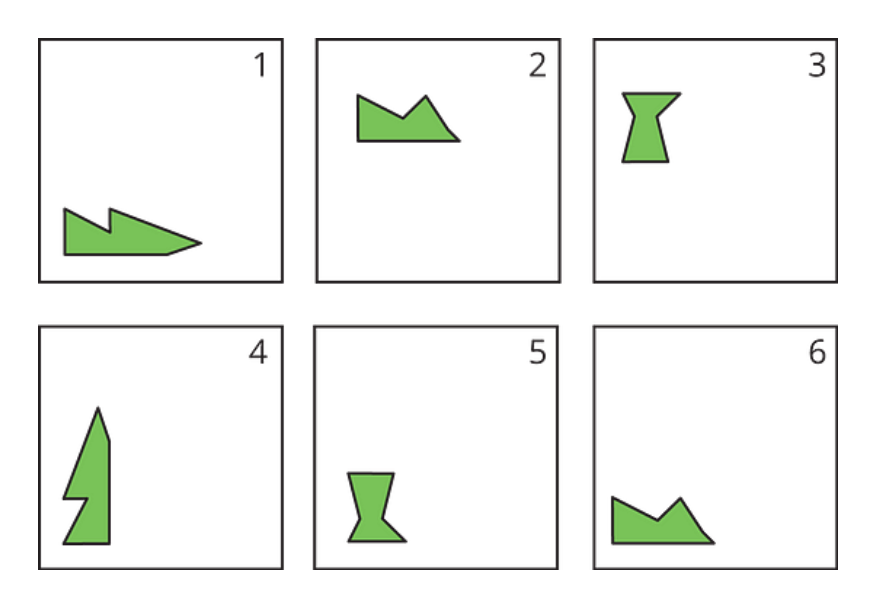
Which pair of cards show a shape and its image after a rotation?

a)

1 and 4

b)

2 and 6

c)

3 and 5

57.

Which pair of cards shows a shape and its image after a reflection?

a)

1 and 4

b)

2 and 6

c)

3 and 5

58.
A transformation that “turns” a figure about a fixed point at a given angle and a given direction.
a)
rotation
b)
translation
c)
reflection
d)
dilation
59.
A type of transformation where a figure is “flipped” over a line of symmetry. A reflection produces a mirror image of a figure.
a)
rotation
b)
translation
c)
dilation
d)
reflection
60.
A slide is also called a _________.
a)
Translation
b)
Reflection
c)
Rotation
d)
Transformation
61.
Translations, reflections and rotations are all known as ________________________.
a)
Geometry
b)
Transformations
c)
Congruent
62.

What combination of transformations is shown?

a)

translation, then reflection

b)

translation, then rotation

c)

rotation, then reflection

d)

Rotation, then translation

63.
Flipping a figures is a ...
a)
Rotation
b)
Reflection
c)
Dilation
d)
Translation
64.
Determine where X' would be if you translated 3 units to the left and 9 units down.
a)
(-4, 4)
b)
(-10, 2)
c)
(-4, -5)
d)
(-1, 5)
65.
How is trapezoid ABCD translated to trapezoid A'B'C'D'?
a)
Translated 5 units down and 5 units to the right
b)
Translated 5 units down and 1 to the right
c)
Translated 8 units down and 5 units to the right
d)
Translated 5 units down and 4 units to the right
66.
What does a translation do to an image?
a)
Turns it 90* clockwise
b)
Mirrors it
c)
Shrinks it
d)
Slides it
67.
Which answer shows a reflection across the x-axis?
a)
d
b)
c
c)
b
d)
a
68.
Flipping a figures is a ...
a)
Rotation
b)
Reflection
c)
Dilation
d)
Translation
69.
If you were to rotate ABCD 90° counterclockwise about the origin, what would the coordinate of A' be?
a)
(-5, 5)
b)
(-3, 5)
c)
(-5, 3)
d)
(-3, 3)
70.
What is the angle of rotation for this counterclockwise rotation about the origin?
a)
90°
b)
180°
c)
270°
d)
360°
71.
Triangle C is rotated 180° clockwise with the origin as the center of rotation to create a new figure. Which triangle shows the new location?
a)
A
b)
B
c)
C
d)
D
72.
Choose the correct scale factor:
a)
2
b)
3
c)
1/3
d)
1/2
73.
What is the algebraic rule?
a)
A
b)
B
c)
C
d)
D
74.
An entire pre-image that is located in quadrant III is then rotated 90° clockwise about the origin.  In which quadrant will the image fall?
a)
Quadrant I
b)
Quadrant II
c)
Quadrant III
d)
Quadrant IV
75.
Triangle RST has vertices R(1, 1), S(1, 4), and   T(3, 1).  Graph the figure and its rotated image after a counterclockwise rotation of 180° about the origin. What are the coordinates of  Tʹ?
a)
(-3, -1)
b)
(-3,-2)
c)
(5,2)
d)
(5,4)
76.
Determine how to translate triangle A'B'C' to triangle ABC.
a)
(x+2, y-5)
b)
(x+2, y-9)
c)
(x-2, y-9)
77.
Find K' if the figure is reflected across the x-axis
a)
(4, 1))
b)
(-1, -4)
c)
(1, -4)
d)
(1, 4)
78.
Reflecting over the y-axis changes the sign of the ____-_____________. 
a)
x-axis
b)
x-coordinate
c)
y-coordinate
d)
none of the above
79.
Identify the transformation from ABC to A'B'C'.
a)
90o clockwise rotation
b)
90o counter clockwise rotation
c)
Reflection across the y-axis
d)
Reflection across the x-axis
80.
Identify the transformation.
a)
Reflection across y-axis
b)
90 Rotation counter clockwise
c)
Translation 5 units left, 1 unit up.
d)
Translation 5 units right, 1 unit down
81.

Which of the following describes the sequence of transformations shown?

a)

Reflect across the x-axis and then rotate 90 degrees clockwise around the origin

b)

Rotate 90 degrees clockwise around the origin and then translate down.

c)

Reflect across the x-axis and then reflect across the y-axis.

d)

Translate up and then rotate 90 degrees counterclockwise about the origin.

82.
Reflections over the x-axis change the ____-__________. 
a)
y-coordinate
b)
x-coordinate
c)
y-axis
d)
x-axis 
83.
Reflecting over the y-axis changes the ____-_____________. 
a)
x-axis
b)
x-coordinate
c)
y-coordinate
d)
none of the above
84.
How is triangle ABC being translated to triangle A'B'C'?
a)
up 3, left 8
b)
up 9, left 4
c)
down 3, right 8
d)
down 9, right 4
85.

What sequence of transformations will map trapezoid A to its image A'?

a)

Reflection, then translation

b)

Rotation, then translation

c)

Reflection, then rotation

d)

Rotation, then dilation

86.

What sequence of transformations could map ∆ABC onto its image ∆A''B''C''?

a)

a reflection followed by a rotation

b)

a reflection followed by a translation

c)

a translation followed by a rotation

d)

a translation followed by a reflection

87.

Which of the following describes the sequence of transformations shown?

a)

Reflect across the x-axis and then rotate 90 degrees clockwise around the origin

b)

Rotate 90 degrees clockwise around the origin and then translate down.

c)

Reflect across the x-axis and then reflect across the y-axis.

d)

Translate up and then rotate 90 degrees counterclockwise about the origin.

88.

Which transformation is shown?

a)

Translation

b)

Reflection over the x-axis

c)

Reflection over the y-axis

d)

180o rotation

89.

Which transformation is shown?

a)

Translation

b)

Reflection over the x-axis

c)

Reflection over the y-axis

d)

180o rotation

90.

Which transformation is shown?

a)

Translation

b)

Reflection over the x-axis

c)

Reflection over the y-axis

d)

90o counterclockwise rotation

91.
Describe a sequence of transformations that maps figure A onto figure B.
a)
A translation 4 units right followed by a reflection across the x-axis
b)
A reflection across the x-axis followed by a reflection across the y-axis
c)
A reflection across the y-axis followed by a translation 6 units down
d)
A 90° counter-clockwise rotation about the Origin followed by a reflection across the y-axis
92.

Identify the sequences of transformations from the green image to the red image to the blue image.

a)

rotation then translation

b)

translation then rotation

c)

translation then reflection

d)

rotation then reflection

93.

Identify the sequences of transformations from the red image to the blue image to the green image.

a)

translation then translation

b)

rotation then reflection

c)

rotation then rotation

d)

reflection then translation

94.

Which sequence of transformations will result from shape F to its image shape F''?

a)

Reflection over both axes

b)

Reflection, then rotation

c)

Translation, then reflection

d)

Rotation, then translation

95.
What is the sequence of transformations?
a)
Reflect over the y-axis then reflect over the x-axis
b)
Reflect over the x-axis then reflect over the y-axis
c)
Translate 4 units then rotate 90˚ counter-clockwise about the origin
d)
Rotate 90˚ counter-clockwise about the origin then reflect over the x
96.

What combinaton of transformations is shown?

a)

Rotation, then translation

b)

Translation, then reflection

c)

Rotation, then reflection

d)

Translation, then rotation

97.

What combination of transformations is shown?

a)

Reflection, then rotation

b)

Translation, then rotation

c)

Translation, then reflection

d)

Reflection, then translation

98.

What are the final coordinates of B after a rotation of 180 degrees counterclockwise and a reflection over the y-axis

a)

(3, -4)

b)

(3, 4)

c)

(-4, 3)

d)

(4, -3)

99.
Identify the transformation.
a)
Reflection across y-axis
b)
90 Rotation counter clockwise
c)
Translation 5 units left, 1 unit up.
d)
Translation 5 units right, 1 unit down
100.
How many degrees was the figure rotated?
a)
90 degrees counterclockwise 
b)
90 degrees clockwise
101.
Reflect the point (2, -4) over the y-axis.
a)
(-4, 2)
b)
(-2, 4)
c)
(-2, -4)
d)
(2, 4)
102.
Rotate the point (-3,-4) around the origin 180 degrees. State the image of the point.
a)
(-4,-3)
b)
(-4,3)
c)
(4,-3)
d)
(3,4)
103.

Point A is rotated 180 degrees and then flipped over the y-axis. What is A" if A is (2,7)

a)

(2,7)

b)

(-2, -7)

c)

(-2, 7)

d)

(2, -7)

104.
If you were to rotate ABCD 180°  about the origin, what would the coordinate of A' be?
a)
(-5, 5)
b)
(-3, -5)
c)
(-5, 3)
d)
(-3, 3)
105.
The original figure prior to a transformation.
a)
Pre-image
b)
Image
106.
Reflect the point (2, -4) over the y-axis.
a)
(-4, 2)
b)
(-2, 4)
c)
(-2, -4)
d)
(2, 4)
107.
Reflect (6, -3) over the line x-axis.
a)
(6, 3)
b)
(-6, -3)
c)
(-3, 6)
d)
(3, -6)
108.

When you rotate 180 degrees the ( x , y ) becomes ?

a)

( y , x )

b)

( -y , x )

c)

( -x , y )

d)

( -x , -y )

109.

When you rotate 90 degrees clockwise ( x , y ) becomes ?

a)

( -x , -y )

b)

( y , -x )

c)

( y , x )

d)

( -y , -x )

110.

Triangle A is rotated 90° clockwise with the origin as the center of rotation to create a new figure. Which triangle shows the new location?

a)

A

b)

B

c)

C

d)

D

111.
Write a rule for the translation.
a)
 (x -1, y  + 2)
b)
 (x -2, y  + 1)
c)
 (x +2, y  - 1)
d)
(x +1, y  -  2)
112.

If the rectangle were rotated 90º clockwise about the origin, what would be the coordinates of Z'?

a)

(2, -2)

b)

(-2, -3)

c)

(2, 2)

d)

(-3, -2)

113.

If the triangle is reflected across the y-axis, the coordinates of the new triangle will be (5, 0), (2, 3), and ___.

a)

(0, 5)

b)

(4, 3)

c)

(3, 5)

d)

(2, 3)

114.

If the rectangle were rotated 90º counterclockwise about the origin, what would be the location of K'?

a)

(1, -6)

b)

(-1, 6)

c)

(6, -1)

d)

(-6, -1)

115.

If (4,-2) → (4,-2) represents a counterclockwise rotation of the point on a coordinate plane, how many degrees is the rotation?

a)

90

b)

180

c)

270

d)

360

116.

Which transformation(s), no matter which one you do, will the resulting image be congruent? (select all that apply)

a)

translation

b)

reflection

c)

rotation

d)

dilation

117.
The result of a transformation.
a)
Pre-image
b)
Image
118.
What is the angle of rotation for this counterclockwise rotation about the origin?
a)
90°
b)
180°
c)
270°
d)
360°
119.
Which algebraic rule will produce a translation that is 5 units to the right?
a)
(x, y)  --> (  x ,  y + 5)
b)
(x, y)  --> ( x-5 , y + 5)
c)
(x, y)  --> ( x-2 , y + 5)
d)
(x, y)  --> ( x+5 , y)
120.

What type of transformation is shown?

a)

Rotation

b)

Translation

c)

Reflection

121.

What type of transformation is shown?

a)

Translation

b)

Reflection

c)

Rotation

122.

If (3,2)→(-3,-2) represents a counterclockwise rotation of the point on a coordinate plane, how many degrees is the rotation?

a)

90

b)

180

c)

270

d)

360

123.

What is the algebraic representation for the transformation shown?

a)

(x, y) ---> (x - 8, y + 3)

b)

(x, y) ---> (x - 4, y + 9)

c)

(x, y) ---> (x + 8, y - 3)

d)

(x, y) ---> (x + 4, y - 9)

124.

What transformation is the following rule for?

(x, y) ----> (-x, y)

a)

Reflect over the x axis

b)

Reflect over the y-axis

c)

Rotate 90 degrees clockwise

d)

Rotate 270 degrees clockwise

125.
Determine how to translate triangle ABC to triangle A'B'C'.
a)
left 2, up 9
b)
right 2, down 9
c)
left 2, down 9
d)
left 2, up 5
126.

Determine where X' would be if you translated X 3 units to the left and 9 units down.

a)

(-4, 4)

b)

(-4, -5)

c)

(4, 4)

d)

(-1, 5)

127.
Is the picture being reflected in the y-axis or x-axis?
a)
y-axis
b)
x-axis
128.

A slide is also called a _________.

a)

Translation

b)

Reflection

c)

Rotation

d)

Dilation

129.
The original figure prior to a transformation.
a)
Pre-image
b)
Image
130.
State the line of reflection.
a)
Reflection across y-axis
b)
Reflection across x-axis
c)
Reflection across x = 1
d)
Reflection across y = 1
131.
Reflect over x-axis. Which point would be at (3, -6)
a)
A
b)
B
c)
C
d)
H
132.

Which picture is an example of a translation?

a)
b)
c)
d)
133.

Which of the following is NOT a rigid transformation?

a)
b)
c)
d)
134.

Which of the following BEST describes the transformation?

a)

TRANSLATE 5 units down

b)

REFLECT over the x-axis

c)

ROTATE 90 degrees clockwise

d)

None of these

135.

Describe the rotation.

a)

Rotate 90 degrees clockwise about the origin

b)

Rotate 90 degrees counter clockwise about the origin

c)

Rotate 180 degrees about the origin

d)

Rotate 180 degrees

136.

Describe the reflection.

a)

Reflect over the x-axis

b)

Reflect over the y-axis

c)

Reflect 180 degrees

d)

Reflect over the origin

137.

A mirror image of a figure

a)

Translation

b)

Reflection

c)

Rotation

d)

Dilation

138.

to slide or move a figure

a)

Translation

b)

Reflection

c)

Rotation

d)

Dilation

139.

Turning around a point

a)

Translation

b)

Reflection

c)

Rotation

d)

Dilation

140.

What does it mean if two figures are congruent?

a)

The figures are the same shape, but different size

b)

The figures are different size and shape

c)

The figures are the same size and shape

d)

The figures are the same size, but different shape

141.

Are the figures congruent?

(What type of transformation is shown?)

a)

Congruent (rotation)

b)

Congruent (reflection)

c)

NOT Congruent (rotation)

d)

NOT Congruent (reflection)

142.

Are the figures congruent?

(What type of transformation is shown?)

a)

Congruent (rotation)

b)

Congruent (reflection)

c)

NOT Congruent (rotation)

d)

NOT Congruent (reflection)

143.

Point N(6, –5) is reflected across the

x-axis. What are the coordinates of the image?

a)

(-6, -5)

b)

(-5, 6)

c)

(5, -6)

d)

(6, 5)

144.
Determine how to translate triangle A'B'C' to triangle ABC.
a)
(x+2, y-5)
b)
(x+2, y-9)
c)
(x-2, y-9)
d)

(x-2, y+9)

145.

If point H(–6, 2) is translated 4 units up and 3 units right, what are the coordinates of the translated image?

a)

(-2, 5)

b)

(-3, 6)

c)

(-9, -2)

d)

(-9, 6)

146.

Point N(6, –5) is reflected across the

x-axis. What are the coordinates of the image?

a)

(-6, -5)

b)

(-5, 6)

c)

(5, -6)

d)

(6, 5)

147.

Suppose triangle RST shown on the

coordinate grid is reflected across the y-axis. Which ordered pair does not represent a vertex of the reflected triangle?

a)

(5, 1)

b)

(-4, -2)

c)

(2, -4)

d)

(-2, 4)

148.

Triangle LMN has vertices L(–1, 4), M(–2, 4), and N(–1, –1). What are the coordinates of the image of point M after a dilation with a scale factor of 3?

a)

(-6, 12)

b)

(-6, 4)

c)

(-2, 12)

d)

(12, -6)

149.

If the figure is rotated 90 degrees clockwise, what are the coordinates of R?

a)

(-3, 3)

b)

(3, -3)

c)

(-3, -3)

d)

(3, 3)

150.

Triangle RST has vertices R(–1, 1), S(3, 1), and T(3, –4). What are the coordinates of the image of RST after a translation 4 units to the left and 2 units down?

a)

R'(–5, 1), S'(–1, 1), and T'(–1, –4)

b)

R'(–5, –1), S'(3, –1), and T'(–1, –4)

c)

R'(–1, –1), S'(3, –1), and T'(3, –6)

d)

R'(–5, –1), S'(–1, –1), and T'(–1, –6)

151.

Point A(3, 5) was dilated, and the point after dilation was A’(6, 10).  What was the scale factor used?

a)

1/2

b)

2

c)

1

d)

3

152.

What scale factor was used for the dilation shown?

a)

1/2

b)

1

c)

2

d)

3

153.

The vertices of triangle GHI are G(1, 2), H(3, 4), and I(4, 2). The triangle will be reflected across the x-axis. What will be the coordinates of the image point H′?

a)

(-3, 4)

b)

(3, -4)

c)

(-3, -4)

d)

(3, 4)

154.

Point W is located at (7, 3) on a coordinate plane. Point W is translated 2 units to the left and 3 units up. What are the coordinates of the image point W′?

a)

(10, 1)

b)

(9, 0)

c)

(5, 6)

d)

(4, 1)

155.
Determine how to translate triangle A'B'C' to triangle ABC.
a)
(x+2, y-5)
b)
(x+2, y-9)
c)
(x-2, y-9)
d)

(x-2, y+9)

156.
Determine where X' would be if you translated X 3 units to the left and 9 units down.
a)
(-4, 4)
b)
(-10, 2)
c)
(-4, -5)
d)
(-1, 5)
157.
How was B translated to B' if B' is at (4, -2)?
a)
Translated 6 units down
b)
Translated 2 units to the left and 6 units down
c)
Translated 2 units to the right and 6 units down
d)
Translated 2 units to the right
158.
How is trapezoid ABCD translated to trapezoid A'B'C'D'?
a)
Translated 5 units down and 5 units to the right
b)
Translated 5 units down and 1 to the right
c)
Translated 8 units down and 5 units to the right
d)
Translated 5 units down and 4 units to the right
159.
Identify the transformation.
a)
Reflection across y axis
b)
Reflection across x-axis
c)
180 Rotation
d)
Translation 2 units down
160.

What is the ordered pair for point D ?

a)

(3, 3)

b)

(-3, 3)

c)

(-3, -3)

161.

What is the ordered pair for point B ?

a)

(-4, 6)

b)

(6, -4)

c)

(-4, 5)

162.

Which graph shows a translation?

Hint: Translation is to SLIDE

a)
b)
c)
d)
163.

What type of transformation is this?

a)

Reflection

b)

Dilation

c)

Translation

164.

If point H (–6, 2) is translated 3 right and 4 up, what is the new ordered pair ?

a)

(-2, 5)

b)

(-3, 6)

c)

(-9, -2)

d)

(-9, 6)

165.

Point W is at (7, 3) . Point W is translated 2 to the left and 3 up. What is the new ordered pair ?

a)

(10, 1)

b)

(9, 0)

c)

(5, 6)

d)

(4, 1)

166.

Point N (6, –5) is reflected across the

x-axis. What is the new ordered pair ?

a)

(-6, -5)

b)

(-5, 6)

c)

(5, -6)

d)

(6, 5)

167.

What type of transformation is this ?

a)
Reflection across y axis
b)
Reflection across x-axis
c)
Translation 2 units down
168.

What type of transformation is this?

a)

Reflection

b)

Dilation

c)

Translation

169.

What type of transformation is this?

a)

Reflection

b)

Rotation

c)

Dilation

d)

Translation

170.

Dilate the figure by a scale factor of 3.

A (3,3) B (6,6) C (9,3)

Hint: Multiply by 3

a)

A'(9,9) B'(18,18) C'(27,9)

b)

A'(6,6) B'(9,9) C'(12,6)

c)

A'(0,0) B'(3,3) C'(6,0)

d)

A'(1,1) B'(2,2) C'(3,1)

171.

Dilate the figure by a scale factor of 12\frac{1}{2}  .

What are the new ordered pairs ? A (10,8) B (6,6) C (4,2)

Hint: Divide by 2

a)

A' (4,3) B' (2, 3)

C' (2, 1)

b)

A' (5,4) B' (3, 3)

C' (2, 1)

c)

A' (5,1) B' (2, 2)

C' (2, 1 )

172.

What type of transformation is this?

a)

rotation

b)

translation

c)

reflection

d)

dilation

173.

What type of transformation is this?

a)

rotation

b)

translation

c)

reflection

d)

dilation

174.

What type of transformation is this?

a)

rotation

b)

translation

c)

reflection

d)

dilation

175.

What type of transformation is this?

a)

rotation

b)

translation

c)

reflection

d)

dilation

176.

What type of transformation is this?

a)

rotation

b)

translation

c)

reflection

d)

dilation

177.

This type of transformation changes the size:

a)

rotation

b)

translation

c)

reflection

d)

dilation

178.

Which is the pre-image (first one)?

a)

Purple

b)

Blue

179.

Which picture shows a TRANSLATION?

a)
b)
c)
d)
180.
Identify the transformation from ABC to A'B'C'.
a)
90o clockwise rotation
b)
90o counter clockwise rotation
c)
Reflection across the y-axis
d)
Reflection across the x-axis
181.

Which picture shows a TRANSLATION?

a)
b)
c)
d)
182.
Identify the transformation from ABC to A'B'C'.
a)
90o clockwise rotation
b)
90o counter clockwise rotation
c)
Reflection across the y-axis
d)
Reflection across the x-axis
183.
Identify the transformation from ABCD to A'B'C'D'.
a)
Translation
b)
Reflection across the y-axis
c)
Reflection across the x-axis
d)
90o counter clockwise Rotation
184.
Write a rule for the translation.
a)
 (x -1, y  + 2)
b)
 (x -2, y  + 1)
c)
 (x +2, y  - 1)
d)
(x +1, y  -  2)
185.
What is this picture an example of? 
a)
An angle
b)
A cat vertex 
c)
Rotation 
d)
Dilation
186.

Translated figures are always __________________.

a)

Congruent

b)

Bigger

c)

Smaller

d)

Rotated

187.

A transformation that “turns” a figure about a fixed point is a _____________________.

a)

rotation

b)

translation

c)

reflection

d)

dilation

188.

A reflection ____________________.

a)

turns a figure around a point.

b)

slides an object form one place to another.

c)

flips or mirrors an object across a line.

d)

changes the size of an object.

189.

A type of transformation where a geometric figure slides horizontally, vertically, or both.

a)

dilation

b)

translation

c)

rotation

d)

reflection

190.
Reflect the point (2, -4) over the y-axis.
a)
(-4, 2)
b)
(-2, 4)
c)
(-2, -4)
d)
(2, 4)
191.

What transformation is happening?

T(x + 2, y - 3)

a)

translate up 2, left 3

b)

translate right 2, up 3

c)

translate right 2, down 3

d)

translate left 3, right 2

192.
Reflect (6, -3) over the line x-axis.
a)
(6, 3)
b)
(-6, -3)
c)
(-3, 6)
d)
(3, -6)
193.
Rotate the point (7,8) around the origin 90 counter clockwise degrees. State the image of the point.
a)
(-7,-8)
b)
(8,-7)
c)
(-8,7)
d)
(8,7)
194.
If you were to rotate ABCD 180°  about the origin, what would the coordinate of A' be?
a)
(-5, 5)
b)
(-3, -5)
c)
(-5, 3)
d)
(-3, 3)
195.

How many degrees COUNTERCLOCKWISE was quadrilateral ABCD rotated?

a)

90°

b)

180°

c)

270°

d)

360°

196.
Determine how to translate triangle ABC to triangle A'B'C'.
a)
(x-2, y+5)
b)
(x+2, y-9)
c)
(x-2, y+9)
d)
(x-9, y+2)
197.
Where would point J' be if you translated point J 5 units to the left and 2 units up?
a)
(5, 3)
b)
(3, -5)
c)
(-5, 3)
d)
(-3, 5)
198.
Which answer shows a reflection across the y-axis?
a)
a
b)
b
c)
c
d)
d
199.

Reflect the point (2, -4) over y = x.

a)
(-4, 2)
b)
(-2, 4)
c)
(-2, -4)
d)
(2, 4)
200.

Reflect the point D (-9, -12) over the line y = -x.

a)

(12, 9)

b)

(-12, -9)

c)

(-12, 9)

d)

(12, -9)

201.

Find the image of F after it has been translated by the vector <5, 1>.

a)

F'( 1, 3)

b)

F' (2, 4)

c)

F' (2, -1)

d)

F' (0, -1)

202.

Find the coordinates of E' after a rotation 90o clockwise.

a)

E' (3, -2)

b)

E' (2, 3)

c)

E' (3, 2)

d)

E' (-3, -2)

203.
A turn is also called a ___________.
a)
Translation
b)
Reflection
c)
Rotation
d)
Transformation
204.
A slide is also called a _________.
a)
Translation
b)
Reflection
c)
Rotation
d)
Transformation
205.
Identify the transformation.
a)
Reflection across y-axis
b)
90 Rotation counter clockwise
c)
Translation 5 units left, 1 unit up.
d)
Translation 5 units right, 1 unit down
206.

Identify this transformation.

a)

Dilation

b)

Rotation

c)

Translation

d)

Reflection

207.

Describe the Transformation

a)

Translation

b)

Reflection

c)

Rotation

d)

Dilation

208.

Which way do you rotate if you turn to the right?

a)

clockwise

b)

counterclockwise

c)

flip-flop

d)

upside down

209.

What type of transformation is this?

a)

Translation

b)

Dilation

c)

Reflection

d)

Rotation

210.

What type of transformation changes the size?

a)

Rotation

b)

Reflection

c)

Translation

d)

Dilation

211.

Translated figures are always ________.

a)

Congruent

b)

similar

c)

Bigger

d)

Rotated

212.

What is a transformation

a)

 a change in position or size, including reflection … flip, a translation … slide, rotation … turn and dilation ... zoom.

b)

translation

c)

rotation

d)

reflections

213.

The image shows what type of transformation?

a)

Rotation

b)

Translation

c)

Reflection

214.

After a transformation, your new vertices should have what symbol on them?

a)

$

b)

#

c)

'

d)

&

215.

What is the correct definition of a translation?

a)

moving a figure by reflecting across an axis

b)

moving a figure by sliding left/right or up/down

c)

moving a figure by rotating a figure

d)

moving a figure by enlarging or reducing a figure

216.

A reflection is

a)

flipping a figure

b)

turning a figure

c)

enlarging a figure

d)

sliding a figure

217.

Having the same size and shape; ≅.

a)

Congruent

b)

Similar

c)

Image

d)

Preimage

218.

What kind of transformation is this?

a)

Reflection

b)

Translation

c)

Rotation

219.

What kind of transformation is this?

a)

Rotation

b)

Reflection

c)

Translation

220.

What kind of transformation is this?

a)

Translation

b)

Reflection

c)

Rotation

221.
A transformation that “turns” a figure about a fixed point at a given angle and a given direction.
a)
rotation
b)
translation
c)
reflection
d)
dilation
222.
If the quadrilateral is translated 4 units to the left and 5 units down what is the coordinates for Point A'?
a)
(4,0)
b)
(0,4)
c)
(-1,5)
d)
(5,-1)
223.

Reflections over the x-axis change the __________.

a)

y-coordinate

b)

x-coordinate

224.
Identify the transformation.
a)
Reflection across y-axis
b)
90 Rotation counter clockwise
c)
Translation 5 units left, 1 unit up.
d)
Translation 5 units right, 1 unit down
225.
Determine where X' would be if you translated X 3 units to the left and 9 units down.
a)
(-4, 4)
b)
(-10, 2)
c)
(-4, -5)
d)
(-1, 5)
226.
∆BCD contains the points: B(2,3) C(2,1) D(5,1). If the triangle is reflected across the x-axis, what will B' be?
a)
B'(2, -3)
b)
B'(-2, 3)
c)
B'(-2, -3)
d)
B'(2, 3)
227.

Describe the transformation:

(x, y) -> (x-2, y+7)

a)

Translation 2 units to the left & 7 units up

b)

Translation 2 units to the left & 7 units down

c)

Translation 2 units to the right & 7 units up

d)

Translation 2 units to the right & 7 units down

228.

A mirror image of a figure

a)

Translation

b)

Reflection

c)

Rotation

d)

Dilation

229.

to slide or move a figure

a)

Translation

b)

Reflection

c)

Rotation

d)

Dilation

230.

Turning around a point

a)

Translation

b)

Reflection

c)

Rotation

d)

Dilation

231.

What is a rigid motion?

a)

Same shape and size after a transformation

b)

Same shape but different size after a transformation

c)

Different shape but the same size after a transformation

d)

Rigid motion?!

232.
If you were to rotate ABCD 90° counterclockwise about the origin, what would the coordinate of A' be?
a)
(-5, 5)
b)
(-3, 5)
c)
(-5, 3)
d)
(-3, 3)
233.

Graph the image of the figure using the transformation given.

a)
b)
c)
d)
234.

Graph the image of the figure using the transformation given.

a)
b)
c)
d)
235.

Graph the image of the figure using the transformation given.

a)
b)
c)
d)
236.

Graph the image of the figure using the transformation given.

a)
b)
c)
d)
237.

Graph the image of the figure using the transformation given.

a)
b)
c)
d)
238.

Graph the image of the figure using the transformation given.

a)
b)
c)
d)
239.

Graph the image of the figure using the transformation given.

a)
b)
c)
d)
240.

Graph the image of the figure using the transformation given.

a)
b)
c)
d)
241.

Graph the image of the figure using the transformation given.

a)
b)
c)
d)
242.

Which series of transformations were performed in the figure?

a)

Translation 5 units down, reflection over the y-axis

b)

Reflection over the x-axis, translation 6 units right

c)

Rotation 90o clockwise, reflection over the x-axis

d)

Rotation 180o clockwise, reflection over the y-axis

243.

Which of the following describes the sequence of transformations shown?

a)

Reflect across the x-axis and then rotate 90 degrees clockwise around the origin

b)

Rotate 90 degrees clockwise around the origin and then translate down.

c)

Reflect across the x-axis and then reflect across the y-axis.

d)

Translate up and then rotate 90 degrees counterclockwise about the origin.

244.

(2, 6) --> Translate up 3, left 1 and rotate 180°

a)

(-1,-9)

b)

(1, -9)

c)

(5,5)

d)

(-5,5)

245.

Choose the correct transformations

a)

rotate 90 degrees counter-clockwise around the origin, and then reflect over the x-axis

b)

right 1, down 4, and then reflection over the y-axis

c)

right 6, and then reflection over the x-axis

d)

reflection over the line y=x, and then translate up 4, right 2

246.
What sequence of transformations will get you from shape 1 to shape 2 to shape 3 in three steps?
a)
Rotation, then Dilation, then Reflection
b)
Translation, then Reflection, then Rotation
c)
Reflection, then
Dilation, then Rotation
d)
Dilation, then Translation, then Reflection
247.
Triangle C is rotated 180° clockwise with the origin as the center of rotation to create a new figure. Which triangle shows the new location?
a)
A
b)
B
c)
C
d)
D
248.

Choose the correct transformations

a)

rotate 90 degrees counter-clockwise around the origin, and then reflect over the x-axis

b)

right 1, down 4, and then reflection over the y-axis

c)

right 6, and then reflection over the x-axis

d)

reflection over the line y=x, and then translate up 4, right 2

249.
Identify the transformation from A to B.
a)
90o Clockwise Rotation
b)
180o Rotation
c)
270o  clockwise Rotation
d)
360o Rotation
250.
A flip is also called a __________
a)
Translation
b)
Rotation
c)
Reflection
d)
Transformation
251.
Identify the transformation from ABC to A'B'C'.
a)
90o clockwise rotation
b)
90o counter clockwise rotation
c)
Reflection across the y-axis
d)
Reflection across the x-axis
252.
A slide is also called a _________.
a)
Translation
b)
Reflection
c)
Rotation
d)
Transformation
253.

A type of transformation where a figure is “flipped” over a line of symmetry. It produces a mirror image of a figure.

a)

rotation

b)

translation

c)

dilation

d)

reflection

254.
A transformation that “turns” a figure about a fixed point at a given angle and a given direction.
a)
rotation
b)
translation
c)
reflection
d)
dilation
255.
Identify the transformation from ABCD to A'B'C'D'.
a)
Translation
b)
Reflection across the y-axis
c)
Reflection across the x-axis
d)
90o counter clockwise Rotation
256.
Which answer shows a reflection across the x-axis?
a)
d
b)
c
c)
b
d)
a
257.
State the line of reflection.
a)
Reflection across y-axis
b)
Reflection across x-axis
c)
Reflection across x = 1
d)
Reflection across y = 1
258.
Dilations are ________ but not congruent.
a)
Similar
b)
Flipped
c)
Rotated
d)
Congruent
259.
What is (3, 6) under a dilation of 2?
a)
(3, 6)
b)
(1.5, 3)
c)
(6, 12)
d)
(12, 6)
260.

In the coordinate plane, the point (0,0) is called the...

a)

vertex

b)

origin

c)

coordinate

d)

axis

261.

In the diagram, Figure B is a reflection of Figure....

a)

D

b)

E

c)

A

d)

C