
Font size
 Worksheets
1st NW Proof Review
Total questions: 55
Worksheet time: 1hrs 8mins
If a is related to b and b is related to c then a is related to c
transitive property
subtraction property of equality
Given
Definition of right angle
AB + BC = AC
Angle addition postulate
Segment addition postulate
Definition of supplementary angles
Transitive property
If <1 is a right angle, then m<1 = 90o
Definition of right angle
Definition of supplementary angles
Definition of angle bisector
Definition of midpoint
If B is the midpoint of AC , then AB≅BC
Definition of midpoint
Definition of angle bisector
Definition of segment bisector
Definition of perpendicular lines
If m<1 + m<2 = 50 and m<2 = 10, then m<1 + 10 = 50
Transitive property
Substitution
Definition of angle bisector
Subtraction property of equality
m<AMX + m<XMB = m<AMB
Segment addition postulate
Angle addition postulate
Definition of supplementary angles
Definition of angle bisector
The symbol ≅ means..........
Congruent
transitive
equal sign
supplementary
When writing a proof start with ......
The given
Transitive property
Supplementary angles
Subtraction property of equality

Which reason justifies the statement?
Addition Property of Equality
Multiplication Property of Equality
Subtraction Property of Equality
Division Property of Equality

Which reason justifies the statement?
Subtraction Property of Equality
Combine Like Terms
Division Property of Equality
Addition Property of Equality
The product of any two prime numbers is always odd.
The square of a number is always larger than the number.
Two lines always intersect at a point.
Which reason justifies the statement?
Subtraction Property of Equality
Combine Like Terms
Division Property of Equality
Addition Property of Equality
Which reason justifies the statement?
Addition Property of Equality
Multiplication Property of Equality
Subtraction Property of Equality
Division Property of Equality

Which reason justifies the statement?
Division Property of Equality
Addition Property of Equality
Multiplication Property of Equality
Subtraction Property of Equality

Which reason justifies the statement?
Combine Like Terms
Multiplication Property of Equality
Division Property of Equality
Addition Property of Equality

Which reason justifies the statement?
Combine Like Terms
Distributive Property of Equality
Multiplication Property of Equality
Division Property of Equality

Which reason justifies the statement?
Reflexive Property of Equality
Division Property of Equality
Symmetric Property of Equality
Commutative Property of Equality


What is step 2?
Distributive Property
Multiplication property of equality
Division property of equality
Substitution property

What is step 6?
Subtraction property of equality
Division property of equality
Addition property of equality
Given

What is step 2?
Given
Subtraction Property of Equality
Division Property of Equality
Multiplication Property of Equality
Addition Property of Equality
What is always the 1st reason of a proof?
Given
Reason
Prove
Statement


Given: B is the midpoint of AC. What should you conclude?
AB + BC = AC
AB = BC
A is the segment bisector of BC
ABC is a straight angle

What property makes this true?
Reflexive Property
Symmetric Property
Transitive Property
Segment Addition Postulate
What property makes this true?
m<1 + m<2 = 180 degrees
Definition of Supplementary Angles
Definition of Complementary Angles
Definition of Congruence
Definition of Right Angle

What property makes this true?
<DBC is a right angle.
Given
Definition of Supplementary Angles
Definition of Perpendicular
Definition of Congruence
What is step 2?
Distributive Property
Multiplication property of equality
Division property of equality
Substitution property
Given: B is the midpoint of AC. What should you conclude?
AB + BC = AC
AB = BC
A is the segment bisector of BC
ABC is a straight angle
What property makes this true?
Reflexive Property
Symmetric Property
Transitive Property
Segment Addition Postulate
What property makes this true?
m<1 + m<2 = 180 degrees
Definition of Supplementary Angles
Definition of Complementary Angles
Definition of Congruence
Definition of Right Angle
What property makes this true?
<DBC is a right angle.
Given
Definition of Supplementary Angles
Definition of Perpendicular
Definition of Congruence
What is a counterexample?
The process of reasoning using observations and patterns.
An example that proves that a conjecture or statement is false.
The process of reasoning logically and drawing a conclusion from given facts and statements.


Given: B is the midpoint of AC. What should you conclude?
AB + BC = AC
AB = BC
A is the segment bisector of BC
ABC is a straight angle
Which of the following is an example of the transitive property?
If x = 5 and and x = y, then y = 5.
If x = y then y = x
x = x
If 2x + 4 = 2, then x = -1
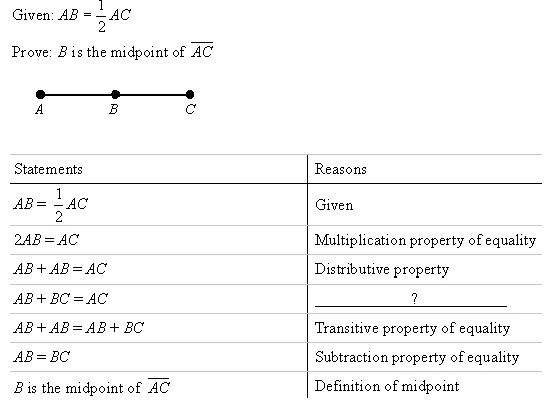
What is the missing statement in the proof?
Addition property
Segment Addition Postulate
Substitution property
Transitive property
If B is the midpoint of segment AC, then AB = BC.
Definition of Congruent Segments
Definition of Midpoint
Vertical Angles Theorem
Definition of Angle Bisector


What is the justification?
Segment Addition Postulate
Definition of Midpoint
Addition Property of Equality
Complement Theorem

