
 Worksheets
Byzantine Art Review
Total questions: 24
Worksheet time: 13mins
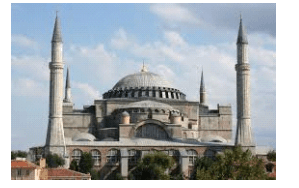
What church was found in the Byzantine Empire?
Eastern Orthodox
Roman Catholic
Lutheran
Methodist
Which emperor had his own law codes and built the Hagia Sophia?
Justinian
Theodora
Constantine
Diocletian
______________ is a person who wanted to ban icons
Anti-Iconist
Ionian
Iconoclast
Serf
Where is San Vitale located?
Constantinople
Ravenna
Dara
Ravello
Why is the Justinian Mosaic so important?
it is the only mosaic which clearly depicts Justinian
it is one of the most complete programs of mosaics still extant

Name this image
(a)

The formal qualities of the work shown above identify it as an example of an
early Christian manuscript because of the flattened frontal figures
early Christian manuscript because of the use of gold leaf and saturated colors
early Byzantine icon because of the inclusion of aerial perspective
early Byzantine icon because of the heavily contoured figures in a shallow space

Above are shown the mosaics of Theodora and Justinian. These mosaics have been placed in San Vitale
because they were declared saints after they died
to symbolize their presence as as participants in the Mass, even if they were physically absent
as a thank you for helping to construct the building.
to commemorate a state visit by the Emperor and the Empress in the year 547 CE
An important structural innovation of Hagia Sophia is the use of
pendentives
corbelled galleries
groin vaults
concrete construction
Which of the following art historical periods did NOT influence San Vitale?
Roman
Byzantine
Early Christian
Romanesque
Originally Hagia Sophia may have lacked figural imagery either because the builders feared making graven images or because
they desired to focus the attention of visitors on the architecture and surface decoration
they ran out of money to finish their planned program of decoration
Emperor Justinian wanted to outshine all other aspects of the building when he appeared
Christians had not yet developed a tradition of figural imagery for church decoration

The steady gazes and frontal poses of the foreground figures likely affected the original audience by
encouraging a personal connection with holy figures
modeling appropriate manners at court
monitoring the viewer’s moral conduct
demonstrating reverence for community elders
Both San Vitale and the Pantheon have which of the following architectural features?
Pendentives
A dome
An oculus
An ambulatory
Two structures associated with Emperor Justinian are
Santa Costanza and Saint Peter's
Hagia Sophia and San Vitale
San Marco and the Doges' Palace
Saint-Denis and Chartres
The Byzantine mosaics of Emperor Justinian and Empress Theodora from the Church of San Vitale in Ravenna differ from classical Roman mosaics in that they
focus on realism, illustrating the concern of Byzantine art for making religious subject matter more relatable
employ diagonal lines and stacked bodies, showing the focus of early Christian art on drama and emotional impact
portray secular leaders, demonstrating the preference of Byzantine art for historic over religious subject matter
favor stylized figures against a gold-leaf background, reflecting the emphasis of early Christian art on spirituality

If the columns of this building were REUSED from a previous architectural structure, they would be called...
Which walkway gives access to the chapels without disturbing the devoted? (behind the altar)
Ambulatory
Nave
Choir
Apse

In a Christian church, a recessed area that contains the altar.
Clerestory
Gallery
Apse
Arcade

An upper section of a wall that contains a long row of windows.
Clerestory
Gallery
Apse
Arcade

What do we call this structure?
dome
beam
column
tower
The destruction of religious images images in the Byzantine period.
Horror Vacui
Iconoclasm
Spolia
Reliquary

