
 Worksheets
Chapter 3 Atomic Structure Test Review AP
Total questions: 55
Worksheet time: 59mins

Which term means the distance from the crest of one wave to the next crest?
Amplitude
Frequency
Wavelength
Which term means the number of waves that pass a point in 1 second?
Which of the following occurs as the frequency of a wave decreases?
The wavelength increases
The wavelength decreases
The wavelength increases and then decreases.
The wavelength remains the same

Which of the following is proportional to energy?
Wavelength
Frequency
Amplitude
Speed
As the frequency of an electromagnetic wave increases, the speed of light ____.
increases.
decreases.
stays the same.

A wave with a large wavelength will have...
Low Frequency & Low Energy
High Frequency & High Energy
High Frequency & Low Energy
Low Frequency & High Energy

Which color on the visible light spectrum has the LOWEST energy associated with it?
Red
Yellow
Green
Violet

If an electron moves from n=4 to n=2 it ____
absorbs energy
releases energy

Which transition will result in the emission of the largest energy photon?
N=4 to N=2 (green light)
N=3 to N=2 (red light)
Which of the following explanations BEST describes how an atom emits color?
Electrons jump to higher energy levels and specific wavelengths are emitted as the electrons return to the ground state.
Electrons jump to higher energy levels and specific wavelengths are emitted as the electrons move to the excited state.
Protons jump to higher energy levels and specific wavelengths are emitted as the electrons return to the ground state.
Protons jump to higher energy levels and specific wavelengths are emitted as the electrons move to the excited state.

The unknown emissions spectra belongs to the element
Hydrogen
Mercury
Neon
Helium

Each element produces its own pattern of emission spectra lines because each element has its own distinct
Speed of light
Electron configuration
Number of neutrons
None of these

Determine the energy of yellow light at 590nm. (There are 1x10⁹nm in 1 m).
3.37 x 10⁻¹⁹J
5.1 x 10¹⁴J
5.90 x 10⁻⁷J

In the photoelectric effect, there is a threshold frequency that must be met for what to happen?
Eject an electron from the surface
Absorb an electron onto the surface
A beam of red light is shone down on a piece of metal and electrons are NOT emitted off the metal. What would need to happen to eject the electrons?
Use a higher intensity red light
Use a different color of light
A beam of red light is shone down on a piece of metal and electrons are emitted off the metal. What would happen if a higher intensity red light was used?
More electrons would eject off the metal.
Less electrons would eject off the metal.
Which atom has the largest atomic radius?
potassium
rubidium
francium
cesium
Which atom has the largest atomic radius?
Sodium
Magnesium
Aluminum
Argon
Which has the larger atomic/ionic radius?
Mg
Mg2+
Which has the larger atomic/ionic radius?
F
F1−
Which atoms are isoelectronic? (Same # of electrons)
N and O2-
F1- and Ne
Na1+ and Mg
When across a period, the atomic size decreases so the first IE ___________.
increases
decreases
constant
i am not sure
When across a period, the atomic size decreases so the first IE increases because
the attraction between the protons and electrons is less
the attraction between the protons and electrons is more
When going down a group, the atomic size increases so the first IE __________.
increases
decreases
constant
I am not sure
Which of the following electron configurations gives rise to the largest increase between the second and third ionisation energies?
1s2 2s2 2p2
1s2 2s2 2p6 3s1
1s2 2s2 2p6 3s2
1s2 2s2 2p1
Which element can have the following ionization energies: 250, 500, 2500, 2800?
K
Mg
O
F
Which element can have the following ionization energies: 100, 700, 900, 1000?
K
Mg
O
F

Where is there a big jump of ionization energy increase for successive ionizations of the element Silicon(Si)?
between 1 and 2
between 6 and 7
between 7 and 8
between 4 and 5
How many valence electrons does the element have?
E1 = 943
E2 = 1,950
E3 = 3,852
E4 = 5,492
E5 = 23,085
E6 = 26,791
E7 = 30,024
1
2
3
4
5
Match the sub shell shape to its name

S

p

d
What is the difference between a 2p and 3p orbital?
The 3p orbital is a different shape.
The 3p orbital is smaller in size.
The 3p orbital is larger in size.
Which of the following are TRUE of atomic orbitals?
There is 1 s orbital
There are 3 p orbitals
There are 5 d orbitals
There are 7 f orbitals
Select which block of elements represent the P block elements on the periodic table.
Select which block of elements represent the d block elements on the periodic table.
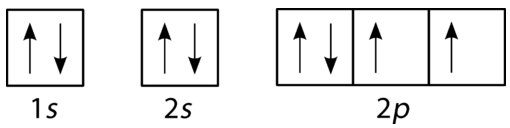
This orbital diagram represents:
Carbon
Boron
Nitrogen
Oxygen

This orbital diagram represents
Nitrogen
Oxygen
Carbon
Neon

What is incorrect about this orbital diagram?
Both arrows in the 2p box should be pointing up
There are too many electrons in the 1s orbital
In the 2p boxes, there should only be 1 electron in the first 2p box and one in the 2nd 2p box
All the arrows should be pointing up

This orbital diagram represents
Sodium
Magnesium
Aluminum
Iron
1s22s22p63s23p64s23d10
1s22s22p63s2
Which electron configuration belongs to a Chloride (Cl-) ion?
1s2 2s2 2p6 3s2 3p5
1s2 2s2 2p6 3s2 3p6
1s2 2s2 2p6 3s2 3p7
1s2 2s2 2p6 3p7
Which electron configuration belongs to a Calcium (Ca2+) ion?
1s2 2s2 2p6 3s2 3p64s23d2
1s2 2s2 2p6 3s2 3p6
1s2 2s2 2p6 3s2 3p7
1s2 2s2 2p6 3s2 3p64s2
Which electron configuration belongs to an Iron (Fe2+) ion?
1s2 2s2 2p6 3s2 3p64s23d6
1s2 2s2 2p6 3s2 3p64s23d8
1s2 2s2 2p6 3s2 3p63d6
1s2 2s2 2p6 3s2 3p64s23d4

The PES spectrum below is for the element _______________.
O
Ne
N
F

Examine the spectrum below. Where would you expect the 2p peak for F be if it were on the same spectrum?
To the left of the peak at 3.04
To the right of the peak at 3.04
To the left of the peak at 1.31
To the right of the peak at 1.31

What does the 4th peak from the left represent?
The 2s electrons
The 3d electrons
The 2p electrons
The 3s electrons

Which peak (or peaks) correspond to the valence electrons?
The peak at 1
The peaks at 1 and 2.05
The peak at 239
The peaks at 239 and 22.7

Where would you expect the 2s peak for Sodium to fall relative to the presented spectrum of a different element below?
Just to the left of the peak at 126
Just to the right of the peak at 126
Just to the left of the peak at 9.07
Just to the right of the peak at 9.07

