wayground logo

Free Printable Worksheets

Font size

S
M
L
XL
Worksheets

Unit 3 Mixed Review

Total questions: 116

Worksheet time: 4hrs 41mins

Name
Class
Date
1.
Does this mapping diagram represent a function?
a)
No, because an input value goes to multiple output values
b)
Yes, because each input goes to one and only one output
2.
a)
Function
b)
Not a Function
3.

What is the definition of a function?

a)

Has inputs and outputs

b)

Inputs have different outputs every time

c)

x-values and

y-values

d)

Every input has only one output

4.
a)
Yes
b)
No
5.
a)
Yes
b)
No
6.
Is this is a function or not a function?
a)
Function
b)
Not a Function
7.
Is this a function or not a function?
a)
Function
b)
Not a Function
8.
a)
Yes
b)
No
9.

Which set of ordered pairs is a function?

a)

{(9,5), (10,5), (9,-5), (10,-5)}

b)

{(3,4), (4,-3), (7,4), (3, 8)}

c)

{(6,-5), (7, -3), (8, -1), (9, 1)}

d)

{(2, -2), (5, 9), (5, -7), (1, 4)}

10.
Is this graph a function or not a function? 
a)
Function
b)
Not a Function
11.
Is the relation a function? Why.
a)
Yes, because the x-value 11 has two y-values pair with it.
b)
Yes, because each x-value has only one y-value paired with it.
c)
No, because the x-value 11 has two y-values pair with it.
d)
No, because each x-value has only one y-value paired with it.
12.
Is this relation a function?
a)
Yes
b)
No
13.
a)
Function
b)
Not a Function
14.

How do you use the vertical line test?

a)

Draw vertical lines through your graph. If any of the vertical lines you draw intersects the graph more than once then the graph is not the graph of a function.

b)

Draw vertical lines through your graph. If any of the vertical lines you draw intersects the graph more than once, then it is a function.

15.

Is this mapping a function or not a function?

a)

Function; the x's don't repeat

b)

Not a Function; the x's repeat

16.
Is this graph a function or not a function? 
a)
Function
b)
Not a Function
17.

Which of the following is NOT a function?

a)
b)
c)
d)
18.
Which graph is a function?
a)
Graph 1
b)
Graph 2
c)
Graph 3
d)
Graph 4
19.
Which graph is NOT a function?
a)
Graph 1
b)
Graph 2
c)
Graph 3
d)
Graph 4
20.

Which of these sets is not a function?

a)

{ (2,3) , (3,5) , (4,9) }

b)

{ (2,3) , (2,5) , (4, 9) }

c)

{ (2,3) , (3,3) , (4,9) }

21.
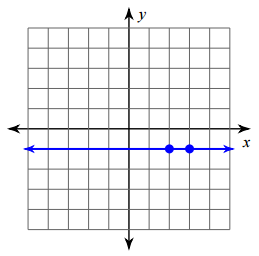
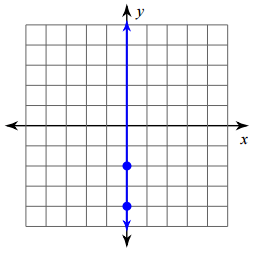
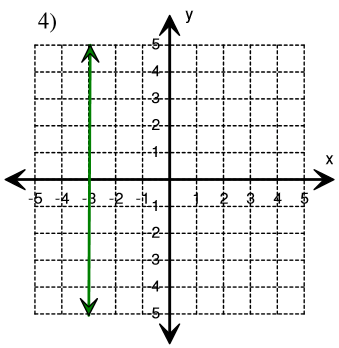
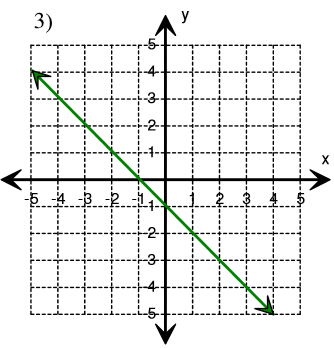
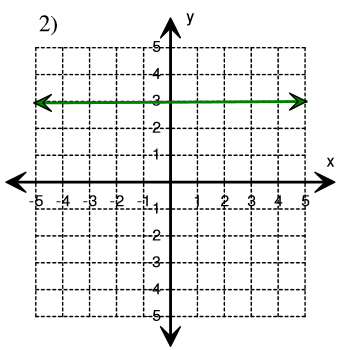
What is the slope?
a)
Positive
b)
Negative
c)
Zero
d)
Undefined
22.
What is the slope?
a)
Positive
b)
Negative
c)
Zero
d)
No Slope
23.
What is the Slope?
a)
Positive
b)
Negative
c)
Zero
d)
No Slope
24.
What is the Slope?
a)
Positive
b)
Negative
c)
Zero
d)
Undefined
25.
Find the slope
a)
-2/3
b)
3/2
c)
-3/2
d)
2/3
26.
Find the slope
a)
4/5
b)
5/4
c)
-5/4
d)
-4/5
27.
Find the slope of:
(1,8) and (3,12)
a)
2
b)
1/2
c)
9/7
d)
-2
28.
Find the slope of:
(-4,5) and (-4, 2)
a)
0
b)
6
c)
undefined
d)
-3/8
29.
Find the slope of:
(12,-2) and (4, -6)
a)
-1/2
b)
5/7
c)
-2
d)
1/2
30.
Find the slope of:
(7,1) and (-2,1)
a)
0
b)
-1/2
c)
undefined
d)
-8
31.
Which of the following are ways to find the rate of change?
a)
change in y over change in x
b)
rise over run
c)
subtract y coordinates over subtract x coordinates
d)
all of the above
32.
What is the slope in the equation y=2x + 3?
a)
2
b)
3
c)
5
d)
Cannot be Determined 
33.
Find the slope of the line.
a)
Undefined
b)
0
c)
1
d)
-1
34.
Find the slope of the line.
a)
Undefined
b)
0
c)
1
d)
-1
35.

What type of slope is shown?

a)

positive

b)

negative

c)

zero

d)

undefined

36.

What type of slope is shown?

a)

positive

b)

negative

c)

zero

d)

undefined

37.

What type of slope is shown?

a)

positive

b)

negative

c)

zero

d)

undefined

38.

What type of slope is shown?

a)

positive

b)

negative

c)

zero

d)

undefined

39.
a)
Positive
b)
Negative
c)
Zero
d)
Undefined
40.
Flag pole
a)
Positive
b)
Negative
c)
Zero
d)
Undefined
41.
The stripes!
a)
Positive
b)
Negative
c)
Zero
d)
Undefined
42.
a)
Positive
b)
Negative
c)
Zero
d)
Undefined
43.
What is the Slope?
a)
Positive
b)
Negative
c)
Zero
d)
Undefined
44.
What is the slope?
a)
Positive
b)
Negative
c)
Zero
d)
No Slope
45.
What is the slope?
a)
Positive
b)
Negative
c)
Zero
d)
Undefined
46.
What is the slope?
a)
Positive
b)
Negative
c)
Zero
d)
No Slope
47.
What is the slope?
a)
Positive
b)
Negative
Negative
c)
Zero
d)
Undefined
48.
What is the slope?
a)
Positive
b)
Negative
c)
Zero
d)
Undefined
49.

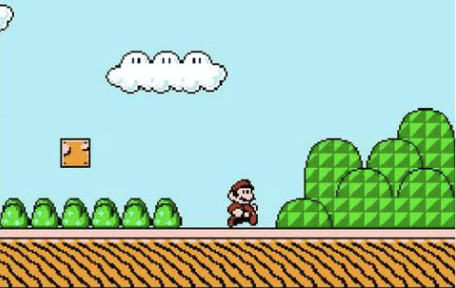
What type of slope is shown in the image?

a)

Positive

b)

Negative

c)

Undefined

d)

Zero

50.

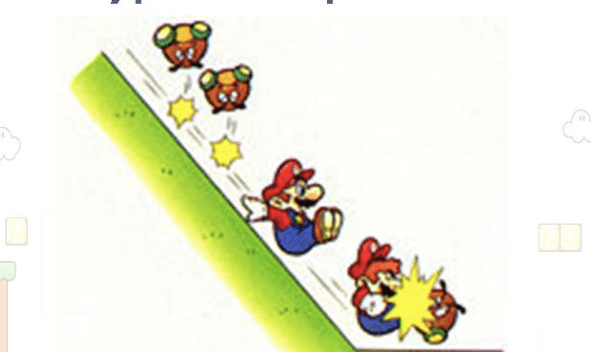
What type of slope is Mario running in the picture?

a)

Positive

b)

Negative

c)

Undefined

d)

Zero

51.

What type of slope is shown by the stairs in the image?

a)

positive

b)

negative

c)

undefined

d)

zero

52.

Which of the following is a function?

a)
b)
c)
d)
53.

Is the following a function?

a)

Yes, this is a function.

b)

No, it's not a function.

c)

Can't be determined with this information.

54.

Which of the following is a function?

a)

A

b)

B

c)

C

d)

D

55.

Is the following graph a function?

a)

Yes, because the x never repeats.

b)

Yes, because they are individual dots.

c)

No, because the x repeats.

d)

No, because it is not a line.

56.

Which is a function?

a)

W

b)

X

c)

Y

d)

Z

57.

Which of the following is NOT a function?

a)
b)
c)
d)
58.

Which is a function?

a)

A

b)

B

c)

C

d)

D

59.

The following is not a function because...

a)

There are two values that equal 2.

b)

x = 10 and x = 40 has two values each.

c)

In the f(x) column, the 5 repeats.

d)

This table is actually a function.

60.

Which of the following is a function?

a)
b)
c)
d)
61.

Is the following graph a function?

a)

Yes it is a function.

b)

No, it is not a function.

c)

There is not enough information to answer this question.

62.
What is the slope?
a)
Positive
b)
Negative
c)
Zero
d)
Undefined
63.
What is the slope?
a)
Positive
b)
Negative
c)
Zero
d)
No Slope
64.
What is the Slope?
a)
Positive
b)
Negative
c)
Zero
d)
No Slope
65.
What is the Slope?
a)
Positive
b)
Negative
c)
Zero
d)
Undefined
66.
Find the slope
a)
-2/3
b)
3/2
c)
-3/2
d)
2/3
67.
Find the slope
a)
4/5
b)
5/4
c)
-5/4
d)
-4/5
68.
Find the slope of:
(1,8) and (3,12)
a)
2
b)
1/2
c)
9/7
d)
-2
69.
Find the slope of:
(-4,5) and (-4, 2)
a)
0
b)
6
c)
undefined
d)
-3/8
70.
Find the slope of:
(12,-2) and (4, -6)
a)
-1/2
b)
5/7
c)
-2
d)
1/2
71.
Find the slope of:
(7,1) and (-2,1)
a)
0
b)
-1/2
c)
undefined
d)
-8
72.
Which of the following are ways to find the rate of change?
a)
change in y over change in x
b)
rise over run
c)
subtract y coordinates over subtract x coordinates
d)
all of the above
73.
What is the slope in the equation y=2x + 3?
a)
2
b)
3
c)
5
d)
Cannot be Determined 
74.
Find the slope of the line.
a)
Undefined
b)
0
c)
1
d)
-1
75.
Find the slope of the line.
a)
Undefined
b)
0
c)
1
d)
-1
76.

Find the slope of the line that goes through the points

(−11,−5) and (1,−12)

a)

58-\frac{5}{8}  

b)

1611\frac{16}{11}  

c)

16\frac{1}{6}  

d)

712-\frac{7}{12}  

77.

Find the slope of the line that goes through the points

(−11,−5) and (1,−12)

a)

58-\frac{5}{8}  

b)

1611\frac{16}{11}  

c)

16\frac{1}{6}  

d)

712-\frac{7}{12}  

78.

Find the slope of the line that goes through the points

(−1,−2) and (−3,−4).

a)

1

b)

2

c)

3

d)

4

79.
a)

1/6

b)

1

c)

-1/6

d)

-1

80.
a)

1/-2

b)

5/14

c)

1/2

d)

-1/2

81.

Find the slope of the line that goes through the points


(−11,−5) and (1,−12)

a)

58-\frac{5}{8}

b)

1611\frac{16}{11}

c)

16\frac{1}{6}

d)

712-\frac{7}{12}

82.

What does "m" stand for in the slope formula?

a)

y axis

b)

slope

c)

y coordinate

d)

x coordinate

83.
Find the slope given the points (3,18) and (0,18). 
a)
undefined
b)
0
c)
22
d)
6
84.
Find the slope given the points (1,4) and (5,9). 
a)
5/4
b)
4/5
c)
-5/4
d)
2/3
85.
Find the slope given the points (2, −7) and (−1, 6). 
a)
-13/3
b)
13/3
c)
0
d)
2/3
86.

Find the slope given the points (3,2) and (4,7).

a)

4

b)

5

c)

-5

d)

1/5

87.
Find the slope given the points (-5,-3) and (2,4). 
a)
5/4
b)
1/7
c)
-1
d)
1
88.

What is the slope of the line that passes through the points (4, 9) and (1, 6)?

a)

1

b)

-3

c)

3

d)

-1

89.

What is the slope of the line that passes through the points (4, 9) and (1, 6)?

a)

1

b)

-3

c)

3

d)

-1

90.

What is the slope of the line that passes through the points (-4, -1) and (-2, -5)?

a)

1/2

b)

-1/2

c)

2

d)

-2

91.
Find the slope given the points (2, −7) and (−1, 6). 
a)
-13/3
b)
13/3
c)
0
d)
2/3
92.
Find the slope of the line that passes through
(10, 1) and (5, 2)
a)
1/5
b)
-1/5
c)
5
d)
-5
93.

A line passes through the ordered pairs (0, 1) and (2, 6). What is its slope?

a)

m = -2/5

b)

m = 2/5

c)

m = 5/2

d)

m = -5/2

94.

A line passes through the ordered pairs (4, 1) and (2, 8). What is its slope?

a)

m = -2/7

b)

m = 2/7

c)

m = 7/2

d)

m = -7/2

95.
a)

Both set it up correctly.

b)

Only Bert set it up correctly.

c)

Only Ernie set it up correctly.

d)

Neither of them set it up correctly.

96.

What did Ernie do wrong?

a)

He put x's on top and y's on bottom (he did run over rise)

b)

He changed the order of the points.

c)

He added instead of subtracting.

d)

He put one point in the numerator and one point in the denominator.

97.

a)

Both set it up correctly.

b)

Only Bert set it up correctly.

c)

Only Ernie set it up correctly.

d)

Neither of them set it up correctly.

98.

a)

Both set it up correctly.

b)

Only Bert set it up correctly.

c)

Only Ernie set it up correctly.

d)

Neither of them set it up correctly.

99.

What did they do wrong?

a)

They added but they should have subtracted

b)

They changed the order of the points

c)

They did run over rise (x's on top, y's on bottom)

d)

They put one coordinate in numerator and one in denominator

100.

a)

Both set it up correctly.

b)

Only Bert set it up correctly.

c)

Only Ernie set it up correctly.

d)

Neither of them set it up correctly.

101.

a)

Both set it up correctly.

b)

Only Bert set it up correctly.

c)

Only Ernie set it up correctly.

d)

Neither of them set it up correctly.

102.

a)

Both set it up correctly.

b)

Only Bert set it up correctly.

c)

Only Ernie set it up correctly.

d)

Neither of them set it up correctly.

103.
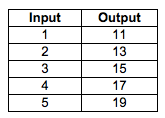
What is the rate of change in the table?
a)
3
b)
2
c)
2/3
d)
3/2
104.
Is the table linear or non-linear?
a)
Linear
b)
Non-Linear
105.
Is the table linear or non-linear?
a)
Linear
b)
Non-Linear
106.
Is the table linear or non-linear?
a)
Linear
b)
Non-Linear
107.
The table below is proportional.  
   x   2      5       9     13
   y   1     2.5   4.5    6.5
 
 The constant of proportionality is ______. The equation is ___ = ____ ____
a)
1/2; y = 1/2x
b)
2; y = 2x
c)
1; y = 1x
d)
3; y = 3x
108.
Find the slope
a)
3
b)
-3
c)
20
d)
Not a constant slope/Non-Linear
109.
Find the rate of change
a)
1
b)
2
c)
11
d)
Not a constant slope/Non-Linear
110.
Find the slope from the table.
a)
1/4
b)
-1/4
c)
-4/1
d)
4/1
111.
What is the y-intercept
a)
12
b)
4
c)
-3
d)
-2
112.
What is the y-intercept?
a)
7
b)
0
c)
1
d)
2
113.
 In order to join an online learning community, there is a $20 startup fee and a $5 monthly fee. Write an equation in slope-intercept form that models this situation.
a)
y = 20x + 5
b)
y = 5x +20
114.
Suppose that a bike rents for $4 plus $1.50 per hour. Write an equation in slope-intercept form that models this situation.
a)
y = 4x + 1.50
b)
y = 1.50x + 4
115.
In order to join a yoga club there is a $100 annual fee and a $5 fee for each class you attend. Write an equation in slope-intercept form that models this situation.  After how many classes will the total cost be $200?
a)
20 classes
b)
15 classes
c)
10 classes
d)
200 classes
116.
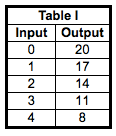
What is the rate of change in the table?
a)
3/2
b)
2/3
c)
-3/2
d)
-2/3