wayground logo

Free Printable Worksheets

Font size

S
M
L
XL
Worksheets

Unit 2 Test: The AOC and the Constitution

Total questions: 61

Worksheet time: 3hrs 36mins

Name
Class
Date
1.

Government with definite restrictions to its power

a)

Consent of the Governed

b)

Rule of Law

c)

Representative Government

d)

Limited Government

2.

Government's powers are divided into three branches

a)

Federalism

b)

Separation of Powers

c)

Checks and Balances

d)

Rule of Law

3.

This principle states that government officials must follow the law

a)

Consent of the Governed

b)

Democracy

c)

Rule of Law

d)

Limited Government

4.

A written change to the Constitution

a)

Preamble

b)

Article

c)

Amendment

d)

Confederation

5.

This system prevents any branch of government from becoming too powerful

a)

Checks and Balances

b)

Democracy

c)

Federalism

d)

Consent of the Governed

6.

Divides the powers of the Constitution between the federal government and the state governments

a)

Separation of Powers

b)

Federalism

c)

Checks and Balances

d)

Limited Government

7.

_____________________________ is where all political power resides with the people of the United States.

a)

Popular Sovereignty

b)

Limited Government

c)

Judicial Review

d)

Federalism

8.

What are the first 10 amendments to the Constitution called?

a)

Petition of Rights

b)

Bill of Rights

c)

Contract of Rights

d)

Law of Rights

9.

This house of Congress has 100 members and includes only 2 from each state

a)

House of Representatives

b)

Senate

c)

President

d)

Supreme Court

10.
This house of Congress has 435 members with the number of members based on each state's population
a)
House of Representatives
b)
Senate
c)
President
d)
Supreme Court
11.

How is the number of members in the House of Representatives determined?

a)

Equality

b)

How big the state is

c)

The state's population

d)

The President picks

12.
Which principle split the power of the government into three branches?
a)
Self-government
b)
Republicanism
c)
Separation of Powers
d)
Limited government
13.
Why was the Bill of Rights included in the Constitution?
a)
To protect the idea of federalism.
b)
To make sure that the three branches of government would work properly.
c)
To provide additional guarantees for individual rights. 
14.
Popular sovereignty, a principle set forth in the Constitution, means that--
a)
People elect their political representatives.
b)
people are the source of the government's power. 
c)
power is divided between national and state government. 
15.
The fact that states can make their own laws is an example of which constitutional principle?
a)
separation of power
b)
federalism
16.
When the Congress disagrees with a law President Obama is trying to pass,  they can veto the law. This action is an example of...
a)
limited government
b)
checks and balances
17.
Which proves we have a limited government?
a)
The Constitution defines the limits of those in power. 
b)
The people are in charge. 
c)
There is a bill of rights. 
d)
The people vote for their leaders. 
18.
Which document was the original stepping stone toward limited government in England, and eventually the rest of Europe?
a)
Declaration of Independence
b)
Magna Carta
c)
English Bill of Rights
d)
U.S. Constitution
19.

Life, Liberty and Property or the Pursuit of Happiness

a)

anarchy

b)

divine rights of kings

c)

natural rights

d)

absolute monarchy

20.

Enlightenment thinker who believed in natural rights (Life, liberty, property):

a)

Montesquieu

b)

Voltaire

c)

Hobbes

d)

Locke

21.

who believe the role of government is to protect natural rights?

a)

John Locke

b)

Thomas Hobbes

c)

Voltaire

d)

Montesquieu

22.

John Locke believed that if a government was not protecting the NATURAL RIGHTS of its citizens then the citizens should:

a)

replace the government

b)

pray

c)

run for office

d)

work harder

23.

The idea that people give up some of their power to the government in exchange for the protection of the laws that government provides.

a)

Social Contract Theory

b)

Divine Right

c)

Constitutional Monarchy

d)

Natural Rights

24.
Which document was based on the Enlightenment ideals and established the separation of the colonies from Britain?
a)
English Bill of Rights
b)
US Constitution
c)
Declaration of Independence
d)
Declaration of the Rights of Man
25.

Thomas Jefferson used John Locke's natural rights in which famous U.S. document?

a)

U.S. constitution

b)

Declaration of independence

c)

English Bill of Rights

d)

Magna Carta

26.

Why did Parliament create the Stamp Act?

a)

The British government wanted the colonists to pay for the costs of the French and Indian War

b)

The British Parliament wanted to build new cities and thought the colonists would like to help pay.

c)

The British Parliament was mad at the colonists for drinking too much tea.

27.
Which phrase became popular after passage of the Stamp Act?
a)
“The rights of Englishmen”
b)
“Give me liberty or give me death”
c)
“Life, liberty, and the pursuit of happiness”
d)
“No taxation without representation“
28.
The _____________ Acts were passed to punish the colonists for the Boston Tea Party protest.
a)
Terrible
b)
Intolerable
c)
Hateful
29.
Article VI establishes the supremacy of the ____________ government over the _______________ Government.
a)
Confederation, Constitutional
b)
State, Federal
c)
Federal, State
d)
American, British
30.
An agreement made at the Constitutional Convention stating that enslaved persons would be counted as three-fifths of a person when determining a state’s population for representation in the House of Representatives 
a)
Two-halves Compromise
b)
Three-fourths Compromise
c)
Two-fifths Compromise
d)
Three-fifths Compromise
31.

The plan of government adopted at the Constitutional Convention established a bicameral (two-house) Congress. In the House of Representatives, representation from each state is based on state population. In the Senate, each state is represented by two senators.

a)

Virginia Plan

b)

Great Addition

c)

Great Compromise

d)

Slave Trade Compromise

32.
The purpose for meeting at the Constitutional Convention was to 
a)
discuss a Bill of Rights
b)
write a new constitution 
c)
revise the Articles of Confederation
d)
elect a president
33.
The Anti-Federalists wanted a Bill of Rights because they 
a)
need to guarantee state rights
b)
wanted  to delay ratification of the U.S. Constitution
c)
distrusted the central government to recognize individual liberties
d)
wanted to persuade Federalists to keep the Articles of Confederation
34.

Who is considered the Father of the Constitution?

a)

James Madison

b)

George Washington

c)

Pocahontas

d)

Thomas Jefferson

35.

Which plan thought all states should have equal say in the government, no matter their size?

a)

Virginia Plan

b)

Florida Plan

c)

New Jersey Plan

d)

George Washington

36.

Which of these was the greatest challenge for the delegates at the Constitutional Convention?

a)

How to respond to the interests of foreign countries.

b)

How to address the concerns of farmers and ranchers.

c)

How to balance the interests of large and small states.

d)

How to get agreement between the Eastern and Western states

37.

This plan called for a Bicameral Legislature based on population, Strong Executive, Strong Legislature, and a weak Judiciary. Supported by "Big States".

a)

Virginia Plan

b)

New Jersey Plan

c)

Connecticut Plan

d)

Great Compromise

38.

"Small State" proposal for the new constitution, calling for a single seat (equal representation) in a unicameral Congress.

a)

Virginia Plan

b)

South Carolina Plan

c)

Constitution

d)

New Jersey Plan

39.

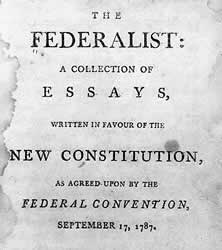
The "Federalist Papers" were written to:

a)

Explain and convince the people into supporting the new U.S Constitution.

b)

spark a new revolution among the American people against their government.

c)

oppose a strong centralized government.

d)

create a new monarchy.

40.
What Constitutional Principle says "We the People"?
a)
Popular Sovereignty
b)
Judicial Review
c)
Limited Government
d)
Separation of Powers
41.
What is federalism?
a)
The people vote for their leaders who then represent them. 
b)
The people have individual rights. 
c)
There are three branches of government. 
d)
The state and national government share power. 
42.
Ability of each branch to oversee the activities of other branches-
a)
Federalism
b)
Separation of powers
c)
Jurisdiction
d)
Checks and balances
43.

Who were the Founders?

a)

People looking for meaning.

b)

Women seeking equal rights.

c)

The people who were important in the establishment of the United States

d)

Civil Rights workers.

44.

What is a constitution?

a)

a group of ideas.

b)

A written set of rules and laws that tells how a government is organized and run. Every country has one.

c)

Only certain countries have one.

d)

a state of nature.

45.

What is a constitutional government?

a)

A government in which there are LIMITS on the powers of the government. Not every country is a constitutional government.

b)

Every country is a constitutional government

c)

A dictatorship.

d)

A set of ideas.

46.
Which branch of government existed when the Articles of Confederation was created?
a)
Legislative (congress)
b)
Judicial (Supreme court)
c)
Executive (President)
d)
Legislative, Executive, and Judicial
47.
Under the Articles of Confederation, which government had the MOST power?
a)
Legislative branch
b)
the president
c)
the state governments
d)
national government
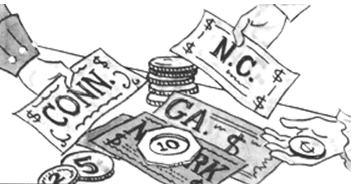
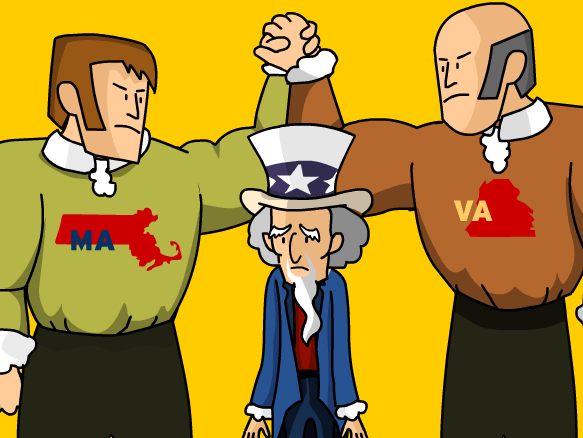
48.
Which of the following weaknesses  in the Articles of Confederation does  this picture represent?
a)
no common currency (money)
b)
no executive branch
c)
no power to tax
d)
one vote for each state
49.
Under the Articles of Confederation, how many votes did each state get?
a)
Zero
b)
One
c)
Two 
d)
Three
50.
Which of the following is an example of a weakness in the Articles of Confederation?
a)
Congress couldn't collect taxes
b)
Weak national government
c)
Provided no common currency/money for all 13 states
d)
All of the  above
51.

Why was this first U.S. government so weak?

a)

King George III was still in charge of USA

b)

Americans were afraid to give their new government too much power

c)

The American army did not win their independence from Great Britain and King George III

d)

Americans feared a national government that had too much power and a return to tyranny

52.
What is the name of the first written plan of government for the newly independent U.S.A.?
a)
Constitution
b)
Treaty of Paris
c)
Declaration of Independence
d)
Articles of Confederation
53.
Because of the Articles  of  Confederarion the government could NOT regulate(control) ______ among the states.
a)
food quality
b)
laws
c)
travel
d)
commerce (trade)
54.
What is one reason Americans wanted to change the Articles of Confederation?
a)
They opposed the Land Ordinance of 1785.
b)
They didn't want the government to have only 1 branch. 
c)
National government was weak, state government had too much power, states were not working together, and there was no leader.
d)
State government was weak and unsuccessful.
55.
One weakness of the Articles of the Confederation was ____________. 
a)
The ability of Congress to tax.
b)
The inability of Congress to tax.
c)
The ability of Congress to declare war.
d)
The ability of Congress to create courts.
56.
Daniel Shays' rebellion showed that:
a)
the government under the Articles of Confederation could not keep control of its citizens
b)
the government should be able to defend our citizens from Great Britain again
c)
the government needs to protect the citizens from Native American attacks
57.
Shay's Rebellion started as a protest against
a)
unfair taxes and farmer debt
b)
the death penalty
c)
no judicial system
d)
debtors' prisons
58.

Which state was included in the Northwest Ordinance?

a)

Mississppi

b)

Virginia

c)

Ohio

d)

Florida

59.

What did the Northwest Ordinance say about slavery?

a)

Slavery was outlawed

b)

Slavery was never mentioned

c)

Only white males could own slaves

d)

Slaves were guaranteed the right to vote

60.

Under what governing document was the Northwest Ordinance created?

a)

The Declaration of Independence

b)

The Articles of Confederation

c)

The Ohio State Constitution

d)

The United States Constitution

61.

What was the purpose of the Northwest Ordinance?

a)

to control Indians in the Northwest Territory

b)

to set a path to statehood and establish rights for settlers

c)

to convince more colonists to fight for independence

d)

to give states a process for collecting taxes