
 Worksheets
Light and Eye STUDY GUIDE
Total questions: 48
Worksheet time: 12hrs 0mins
How / Why does light change direction?
Light bends in a curved path when its frequency is changed
light changes direction when it is absorbed
light changes direction when it speeds up or slows down through different mediums
light changes direction when its wavelength is changed
the light that is absorbed by an object will ____
pass through the object without changing
be reflected at the same angle
change direction until it leaves the object
raise the temperature of the object
Which of the following will create a diffuse reflection?
a rough surface
a smooth, curved surface that bends in
a smooth, curved surface that bends out
a smooth, flat surface
An object that separates white light into the colors of the rainbow is called a:
mirror
normal
prism
lens
Light will travel fastest through:
Empty Space
A Gas
A Liquid
A Solid

This image shows
A concave lens
A convex lens
A concave mirror
A convex mirror
Which of the following determines the color of an object?
incidence of refraction of the material
the wavelength of reflected light
the wavelength of absorbed light
speed of light in the medium
A material that does not allow light to pass through it is known as:
transparent
refractive
translucent
opaque
A material that allows some light to pass through it is known as:
Transparent
Reflective
Translucent
Opaque

What does this object do to light?
Absorb
Reflect
Transmit
None of the Above
An example of a natural light source is
the moon
a candle
the sun
a torch
When an object blocks light, you get
an eclipse
a surprise
a shadow
darkness
The moon _________ the sun's light.
reflects
absorbs
turns on
dims

The angle of incidence is equal to the angle of reflection
Law of Reflection
Law of Light
Incidence Ray
The Normal
what is a wave?
A disturbance that transfers energy from one place to another
A disturbance that transfers matter from one place to another
energy that makes particles move
any type of matter that vibrates back and forth
What part of the electromagnetic spectrum can we see?
Infrared Rays and ultraviolet rays
Visible Light
x rays
gamma rays
Electromagnetic waves are arranged on the electromagnetic spectrum by wavelength.
true
false
What is the shortest wavelength of the Electromagnetic Spectrum?
x-rays
gamma rays
uv light
infrared light
What is the most dangerous type of waves of the spectrum?
radio
ultra violet
gamma ray
visible light
Which part of the EM Spectrum has high enough energy to cause damage to eyes and skin, an even cancer.
visible light
ultra violet
radio
infrared
What color is an object that absorbs all the colors in the light spectrum?
rainbow
white
black
not visible

The brain helps your eyes by:
Flipping an image
Combining an image
Making an image clearer
All of the choices
Longest Wavelengths and Lowest Frequencies?
Visible Light
Microwaves
X-Rays
Radio Waves
Which color has the longest wavelength?
Red
Orange
Yellow
Blue
Which color has the shortest wavelength?
Red
Orange
Yellow
Blue
The hole in the iris gets bigger and smaller because
the iris is a muscle that moves to make the pupil larger/smaller
the pupil can adjust itself to the amount of light coming in
the pupil is a muscle that controls the size of the iris

Number 6 in the diagram is the ______________ and number 7 in the diagram is the _______________
Optic nerve, retina
Optic nerve, blind spot
Blind spot, retina
Blind spot, optic nerve

What path of light allows us to see the vehicle in the reflection?
The sun reflects off of the vehicle, then reflects off of the glass into our eyes.
The sun reflects off of the vehicle into our eyes.
The sun shines into our eyes.
The sun reflects off of the vehicle, then reflects off of the person into car window.
gel substance that gives the eye shape
optic nerve
iris
vitreous humor
retina


In the diagram, which letter represents the angle of incidence?
A
B
C
D

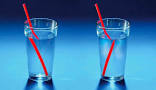
A student placed a pencil in a cup of water. The pencil appears broken because light
always travels in a straight line.
bends when it passes through water.
makes the water in the glass evaporate.
reflects the pencil on the water's surface.

Light refracts when:
It changes speed
It changes from a particle to a wave
Its density changes
It encounters a solid object
The student looks out the window and clearly sees other students outside. What is happening to MOST of the light that hits the window from the outside?
The light is being absorbed.
The light is being reflected.
The light is being transmitted.
The light is being scattered.

