wayground logo

Free Printable Worksheets

NEW

Font size

S
M
L
XL
Worksheets

Review

Total questions: 66

Worksheet time: 2hrs 50mins

Name
Class
Date
1.
The part of the earth that includes the crust and the upper mantle and is split into tectonic plates is the
a)
lithosphere
b)
 crust
c)
asthenosphere
d)
mantle
2.
The least dense layer
a)
Crust
b)
Mantle
c)
Outer Core
d)
Inner Core
3.
Earth's core is believed to be made of
a)
iron & nickel
b)
just nickel
c)
just iron
d)
iron & oxygen
4.
Scientists think that convection currents that move the plates flow in Earth's
a)
Continental crust
b)
Oceanic crust
c)
Asthenosphere
d)
Lithosphere
5.
Which of the following statements describes how convection currents work in the mantle?
a)
Magma is heated by the crust and sinks. It then rises back up when it cools off.
b)
Magma is heated near the core and rises. It then cools off and sinks.
c)
Magma is heated by the mantle and rises. It never sinks back down.
d)
Magma is heated by the mantle and rises. It cools off and sinks back down.
6.
Which layer of Earth is LIQUID?
a)
upper mantle
b)
lower mantle
c)
outer core
d)
inner core
7.
the theory that explains how large pieces of the lithosphere, called plates, move and change shape
a)
Plate Tectonics
b)
Continental Drift
c)
Seafloor Spreading
d)
Rifting
8.
Oceanic Crust is ________ dense than Continental crust
a)
More 
b)
Less
c)
Equal
9.
Which of the following statements describes how convection currents work in the mantle?
a)
Magma is heated by the crust and sinks. It then rises back up when it cools off.
b)
Magma is heated near the core and rises. It then cools off and sinks.
c)
Magma is heated by the mantle and rises. It never sinks back down.
d)
Magma is heated by the mantle and rises. It cools off and sinks back down.
10.
What is the process during which water cools and turns from a gas to a liquid?
a)
Codensation
b)
Runoff
c)
Precipitation
d)
Evaporation
11.
When water _________, dew forms.
a)
Melts
b)
Evaporates
c)
Condenses
d)
Precipitates
12.
Heat is the _______ of energy.
a)
Transfer
b)
Measure
13.
Temperature is the ________ of energy.
a)
Transfer
b)
Measure
14.
Which choice below deals with how fast the particles of an object move?
a)
Heat
b)
Temperature
15.
If you put a burger on the grill...
a)
It's particles will speed up.
b)
It's particles will slow down.
16.
Adding energy to a solid will eventually make a _______.
a)
Liquid
b)
Gas
17.
Removing energy from a liquid will eventually make a _______.
a)
Solid
b)
Gas
18.
The main job of a refrigerator is to....
a)
remove energy.
b)
add energy.
19.
What process brings the deep cold ocean currents up to the surface?
a)
Conduction
b)
Global Wind Patterns
c)
Convection Currents
d)
Temperature and salinity
20.
Why are surface currents at the surface of the ocean?
a)
colder temperature
b)
colder temperature & more salinty
c)
warmer temperature & less salinty
d)
less salinty
21.

Liquid to Gas

a)

melting

b)

vaporization

c)

condensation

d)

sublimation

22.

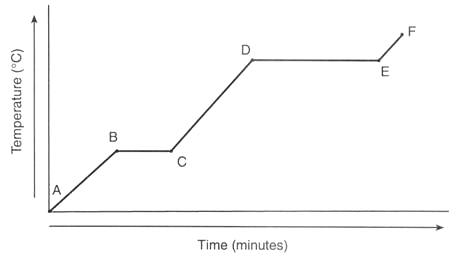
Freezing

a)

F

b)

C

c)

A

d)

D

23.

Sublimation

a)

A

b)

B

c)

C

d)

F

24.
At higher temperatures
a)
particles in an object have less energy
b)
particles in an object move faster
c)
a gas contracts
25.

The slower the particles in a substance move,

a)

the colder it is.

b)

the warmer it is.

c)

the more energy it has.

26.

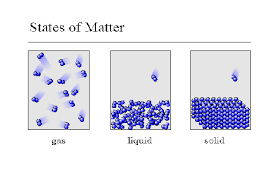
What is the phase change of a solid to a liquid?

a)

freezing

b)

melting

c)

boiling

d)

condensation

27.

Change from liquid to gas is called....

a)

expansion

b)

evaporation

c)

condensation

d)

sublimation

28.

What state/phase is the object likely from points A to B?

a)

Solid

b)

Liquid

c)

Gas

d)

Plasma

29.
How is a gas defined?
a)
Indefinite shape, indefinite volume
b)
Definite shape, definite volume
c)
Found in stars
d)
Definite volume, indefinite shape
30.

TRUE or FALSE: Liquids have a fixed volume but not a fixed shape.

a)

TRUE

b)

FALSE

31.

TRUE or FALSE: The particles in solids move around a lot and spread out.

a)

TRUE

b)

FALSE

32.

Phase change from gas to liquid is called:

a)

Melting

b)

Freezing

c)

Deposition

d)

Condensation

33.

When changing a substance from liquid to solid, the energy has to...

a)

INCREASE

b)

DECREASE

34.

When changing a substance from gas to liquid, the energy has to...

a)

INCREASE

b)

DECREASE

35.

Which of the following statements is NOT true about gases?

a)

Gases do not have fixed shape or volume

b)

Gas particles do not move much, but vibrate

c)

Gas particles have a lot of free space

d)

Unlike solids, gases can be compressed

36.

Which of the following statements is true about liquids?

a)

Particles do not move around much, but vibrate

b)

Particles have a lot of free space and spread out

c)

Liquids have fixed shape & volume

d)

Particles are less closely packed than solids

37.

Which of the following statements is true about solids?

a)

Particles do not move around much, but vibrate

b)

Particles have a lot of free space and spread out

c)

Solids have fixed shape but not volume.

d)

Particles are less closely packed than gas.

38.

Which of the following statements is true about phase changes?

a)

Solid turning into liquid is called freezing

b)

When ice melts, the kinetic energy is decreased

c)

Liquid turning into gas is called condensing

d)

When water boils, the kinetic energy is increased

39.

What is sublimation? (Definition)

a)

When liquid turns in solid.

b)

When solid turns into gas.

c)

When gas turns into solid.

d)

When solid turns into liquid.

40.

To condense a gas to a liquid, energy must be

a)

added

b)

removed

41.

If you are holding a hot cup of tea, where will the heat go?

a)

into the cup of tea

b)

into your hand

42.

To evaporate a liquid, energy must be...

a)

added

b)

removed

43.
____________ occurs when an energy source transfers heat directly to another object through space; an example would be an object becoming warm by sitting in the sunshine.
a)
conduction
b)
convection
c)
radiation
d)
heat
44.
____________ occurs when heat is transferred to an object through direct contact with particles; an example would be the heat from a stove transferring to your hand through the handle on a pot or pan.
a)
conduction
b)
convection
c)
radiation
d)
heat
45.
The transfer of heat by the movement of heated fluid is called conduction.
a)
True
b)
False
46.
Mantle material rises in convection currents because heated materials become more dense.
a)
True
b)
False
47.
The heat from the Sun reaches Earth through convection.
a)
True
b)
False
48.
Convection currents affect the movement of plates on the Earth's crust.
a)
True
b)
False
49.
The transfer of energy through empty space is called
a)
conduction
b)
radiation
c)
convection
d)
subduction
50.
Scientists believe that differences in ____ cause hot, plastic-like rock in the asthenosphere to rise toward Earth's surface.
a)
magnetism
b)
weight
c)
density
d)
force
51.

If you were to design an object to conduct heat, which material would you use?

a)

wood

b)

plastic

c)

metal

d)

fabric

52.

Which of the following best explains why the sand at the beach is hotter than the water?

a)

Sand has a higher specific heat than water.

b)

Sand has a lower specific heat than water.

c)

There is more water than sand at the beach.

d)

There is more sand than water at the beach.

53.

Air conditioner cooling the hot room.

a)

Conduction

b)

Convection

c)

Radiation

54.

Ironing a wrinkled shirt.

a)

Conduction

b)

Convection

c)

Radiation

55.

Laying under the sun to get tan.

a)

Conduction

b)

Convection

c)

Radiation

56.

Carole owns a two story house with a heating and cooling unit on each floor. In the winter she mostly uses the downstairs unit to heat the house because the volume of warm air __________ and __________, warming the whole house through __________.

a)

expands and rises, convection

b)

expands and sinks, conduction

c)

contracts and rises, conversion

d)

contracts and sinks, conduction

57.

After cooking an egg in boiling water, you cool the egg by putting it into a bowl of cold water. Which of the following explains the egg’s cooling process?

a)

Hot water moves from the egg to the water.

b)

Cold water moves into the egg.

c)

Energy is transferred from the water to the egg.

d)

Energy is transferred from the egg to the water.

58.

If you put a metal spoon and a wooden spoon into a pot of boiling water, one will become too hot to touch. Why?

a)

Metals conduct heat better than wood.

b)

Wood conducts heat better than metals.

c)

Metals pull in heat because heat is attracted to metals.

d)

Wood isn’t as strong as metals.

59.

A material that does not conduct heat well is called a(n) __________.

a)

conductor (ex. spoon, metals)

b)

insulator (ex. wood, wool, straw, paper)
60.
Why is the Inner Core solid?
a)
Extreme Heat
b)
High Pressure
c)
All the layers are solid
d)
It's made of rock
61.
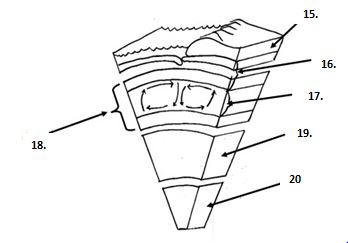
Identify each layer - #20.
a)
mantle
b)
asthenosphere
c)
inner core
d)
outer core
62.
Temperature _____________________ as you go deeper into the earth.
a)
increases
b)
decreases
c)
goes up and down depending on the layer
d)
stays the same
63.

The Earth Layers are composed of 3 main layers. They are...

a)

Crust, Mantle , Surface

b)

Crust, Molten, Care

c)

Crust, Mantle, Core

d)

Gravity, Atmosphere, Air

64.
This is the outermost, rigid layer of the Earth, made up of two parts, is divided into pieces call tectonic plates.
a)
Inner Core
b)
Asthensophere
c)
Lithosphere
d)
Outer Core
65.
Identify the letter in the diagram.  Identify letter F
a)
Lithosphere
b)
Asthenosphere
c)
Mantle
d)
Outer Core
66.

List the physical plates from outermost layers to the innermost layers.

a)

Crust, mantle, core

b)

Crust, mantle, asthenosphere, outer core, inner core

c)

Lithosphere, asthenosphere, mesosphere, outer core, inner core

d)

Lithosphere, asthensphere, hemisphere